

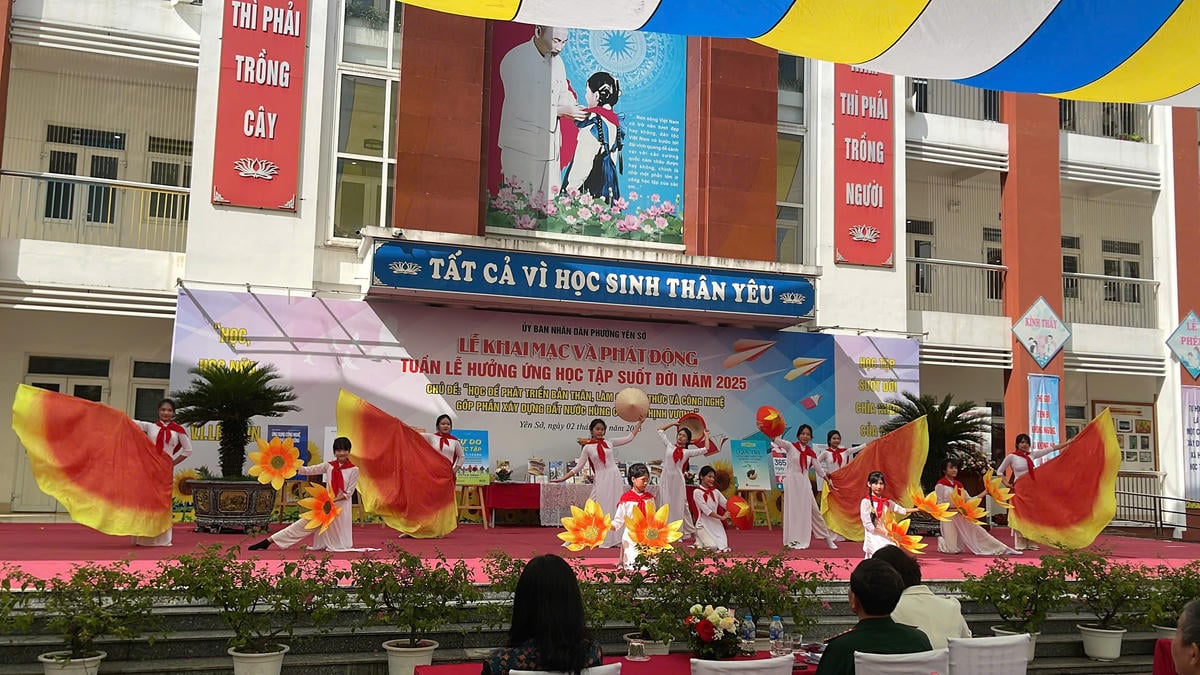
The paradox of teacher shortage
In the first round of teacher recruitment exams in Ho Chi Minh City for the 2025-2026 school year, very few people applied for the Music and Fine Arts teaching positions. Specifically, the Music subject in primary schools had only 46 candidates, while the quota was 180. At the secondary school level, 65 people applied, although the city needed 223 people.
The shortage of teachers for this subject has been going on for many years, not only in Ho Chi Minh City but also in all localities across the country, especially in remote areas when music became an elective subject in high schools according to the 2018 General Education Program. However, due to the inability to recruit teachers, in many schools, when building groups of elective subjects, there was no appearance of Music. Right in Hanoi, statistics in high schools in 2024, but only 30 schools taught Music, accounting for 12.45%.
It is worth mentioning that the paradox of having too many students but not enough music teachers exists. According to statistics from the Ministry of Education and Training (MOET) for the 2023-2024 school year, the number of high schools nationwide is about 2,400. Thus, if we only count each school that needs at least 1 music teacher, we are short of 2,400 teachers in high schools, not counting the shortage at the secondary and primary levels. However, statistics show that the number of students that training institutions have graduated is more than 6,000 people, as of 2024. This shows that after graduation, not many students pursue teaching because they have other orientations or because schools do not have recruitment targets to register for exams.
Dr. Tran Thi Thu Ha - Head of the Faculty of Arts (Hanoi National University of Education) said that the income level at public schools is not really attractive, so many students after graduation tend to work at non-public schools, open their own art centers or do not pursue education.
According to Mr. Nguyen Van Hieu - Director of the Department of Education and Training of Ho Chi Minh City, the Department has consulted the City People's Committee on policies to attract human resources, but due to regulations on salary regime, there cannot be a specific mechanism for music teachers in particular and art teachers in general.
Not only is there a lack of quantity, the issue of quality is also a problem today. Because for music teachers teaching at high school level, knowledge must be both broad and deep, and must be solid in both professional knowledge and pedagogical skills, so not everyone can meet the requirements.
The solution that many places are applying is to provide training to improve the standards of teachers to meet the requirements of teaching Music at the high school level, especially for teachers who previously graduated from college or intermediate level. In addition, to improve the quality of music education, many schools are changing the way of organizing teaching towards experience, inviting artists to participate in educational activities.
Music education schools are also actively reviewing to incorporate practical knowledge into teaching according to the requirements of the 2018 General Education Program for each level, eliminating knowledge that is too academic and not really necessary.
Increased investment in infrastructure
From the 2022-2023 school year, Music will be included in the high school curriculum for the first time, but the facilities of many schools still only meet the old curriculum. This subject requires separate functional rooms such as singing practice rooms, music classrooms, and a system of equipment and musical instruments for teaching and learning. The cost of this infrastructure is quite large, beyond the autonomy of schools, so investment from localities is needed.
A good model has been successfully applied at Phung Khac Khoan High School (Hanoi) since the 2022-2023 school year, which is to flexibly apply all three forms of direct and online teaching and assignment, and accompanying homework correction through each Music lesson to help students learn this subject and more than 95% meet the requirements according to the program's assessment. Students practice with musical instruments such as guitar and bamboo flute, developing performance skills, confidence and cultural understanding. In addition, practicing with musical instruments also trains students in patience, discipline, concentration and reduces the use of social networks. After the first school year, many students confidently performed in front of crowds, contributing to enriching the cultural and spiritual life of the school.
These obvious changes have affected the psychology of parents and students and the whole society towards Music, which has long been considered a minor subject, not appearing in the combination of subjects for university entrance exams or 10th grade high school entrance exams. In the development trend of modern society, music helps people expand their emotions, nurture their souls and create balance in life. When children, teenagers or even adults have access to music in a systematic way, they have the opportunity to practice their ability to perceive, persevere, and be creative, while also forming aesthetic thinking - an important factor of a civilized citizen.
Source: https://daidoanket.vn/dua-am-nhac-vao-truong-pho-thong.html

![[Photo] Urgently help people soon have a place to live and stabilize their lives](/_next/image?url=https%3A%2F%2Fvphoto.vietnam.vn%2Fthumb%2F1200x675%2Fvietnam%2Fresource%2FIMAGE%2F2025%2F12%2F09%2F1765248230297_c-jpg.webp&w=3840&q=75)








































![[Photo] General Secretary To Lam works with the Standing Committees of the 14th Party Congress Subcommittees](https://vphoto.vietnam.vn/thumb/402x226/vietnam/resource/IMAGE/2025/12/09/1765265023554_image.jpeg)























Comment (0)