

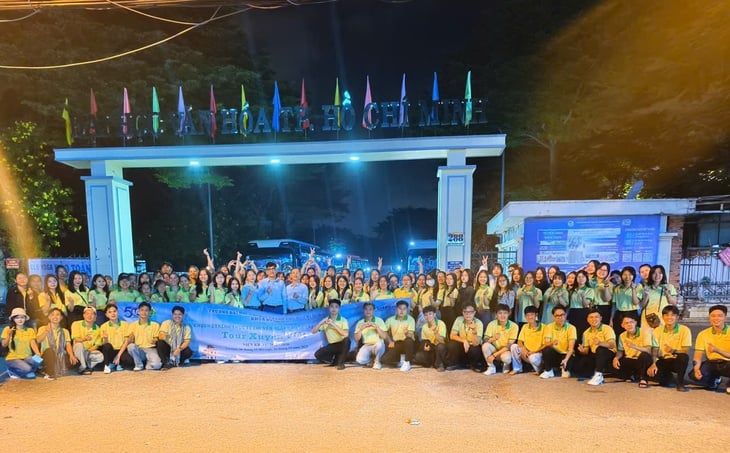
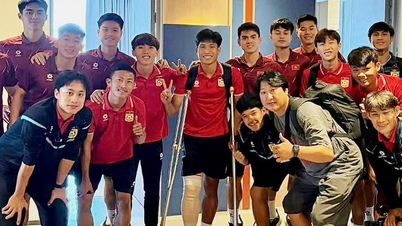
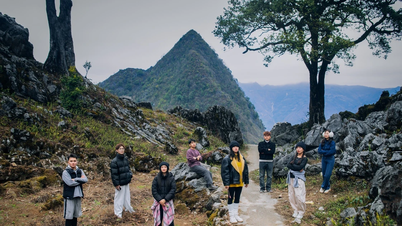
On the morning of December 6, a group of students from Ho Chi Minh City University of Culture set off to participate in a 21-day cross-country program through the Central and Northern provinces - Photo: Contributor
Tuoi Tre Online newspaper has an article: "School "brainstorms" when organizing field trips for students when floods are complicated" reflecting the fact that Ho Chi Minh City University of Culture is taking students on field trips when the flood situation in the Central provinces is complicated.
Many readers have asked: why does the school "subcontract" the trip to a travel agency? What will students learn from the expensive trip?...
Whoever organizes must sign a commitment and take responsibility.
One of the issues that many readers are concerned about is who is responsible if there is a problem? The school or the student?
"The school requires students to sign a commitment before they can get on the bus. So I ask, if students don't sign, do they have no other choice? The school is afraid of being criticized, so they organized a meeting. After the meeting, they asked to wait for the principal's result, but there was no result. I entrust my children's lives to the school, and the teacher in charge asked the company to come forward and resolve the matter," reader Mai wrote.
Reader Hai Nam said that the two "teachers affirmed that there was nothing unusual but asked the students to sign a commitment? When something unfortunate happened, would they just take out the students' commitment?"
Meanwhile, reader Minh argued: "If what the article says is true, then Mr. Nguyen Thanh Tung and Mr. Duong Van Cham must sign a commitment to take responsibility for the trip."
Similarly, reader Khai Phong believes that whoever decides to organize the trip should sign a commitment to take responsibility. This reader believes that compulsory subjects do not mean that they must be implemented at any cost when the risk of storms and floods still exists.
According to this reader, we should not force ourselves to travel regardless of the possible consequences. If we go now and are worried about the risk of rain, storms, and floods that can happen at any time, and in January when the weather is dry, which option is safer?
From this analysis, reader Kha Phong affirmed: "Whoever insists on going should be forced to commit to taking full responsibility for the safety and lives of the group members. Do they dare? And if they don't dare, they should postpone the trip to January."
Reader Pham Loc also said that according to the forecast of storm No. 16 continuing to make landfall, if the trip is still organized, the principal must commit to taking legal responsibility if an accident occurs. And the travel agency saying that the price will increase by 5-20% in January 2026 is unreasonable.
"Forcing students to sign a commitment as if to absolve them of responsibility puts them in a passive position. Those who do not sign will not be allowed on the bus, and who would dare not sign?", reader Ngoc expressed his opinion.
However, reader Lao Gan analyzed: even if the students agree, they still wonder why they are forced to sign the commitment, and what is the content of the commitment? Legally, even if the students sign the commitment, if any consequences occur, the group leader still cannot escape responsibility.
Another reader wondered: Vietnamese and international weather experts warn of the danger level and currently many places in Vietnam have announced natural disasters, landslides, floods... The school did not know or something and let the students go to dangerous places. "I hope nothing dangerous happens to the students," this reader confided.
What do students learn from outsourcing to travel companies?
In addition to safety and responsibility issues, readers also discussed the quality of the 21-day cross-country reality program that was outsourced to a travel agency. Readers asked: what do students learn, and what is the role of teachers?
Reader Anh Vu wrote: Tourism faculty must have practical experience, enough theoretical and practical knowledge, and organize tours for students.
You can flexibly switch to a tour to experience the Mekong Delta, it is not necessary to insist on going to the Central region at a time of natural disaster like this.
Regarding the training role of the school, reader Nguyen Van raised the issue of tourism training but outsourcing all practice to travel companies, what can be called training? Today's students are tomorrow's workforce, but instead of learning how to design tours, operate tours, and handle risks, they are only allowed to go on outsourced tours like tourists.
Teachers only follow to supervise while the business runs everything, so what do students learn?
"If we work in tourism without vocational training from the very beginning, what will the future of human resources be like? We need to stop the commercialization of internships and restore the true value of tourism training," reader Van expressed his opinion.
Some readers also believe that doing fieldwork in difficult circumstances will help students experience complex situations.
From his own experience, a reader with email nlpv****@gmail.com said: "I once had to go on a tour of Ha Giang through the recent storms No. 10 and 11 to feel the bravery of a tour guide.
Experiencing complex situations in practice is also a valuable experience for students. The experienced organizing company has guaranteed absolute safety, so everyone can rest assured."
Source: https://tuoitre.vn/dua-sinh-vien-di-thuc-te-khi-mua-lu-phuc-tap-truong-phai-ky-cam-ket-chiu-trach-nhiem-20251206102839812.htm









































































Comment (0)