

Directly lead the transformation...
When it comes to agricultural and rural credit in Vietnam, Agribank has always been one of the central entities. With its extensive network, deep coverage in rural, mountainous, and remote areas, and long-standing experience in serving agricultural households, cooperatives, and businesses, Agribank holds a special position in bringing capital to the agricultural sector.
That role is not only reflected in the scale of capital, but also in the ability to closely follow production practices. Agriculture is a highly volatile sector that cannot be assessed solely by financial records or collateral. An agricultural loan is linked to seasons, land, weather, diseases, agricultural product prices, market outlets, and the borrower's reputation within the community. Agribank's presence at the grassroots level enables it to thoroughly understand the workings of the agricultural sector.
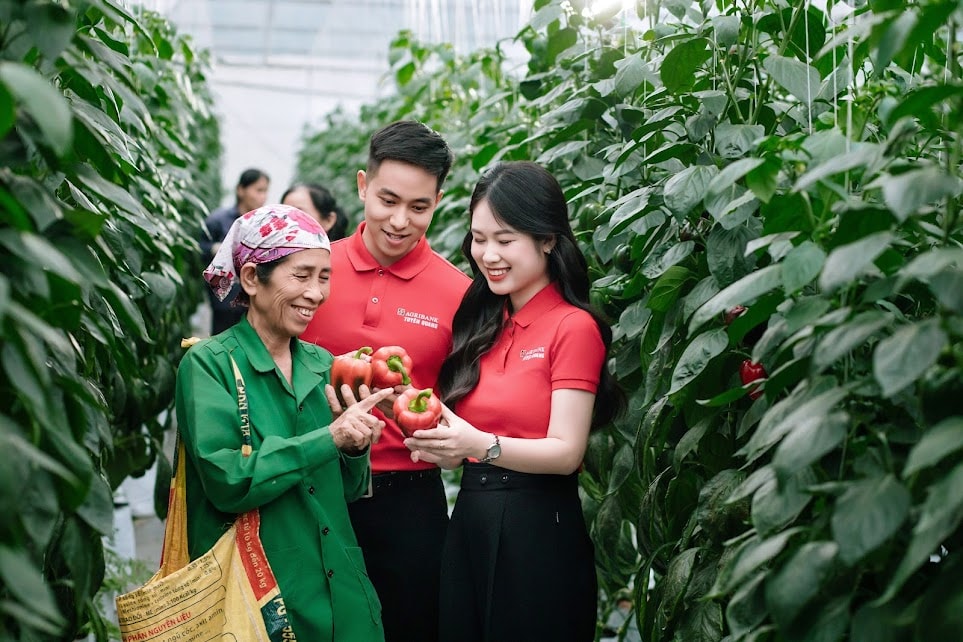
A new development in the current phase is that Agribank is not only playing the role of "the bank of agriculture, farmers, and rural areas" in the traditional sense, but is also gradually positioning itself in the green transformation process. According to Agribank Deputy General Director Phung Thi Binh, Agribank identifies green credit as the key to realizing its commitment to supporting agriculture, farmers, and rural areas in the new phase; the bank not only provides capital but also positions itself as a leading entity in guiding capital flows to serve the transformation of agricultural production models.
While previously credit capital primarily helped people maintain production, in the new era, capital must contribute to changing production methods. When capital flows into clean agriculture projects, high-tech agriculture, low-emission rice production, renewable energy, sustainable forestry, green value chains, etc., loans are no longer simply capital for a single crop season, but capital for transforming production methods, enhancing the value of agricultural products, and promoting sustainable development.
At the seminar "Improving Credit Policies for Digital and Green Agriculture" organized by the People's Representatives Newspaper on April 24th, Mr. Nguyen Quang Ngoc, Deputy Head of the Credit Policy Department of Agribank, stated that in the context of the Fourth Industrial Revolution, inclusive finance is no longer an option but has become a prerequisite for building a fair and sustainable economy . This approach is consistent with Agribank's role in rural areas: not only providing capital, but also expanding access to financial services for individuals, cooperatives, and small businesses.
And shaping new ways of doing things.
In the process of green transformation, it's not just about having capital, but about having that capital linked to specific models. Agribank has implemented many large-scale programs such as lending for high-tech and clean agriculture; financing projects in the green sector; preferential credit for OCOP products; and lending for the implementation of the 1 million hectare high-quality, low-emission rice project in the Mekong Delta. These programs show that Agribank views green credit not just as a financial product, but as a way to organize capital flows to serve the transformation of production models.
The project to cultivate 1 million hectares of high-quality, low-emission rice in the Mekong Delta is a clear example of how credit can be directly linked to the goal of reorganizing production. When capital is invested in seeds, cultivation processes, mechanization, processing, consumption, traceability, and market linkages, credit transcends its role as conventional production financing, becoming a tool for shaping new ways of doing things for a strategic industry.
From the orange-growing regions of Ha Tinh to the low-emission rice paddies of the Mekong Delta, Agribank's green capital models demonstrate that credit is only truly effective when accompanied by changes in awareness and production organization. If capital is combined with technology, data, cooperatives, purchasing agents, insurance, and green standards, the potential for value creation will be much higher than fragmented, uncoordinated, and unstandardized production.
Therefore, to expand green capital flows more strongly, Agribank needs a more synchronized policy ecosystem. First, there needs to be a green classification criterion in agriculture so that the bank has a basis for identifying and monitoring loans. Next, data on growing areas, cooperatives, businesses, production volume, standards, traceability, forward contracts, insurance, and credit history are needed, helping the bank to lend based on cash flow and value chain, instead of relying too heavily on collateral. Along with that, there needs to be a mechanism for risk sharing and chain linkage through insurance to protect capital for participating parties.
In short, perfecting credit policies for digital and green agriculture is, ultimately, not just about opening another capital channel for agriculture. It's about shaping the future of rural Vietnam: a smarter, greener, higher-value agriculture that is competitive in a rapidly changing world. In this process, Agribank is not only the bank of agriculture, farmers, and rural areas, but also a leading force in the green transformation process in rural areas – a crucial force in putting Vietnamese agriculture on a path of sustainable development.
Source: https://daibieunhandan.vn/dua-von-xanh-ve-voi-nong-thon-10417783.html


























































































Comment (0)