

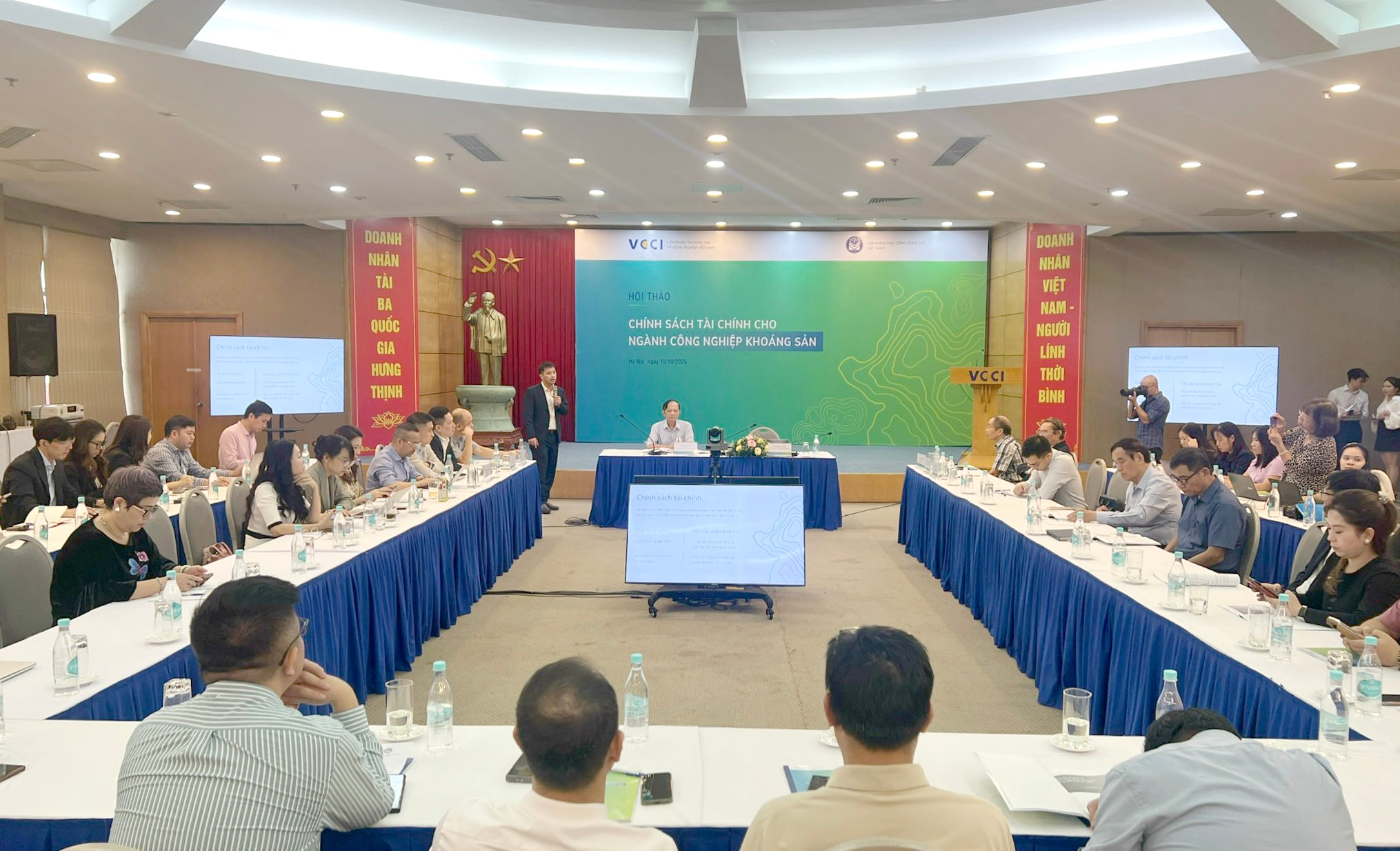
At the workshop “Financial policy for the mineral industry” organized by the Vietnam Federation of Commerce and Industry (VCCI) and the Vietnam Mining Science and Technology Association on October 15, Mr. Dau Anh Tuan, Deputy General Secretary and Head of the Legal Department of VCCI, said that mining enterprises currently have to simultaneously fulfill two major financial obligations: resource tax according to the Law on Resource Tax 2009 and mineral exploitation right fee according to the Law on Minerals 2010 (inherited in the Law on Geology and Minerals 2024).
According to Mr. Tuan, both revenues are aimed at ensuring that the State collects the value from public assets, which are mineral resources. However, applying two financial mechanisms at the same time to the same subject is creating many problems, both legal and practical.
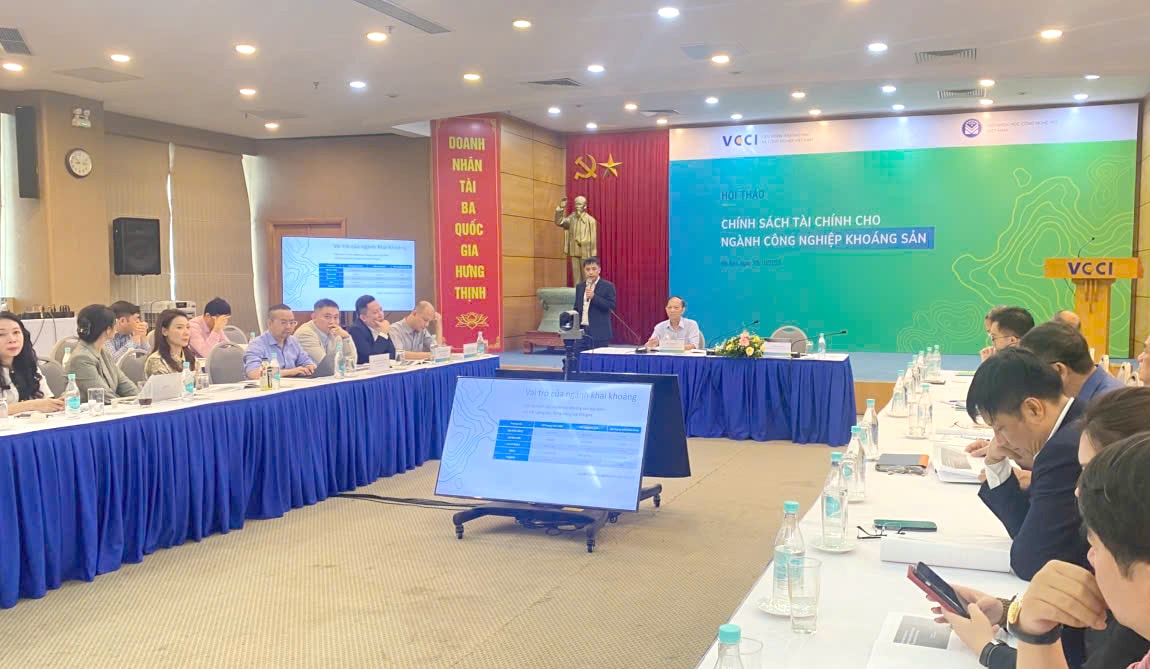
Feedback from the business community shows that the total financial obligations currently account for 30-40% of revenue, significantly higher than international practice. The overlap between resource tax and licensing fees increases costs, reduces competitiveness and distorts investment incentives for efficient exploitation or deep processing, Mr. Tuan said.
According to VCCI, the calculation of the two revenues is quite similar as they are both based on the reserves and value of exploited minerals, but are managed, collected and classified differently, creating a sense of "overlapping collection" and increasing administrative procedures. This overlap is increasing compliance costs, negatively impacting production and business results and hindering technological innovation, the VCCI representative emphasized.
From a business perspective, Mr. Phan Chien Thang, Deputy General Director of Masan High-tech Materials, said that recent policy changes are causing disadvantages for mineral companies. He gave an example: when Masan invested in 2010, the resource tax was only under 10%, but after the project went into production, this rate increased to 6-25%.
In addition, the regulations on mineral exploitation licensing fees were issued after the enterprise had invested, causing the entire financial plan to be disrupted. “We also have to bear additional environmental protection costs arising after the project comes into operation, significantly reducing the efficiency and investment attractiveness,” Mr. Thang shared.
According to him, the total current taxes and fees, not including corporate income tax, account for 24-26% of revenue, creating great pressure and directly affecting competitiveness. Therefore, businesses recommend that in the process of building and promulgating financial and tax policies, especially in the mineral sector, there should be early and full consultation from businesses to avoid disrupting the investment environment.
Another issue raised by many businesses is that export tax on deeply processed products is still as high as the tax applied to raw minerals, while the domestic market is not yet capable of consuming the products.
For example, acid-grade fluorite (CaF₂ > 97%) is subject to a 10% export tax, while cemented bismuth (Bi > 80%) is subject to a 5% tax, even though both are certified as highly processed products. Meanwhile, countries such as China, Germany, the US, Australia or Canada all apply a 0% tax rate to similar products. This reduces the competitiveness of Vietnamese mineral products in the international market.
To remove bottlenecks, experts proposed a comprehensive review of tax laws and the Law on Geology and Minerals to adjust them in line with sustainable development goals.
At the same time, research and clarify the content and management methods to unify policies on two revenue sources: resource tax and exploitation rights fee.
At the same time, it is necessary to design a mechanism to encourage long-term investment, support businesses in innovating mining technology, improving recovery efficiency and deep processing to increase value, save resources and protect the environment.
Source: https://daibieunhandan.vn/ganh-nang-thue-lam-giam-suc-canh-tranh-cua-doanh-nghiep-khai-khoang-10390460.html










































































Comment (0)