

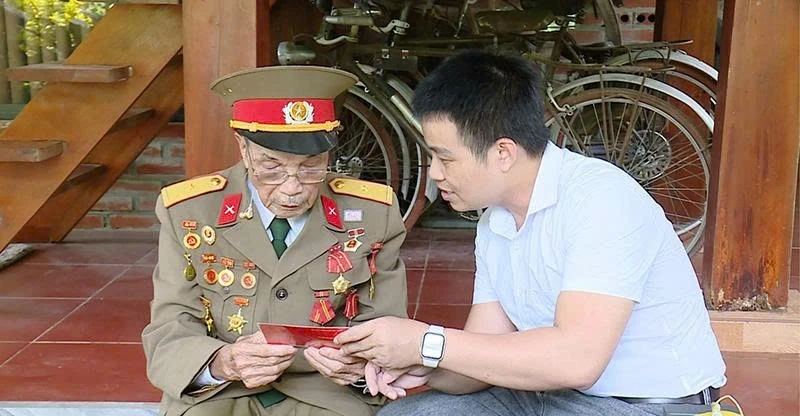
Mr. Ngan Tien Nhan introduced the medals and awards awarded by the Party and State.
Mr. Ngan Tien Nhan was born in 1930 in Nhung village, Thien Phu commune, old Quan Hoa district. The son of a Muong farmer family, the young man was enlightened about the revolution early. In September 1946, he enrolled in the "Popular Education" class organized by the commune. "Seven days of continuous study, not allowed to go home, after more than a year of study, I passed the exam", he said with the joy of a person who had been enlightened by letters.
In response to President Ho Chi Minh's "Call for Patriotic Emulation" (June 11, 1948), Mr. Nhan volunteered to be a teacher to teach the people of the highlands, contributing to the eradication of illiteracy in the mountains and forests. He still remembers Uncle Ho's teachings from the past: "Every Vietnamese citizen, regardless of age, young, male, female; regardless of rich, poor, big, small, must become a fighter on the fronts: military, economic, political , cultural", Mr. Nhan emotionally recalled.
In early 1951, he joined the guerrilla team, then the communal security team. With his teammates, he repeatedly intercepted spies and protected the safety of ammunition depots and food gathering stations of the militia. During his time in the guerrilla and security team, he and his teammates repeatedly chased and captured two enemies on Muop slope, Hoi Xuan commune and Duom village, Phu Le commune. At that time, French colonial informants were everywhere in the upper Thanh Hoa region. They were so cunning that as soon as they discovered our position, they immediately hung a small mirror or a piece of red or white cloth on a bamboo top so that enemy planes could easily recognize and drop bombs. The most haunting memory in his life was the afternoon of April 2, 1953, when French planes dropped bombs on the Co Phuong cave area, Sai village, Phu Le commune, the cave entrance collapsed, and 11 frontline workers were buried forever. His eyes filled with tears: "At that time, I was at Pung stream. Hearing the sound of bombs, I immediately ran up the hill and dug with the villagers all night without being able to save anyone... I will never forget that scene."
In February 1954, when the Dien Bien Phu campaign entered its fierce phase, the 24-year-old Muong ethnic man enthusiastically enlisted in the army, becoming a soldier of Company 188 - a local army, tasked with protecting the route of transporting food and weapons to the front. During the arduous years in the deep forest, living amidst hunger, cold, malaria and bombs, Ngan Tien Nhan and his comrades never gave up their spirit. "There were months when we just stayed in the forest, not even daring to cook with smoke. Just a trace of smoke was detected by enemy planes, many of my comrades fell," he said.
The 188th Company contributed to maintaining the vital traffic, ensuring the victory of the campaign. When the first artillery rounds rang out in the decisive battle at Him Lam Hill, his unit was only 30km away. And he clearly heard the echoes of the heroic song that opened the "earth-shaking" victory.
After the Dien Bien Phu victory, he continued his military service. In 1958, he was sent to study military nursing, then became a Sergeant, working at Company 5 - Thanh Hoa Armed Police. Three years later, he was sent to Sam Neua (Laos) to coordinate the capture of Vietnamese criminals in hiding. Knowing Lao and being respected by the people, he quickly completed his mission, bringing many subjects back to the country.
Returning to his hometown, he was assigned to work as a nurse at Station 99 - Thanh Hoa Border Armed Police. In uniform, he was not only a soldier holding a gun, but also a doctor of the green forest. He took advantage of the folk knowledge of the Muong people, secret herbal remedies to treat his comrades and the villagers. "Back then, medicine was scarce, we used whatever was available in the forest, just hoping to save someone was enough to be happy", he said with a gentle look. Once, a victim was bitten by a poisonous snake and thought he would not survive, but thanks to his care and medicine, that person was saved.
In 1965, the image of border nurse Ngan Tien Nhan devotedly caring for the villagers was published in a central newspaper, illustrating the military-civilian relationship in the mountainous region. In the same year, he was honored to receive the Ho Chi Minh Badge from President Ho Chi Minh - a noble award that he still cherishes and preserves like a treasure.
During his more than 20 years in the army, Mr. Nhan has received many noble awards: Second-class Victory Medal; First, Second, and Third-class Glorious Soldier Medal; First-class Resistance Medal; 65-year Party membership badge. However, what he is most proud of is not the medal, but the camaraderie and love of his hometown's children.
Leaving the army, he returned to ordinary life with the hands and determination of a soldier. In the early 80s of the last century, he and his wife and children reclaimed land, restored terraced fields, planted rice, corn, cassava, and raised livestock to make a living. Thanks to his diligence, he turned the barren land on the slopes of Hoi Xuan mountain into a fertile land. Not only taking care of economic development and family life, he was also elected as Party cell secretary, then joined the Party Executive Committee of Quan Hoa district (old) until 1987.
He has four biological children and one adopted child, all grown up, one in the armed forces, one as a cadre, one as a teacher. His eldest son, Ngan Hong Quan, emotionally said: “My father is a hard-working person, doing everything with all his heart. His whole life he was an example of perseverance and responsibility.”
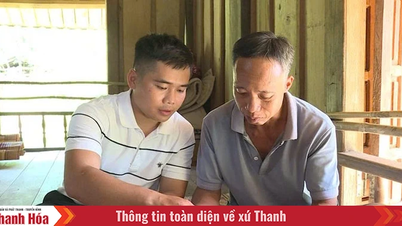
Now, at the age of 95, Mr. Nhan is still lucid. He still welcomes students and young people to listen to stories of Dien Bien. “The war is long gone, but you must cherish peace. Today’s achievements were paid for with the blood and bones of so many people,” he advised.
The Dien Bien soldier’s hair has now turned white, his eyes are dim, but the flame of patriotism in him still burns brightly. In each story he tells, people seem to see the shadow of a time, a time of people who made history with iron will and steadfast hearts.
Article and photos: Ba Phuong
Source: https://baothanhhoa.vn/gap-lai-nguoi-chien-si-dien-bien-o-mien-tay-xu-thanh-270430.htm


![[Photo] Worshiping the Tuyet Son statue - a nearly 400-year-old treasure at Keo Pagoda](/_next/image?url=https%3A%2F%2Fvphoto.vietnam.vn%2Fthumb%2F1200x675%2Fvietnam%2Fresource%2FIMAGE%2F2025%2F12%2F02%2F1764679323086_ndo_br_tempimageomw0hi-4884-jpg.webp&w=3840&q=75)

![[Photo] National Assembly Chairman Tran Thanh Man receives First Vice Chairman of the Federation Council of the Federal Assembly of the Russian Federation](/_next/image?url=https%3A%2F%2Fvphoto.vietnam.vn%2Fthumb%2F1200x675%2Fvietnam%2Fresource%2FIMAGE%2F2025%2F12%2F02%2F1764648408509_ndo_br_bnd-8452-jpg.webp&w=3840&q=75)




































































Comment (0)