

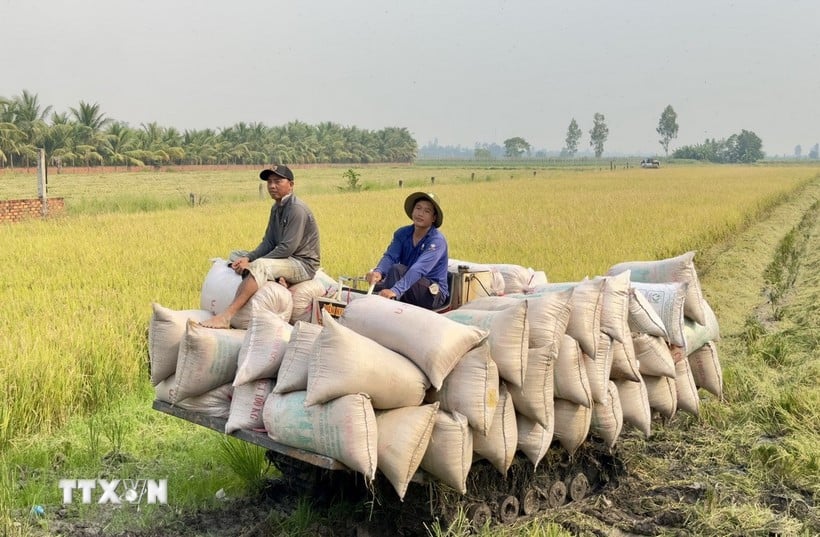
(Photo: Thanh Sang/VNA)
Vietnam’s rice export prices increased slightly last week. In the domestic market, rice prices in many provinces in the Mekong Delta generally remained relatively quiet.
Prices of 5% broken rice were offered at $365-$370 per tonne, up from $359-$363 a week earlier, marking the highest since early November 2025.
In the domestic market, according to the Institute of Strategy and Policy on Agriculture and Environment, in Can Tho, Jasmine rice is still priced at VND8,400/kg, the same as last week; IR 5451 rice is VND6,200/kg; ST25 is VND9,400/kg; OM 18 is VND6,600/kg.
In Dong Thap , IR 50404 rice costs 6,700 VND/kg, OM 18 is 6,900 VND/kg. In Vinh Long, OM 5451 rice costs 6,300 VND/kg, OM 4900 is 7,000 VND/kg.
In An Giang , prices of most fresh rice varieties remained stable compared to last week, IR 50404 was purchased at 5,100-5,300 VND/kg; OM 18 at 5,600-5,700 VND/kg; Dai Thom 8 from 6,400-6,600 VND/kg; OM 5451 alone from 5,400-5,600 VND/kg, an increase of 200 VND/kg.
As of November 30, according to the Ministry of Agriculture and Environment, in the 2025 Autumn-Winter crop, the entire Mekong Delta region has planted 621,000 hectares, reaching 97% of the plan; of which 387,000 hectares have been harvested with an average yield of 57.77 quintals/hectare, with an estimated output of 2.237 million tons. For the Summer-Autumn crop, localities have sown 160,000 hectares, reaching about 91% of the plan and have begun harvesting about 1,000 hectares.
In the 2025-2026 Winter-Spring crop alone, the whole region has planted 167,000 hectares, equivalent to 13.17% of the total plan of 1.266 million hectares.
In An Giang's retail market, rice prices are stable: regular rice 11,000-12,000 VND/kg; Thai fragrant rice 20,000-22,000 VND/kg; Jasmine 16,000-18,000 VND/kg; white rice 16,000 VND/kg, Nang Hoa 21,000 VND/kg, Huong Lai 22,000 VND/kg, Taiwanese fragrant rice 20,000 VND/kg, Soc Thuong 17,000 VND/kg, Soc Thai 20,000 VND/kg, Japanese rice 22,000 VND/kg.
The price of IR 50404 raw rice remains at 7,550-7,650 VND/kg, IR 504 finished rice at 9,500-9,700 VND/kg; OM 380 raw rice at 7,200-7,300 VND/kg; OM 380 finished rice fluctuates at 8,800-9,000 VND/kg.
For by-products, the price of by-products of all kinds fluctuates between 7,400-10,000 VND/kg; the price of dry bran is at 9,000-10,000 VND/kg.
Meanwhile, in the Asian rice market, Thai rice prices rose to their highest level in more than four months last week due to supply concerns stemming from flooding in the south. In contrast, prices of rice from all over India slid to near a one-month low.
Thailand's 5% broken rice was offered at $375 a tonne this week, up from $370 last week due to the impact of floods, a trader in Bangkok said.
This is the highest price recorded since July 24. The trader explained that this price increase only applies to Thai rice in the southern region due to flooding there.
In India, 5% broken parboiled rice prices fell to $347-$354 a tonne this week from $348-$356 last week, the lowest in nearly a month.
5% broken white rice prices ranged from $340 to $345 a tonne. Demand for Indian rice saw a slight improvement this week as prices fell in line with the rupee’s slide to a record low.
Mr. BV Krishna Rao, President of the Indian Rice Exporters Association, commented that the weakening rupee is helping exporters reduce selling prices to increase competitiveness in attracting demand.
Elsewhere, domestic rice prices in Bangladesh remain high despite ample inventories and bumper harvests. The country has imported 1.437 million tonnes in the 2024-25 crop year and another 500,000 tonnes between July and November, but prices have shown no signs of cooling.

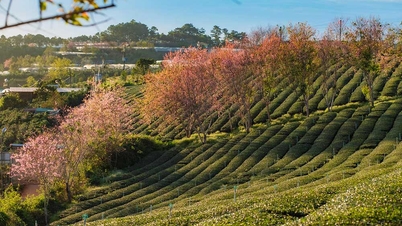
Smart coffee cultivation area in Gia Lai produces high productivity and quality. (Photo: Hong Diep/VNA)
Other agricultural products
Chicago soybean futures edged lower on Thursday and were on track for their first weekly decline in eight weeks, as markets remained cautious amid uncertainty over how much U.S. soybeans China will actually buy under the trade truce.
This session, the price of soybeans in the nearest futures contract on the Chicago Board of Trade (CBOT) decreased by 0.3% to 11.165 USD/bushel (1 bushel of wheat/soybean = 27.2 kg; 1 bushel of corn = 25.4 kg).
The US Department of Agriculture (USDA) recently reported net exports of 1,248,500 tonnes of US soybeans in the week ending October 30, including 232,000 tonnes to China. This is China's first purchase since the US's 2025 harvest.
However, the total purchase volume is still far below the 12 million ton target previously mentioned by senior US officials. US Treasury Secretary Scott Bessent also pushed back the target date this week from the end of December 2025 to the end of February 2026.
Similar to soybeans, wheat and corn prices also cooled as abundant global supplies overshadowed the boost from the vibrant US corn export activity.
CBOT wheat futures fell 0.5% to $5.375 a bushel, while corn futures fell 0.3% to $4.46 a bushel.
Statistics Canada recently reported that the country's total wheat production reached nearly 40 million tonnes, surpassing market expectations. This data shows that global supplies are very abundant, thereby putting pressure on prices.
Meanwhile, on December 5, the Food and Agriculture Organization of the United Nations (FAO) also raised its forecast for world grain production and inventories this crop year to a record high.
Still, Chicago corn futures held near a six-month high hit earlier this week, supported by robust export activity and concerns about cold weather hampering shipments of U.S. grain.
In the international coffee market, coffee prices have had mixed developments but the general trend is a slight increase. The London exchange recorded the price of robusta coffee for delivery in January 2026 increasing by 16 USD to 4,331 USD/ton, and the price of March 2026 increased by 32 USD to 4,244 USD/ton.
On the New York floor, the price of Arabica coffee for delivery in December 2025 increased by 5.45 US cents/lb to 409.2 US cents/lb; the contract for March 2026 increased by 3.7 US cents/lb to 376.15 US cents/lb (1 lb = 0.4535 kg).
Despite the gains, robusta coffee prices hovered around a 1.5-week low as the market continued to monitor the impact of storms and heavy rains in Vietnam. Bad weather in recent days has slowed harvest activities and increased the risk of fruit drop, raising concerns about a lower output this season.
Traders are currently divided into two views: one side believes that output can stabilize thanks to late-season supply, while the other side predicts that output can decrease by 5-10% depending on the region.
Contrasting views cause price movements to fluctuate continuously according to new information from raw material regions.
For arabica coffee, prices were supported by a strong rise in the Brazilian real to a two-week high. The stronger local currency has discouraged Brazilian farmers from selling, helping to keep arabica prices stable.
Brazilian coffee exports to the US remain slow despite the removal of tariff barriers, but are forecast to improve in early 2026 as domestic supplies stabilize.
In the domestic market, coffee prices on December 6 increased slightly again by 400-500 VND/kg, fluctuating from 103,300-104,000 VND/kg in key areas of the Central Highlands.
Specifically, today's coffee price in Dak Lak province increased slightly by 400 VND/kg compared to yesterday, reaching 104,000 VND/kg. Dak Lak is also the locality with the highest coffee price in the country today.
Similarly, today's coffee price in Gia Lai province is trading at 103,600 VND/kg, up 400 VND/kg. In Lam Dong province, the coffee price increased by 500 VND/kg, trading at 103,300 VND/kg./.
According to VNA/Vietnam+
Source: https://www.vietnamplus.vn/gia-gao-xuat-khau-tang-nhe-giao-dich-noi-dia-tram-lang-post1081558.vnp
Source: https://baolongan.vn/gia-gao-xuat-khau-tang-nhe-giao-dich-noi-dia-tram-lang-a207946.html




























































































Comment (0)