

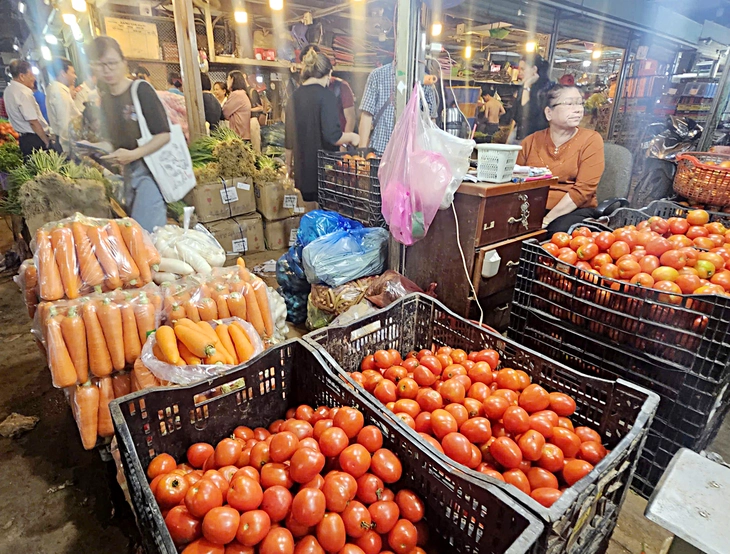
Tomato prices sold at wholesale markets in Ho Chi Minh City remain high for a long time - Photo: N.TRI
On December 1, records at retail markets in Ho Chi Minh City showed that the prices of many types of vegetables sold were still quite high, such as tomatoes from 50,000 - 65,000 VND/kg, lettuce 65,000 - 75,000 VND/kg; squash, pumpkin, luffa 32,000 - 40,000 VND/kg; bitter melon, cucumber, cabbage 35,000 - 45,000 VND/kg; bok choy, bok choy 40,000 - 45,000 VND/kg...
According to Ms. Tran Thi Huong, a trader at Ba Chieu market, vegetable prices have decreased by about 5-10% compared to the peak a week ago but are still twice as high as normal, and some prices are even three times higher. "Selling at high prices seems profitable, but sellers are not happy because the import price is too high, the amount of imported vegetables has decreased, and buyers are more cautious than usual," she said.
Huong said.
Meanwhile, at wholesale markets in Ho Chi Minh City such as Binh Dien, Hoc Mon and Thu Duc, vegetable prices have generally cooled down but are still very high. Wholesale prices of tomatoes at the market are 45,000 VND/kg, spinach 55,000 VND/kg, lettuce 55,000 - 60,000 VND/kg; cabbage, cucumber, bitter melon 20,000 - 24,000 VND/kg; bok choy, green cabbage 16,000 - 18,000 VND/kg...
At many supermarkets in Ho Chi Minh City, although the prices of vegetables have increased compared to normal, they are generally more stable than those in the outside markets. Depending on the point of sale, the common vegetable prices here are tomatoes at 37,000 - 55,000 VND/kg; green cabbage, sweet cabbage 30,000 - 35,000 VND/kg; squash, pumpkin 25,000 - 30,000 VND...
A representative of a unit said that thanks to stable contracts with suppliers, import and selling prices did not increase as rapidly as outside, but the quantity of goods at this time was still 20% lower than normal, especially many items from Da Lat were still down 40-50%, almost not recovered much.
Speaking to Tuoi Tre on December 1, Mr. Nguyen Binh Phuong, Business Director of Thu Duc wholesale market, said that the price of vegetables sold at the market has decreased by about 10% compared to the previous peak, partly due to the increasing supply in the provinces, not to mention the increase in the number of Chinese and Thai goods.
In addition to the regular items such as Chinese cabbage, broccoli, potatoes, and carrots, Chinese goods also include chili peppers, lettuce, and green onions. Thailand recently added mushrooms. However, the amount of vegetables arriving at the market is currently about 1,500 tons per day, still low compared to normal, and the price is still quite high compared to the stable period.
"To be more stable in the coming time, regions less affected by bad weather such as the Eastern and Southwestern regions need to increase the planting area, especially products such as tomatoes, cucumbers, green onions... to replace the sharp decrease from Da Lat," said Mr. Phuong.
Speaking with Tuoi Tre, Ms. Huynh Ngoc Bich Dao, Director of Dong Xanh Farm Company (Da Lat, Lam Dong ), said that due to the impact of widespread flooding and prolonged cold weather, the amount of vegetables sold by the unit at this time is only about 4 - 5 tons/day, a decrease of 50 - 60% compared to normal, in which the amount of leafy vegetables has decreased the most.
However, the unit is still maintaining stable selling prices for supermarket systems. Compared to the prices that traders buy outside the market, the selling price at the unit is much lower. "If the weather is stable, the amount of leafy vegetables can recover stably in about a month, the price will cool down and the supply for the Lunar New Year market is not a concern. As for root vegetables, the production time is longer, so there is a possibility of shortage," said Ms. Dao.
A representative of another vegetable growing unit in Da Lat also said that root vegetables and fruits such as cabbage, potatoes, carrots... usually need an average growing time of about 60 - 90 days depending on the type, or even longer if the production conditions are unfavorable. Therefore, this vegetable source is at high risk of shortage by the end of the year.
Source: https://tuoitre.vn/gia-rau-cu-ha-nhiet-nhung-van-cao-20251201235310364.htm
![[Photo] Worshiping the Tuyet Son statue - a nearly 400-year-old treasure at Keo Pagoda](/_next/image?url=https%3A%2F%2Fvphoto.vietnam.vn%2Fthumb%2F1200x675%2Fvietnam%2Fresource%2FIMAGE%2F2025%2F12%2F02%2F1764679323086_ndo_br_tempimageomw0hi-4884-jpg.webp&w=3840&q=75)


![[Photo] National Assembly Chairman Tran Thanh Man receives First Vice Chairman of the Federation Council of the Federal Assembly of the Russian Federation](/_next/image?url=https%3A%2F%2Fvphoto.vietnam.vn%2Fthumb%2F1200x675%2Fvietnam%2Fresource%2FIMAGE%2F2025%2F12%2F02%2F1764648408509_ndo_br_bnd-8452-jpg.webp&w=3840&q=75)













































































Comment (0)