

Corneas from Nepal bring light to 12 Vietnamese people
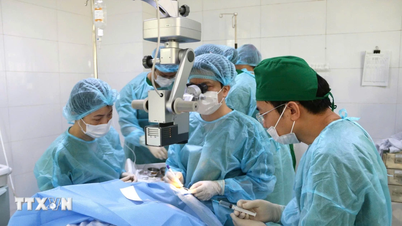
On December 9, a representative of the Ho Chi Minh City Eye Hospital said that recently, doctors here performed surgery, bringing light to 12 patients who had been waiting for transplants for a long time.
Previously, at the end of November, Ho Chi Minh City Eye Hospital received corneal tissue from the Nepal Eye Bank. Immediately, the unit's team of corneal specialists conducted an urgent consultation, selecting the patient's criteria suitable for the tissue and grafting technique to bring the highest efficiency.
Through a strict consultation process according to medical standards, doctors selected 12 cases out of more than 30 patients for corneal transplants this time.
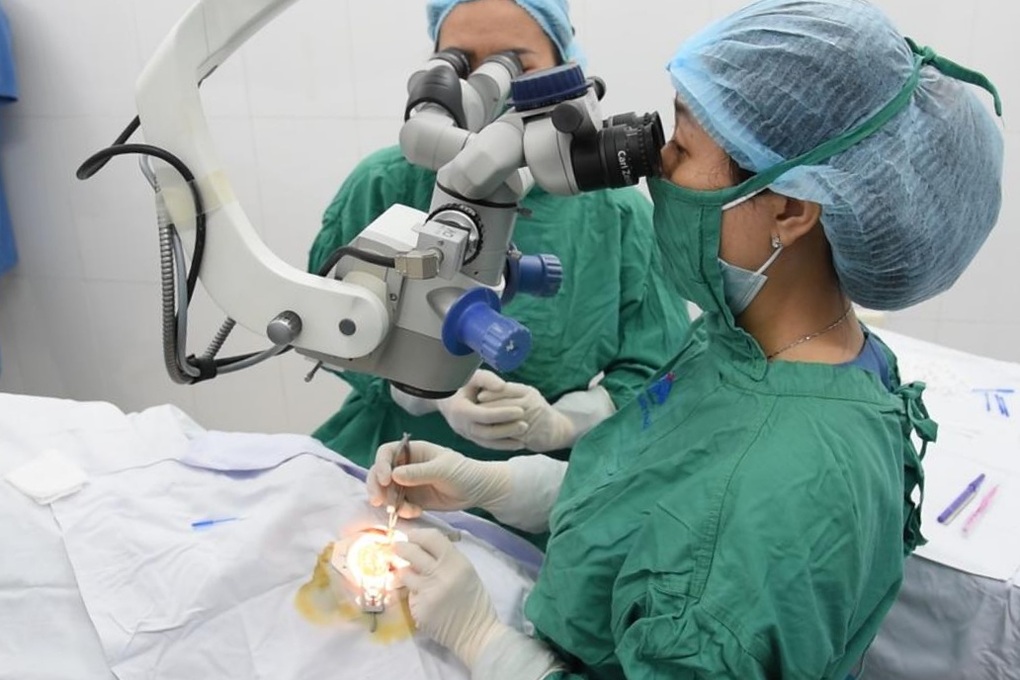
One of 12 cases recently received corneal transplants at Ho Chi Minh City Eye Hospital (Photo: Hospital).
According to Dr. Lam Minh Vinh, Head of the Cornea Department, selecting suitable transplant patients is based on the degree of corneal damage, the level of vision loss, the prognosis for vision recovery after surgery, the risk of transplant rejection and a number of related clinical factors as well as the overall health status.
Among them, there are cases with very low vision in both eyes or in one eye, greatly affecting the ability to work and live.
A typical case is the right eye endothelial corneal transplant for female patient VNBTr. (39 years old, residing in Ho Chi Minh City). 14 years ago, both eyes of the patient were diagnosed with punctate corneal dystrophy and registered for corneal transplant in 2009.
In 2022, the woman received a corneal transplant in her right eye using PK technique, but it did not adapt and she continues to wait for a transplant until now.
During this surgery, the doctor determined that Ms. Tr. had a thicker and clearer corneal graft, a deeper anterior chamber, improved vision, and could be discharged after 3-5 days. The female patient expressed that she really hoped to regain her sight soon so that she could live like everyone else.

Patient regains sight with endothelial corneal transplantation (Photo: Hospital).
Proposal to establish an Eye Bank to reduce blindness rate
"DSAEK endothelial keratoplasty is a technique of replacing the patient's endothelium with an endothelium that has a portion of the donor's posterior stroma.
This technique has the advantages of rapid vision recovery, small incision, less astigmatism, no sutures, reducing complications related to sutures, preserving corneal biomechanics and low risk of graft rejection.
However, endothelial transplantation is technically demanding, difficult to perform in eyes with complex anterior chamber pathology, and not suitable for stromal lesions or full-thickness corneal opacities.
Penetrating keratoplasty (PK) is a method of replacing the entire thickness of the donor cornea into the patient's. This is a classic transplant technique, indicated for cases of full thickness corneal damage, which is familiar to corneal transplant surgeons.
The limitations of this technique are longer visual recovery time, risk of postoperative astigmatism, risk of complications related to sutures, weaker corneal biomechanics and higher graft rejection rate," Dr. Vinh analyzed.

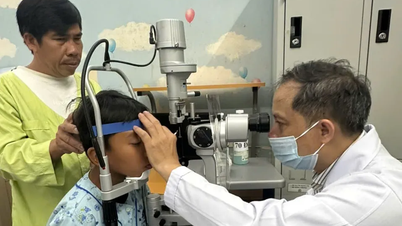
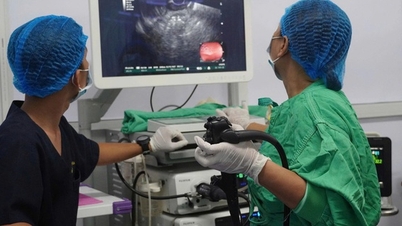
Doctor checks patient's eyesight after surgery (Photo: Hospital).
Over the years, through cooperation and professional support programs, Ho Chi Minh City Eye Hospital has mastered corneal transplant techniques, as well as received corneal transplant resources from international organizations such as Eversight Eye Bank and CorneaGen (USA), Nepal Eye Bank...
Especially in this surgery, the patient does not have to pay for the transplant, helping to reduce the burden of treatment.
According to statistics, over the past 12 years, Ho Chi Minh City Eye Hospital has performed corneal transplants, bringing light to over 400 cases using many different techniques. Of these, more than 90% are manual laborers.
To actively reduce the rate of blindness due to corneal diseases, in the current situation of limited tissue supply, the Eye Hospital has researched many models, as well as proposed to establish an Eye Bank in Ho Chi Minh City following the trend of hospital-school coordination and multi-modal international cooperation.
These proposals aim to proactively source tissues and be more proactive in accessing corneal resources from international organizations, simplify administrative procedures according to the two-tier government model, and increase the amount of corneal tissue available to serve patients in a timely manner.
Source: https://dantri.com.vn/suc-khoe/giac-mac-tu-nepal-xuyen-bien-gioi-mang-lai-anh-sang-cho-12-benh-nhan-viet-20251209122853184.htm

![[Photo] Urgently help people soon have a place to live and stabilize their lives](/_next/image?url=https%3A%2F%2Fvphoto.vietnam.vn%2Fthumb%2F1200x675%2Fvietnam%2Fresource%2FIMAGE%2F2025%2F12%2F09%2F1765248230297_c-jpg.webp&w=3840&q=75)





















































![[Photo] General Secretary To Lam works with the Standing Committees of the 14th Party Congress Subcommittees](https://vphoto.vietnam.vn/thumb/402x226/vietnam/resource/IMAGE/2025/12/09/1765265023554_image.jpeg)






























Comment (0)