

In recent years, along with biodiversity conservation, the Management Board of the Nature Reserve has implemented many livelihood support programs, helping people in the buffer zone gradually escape poverty and stabilize their lives. In particular, the application of digital transformation in the production and consumption of local products is opening up a new direction for sustainable development. On this occasion, a reporter from the Agriculture and Environment Newspaper had an interview with Mr. Nguyen Van Sinh, Director of the Management Board of Pu Hoat Nature Reserve (Nghe An province) about the above content.
Poverty reduction work for people in buffer zones is closely linked to the task of forest protection.
Sir, in recent years, poverty reduction for people in buffer zones has always been closely linked to the task of forest protection. Could you please tell us what specific programs and policies the Board has implemented to help people develop sustainable livelihoods, both improving their lives and contributing to forest protection?
The Management Board of Pu Hoat Nature Reserve is assigned to manage and protect 84,616.82 hectares of forest and forestry land under the planning of special-use forests and protective forests, distributed in 5 communes. The forest area is mainly distributed in remote areas, areas bordering the Vietnam - Laos border. The buffer zone of Pu Hoat Nature Reserve has more than 74 villages; the total population is 47,609 people with diverse ethnic groups including: Thai, Kinh, Kho Mu, Tho and Mong. The life of the people in the area still faces many difficulties, production conditions and income mainly rely on agriculture and forestry. Therefore, this is a significant pressure on the work of forest management, protection and development, and biodiversity conservation in Pu Hoat Nature Reserve.
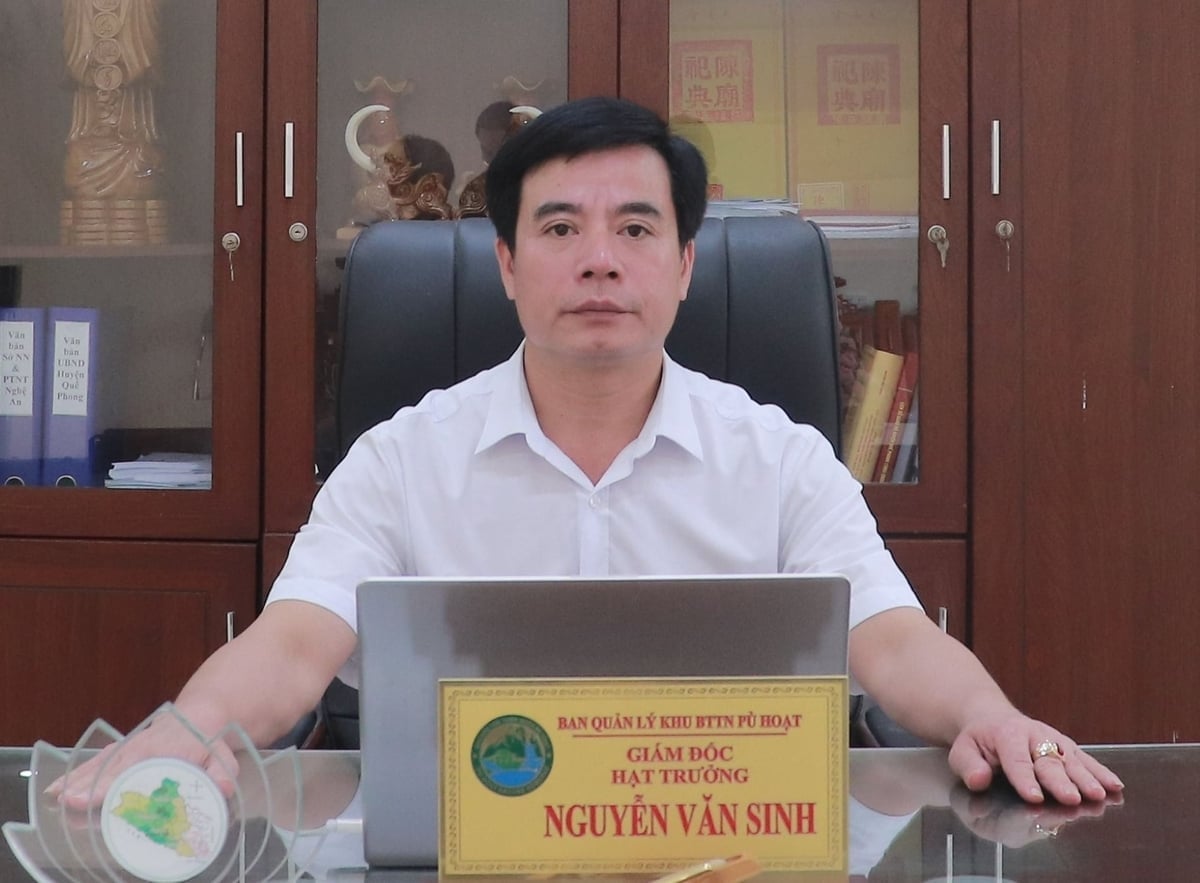
Mr. Nguyen Van Sinh, Director of Pu Hoat Nature Reserve. Photo: Pham Tuan.
Based on that characteristic, the Management Board of Pu Hoat Nature Reserve has determined that in order to well perform the assigned political tasks, well manage the existing forest area and preserve biodiversity values, the most important, sustainable, effective and strategic solution is to create sustainable livelihoods, improve living standards, and reduce poverty for people in the buffer zone. In recent years, the unit has implemented many programs and policies to help people develop sustainable livelihoods, both improving their living standards, creating stable incomes, and contributing to forest protection and biodiversity conservation. In recent times, the Management Board of Pu Hoat Nature Reserve has coordinated with local authorities to implement a number of programs and policies as follows:
Firstly , synchronously implementing the policy of forest protection contracting to residential communities: In recent years, the unit has taken advantage of resources, mechanisms and policies of the State to organize forest protection contracting to people and mobilize people to participate in forest protection contracting. Through forest protection contracting activities, forest patrolling and inspection, people are more aware of the value and benefits of forests, thereby making everyone responsible and voluntary to protect forests. Every year, the Management Board of Pu Hoat Nature Reserve has organized the forest protection contracting of more than 65,000 hectares to 44 village communities with more than 7,000 households participating with an average income of 5 - 7 million VND/household/year.
Second , focus on supporting people to carry out forest development work on forest areas assigned by the State to households and individuals, especially focusing on developing in the direction of large timber production with high economic value trees and specialty trees. Implementing the National Target Program on Sustainable Poverty Reduction in 2025, the unit has supported local people to plant 14.5 hectares of concentrated cinnamon and 44,500 scattered cinnamon trees.
Third , building sustainable livelihood models: Through investment project programs, the Management Board of Pu Hoat Nature Reserve has trained, transferred science and technology and applied the construction of sustainable livelihood models for people. Some typical livelihood models have been implemented such as: Model of developing yellow flower tea trees under the forest canopy in Thong Thu commune, Tien Phong commune; Model of growing Bon bo under the forest canopy in the communes: Tri Le, Que Phong, Thong Thu; Model of growing medicinal plants under the forest canopy such as: growing Dang Sam in Thong Thu commune; growing Mu Tun in Tien Phong commune; growing Ba Kich in Thong Thu commune...
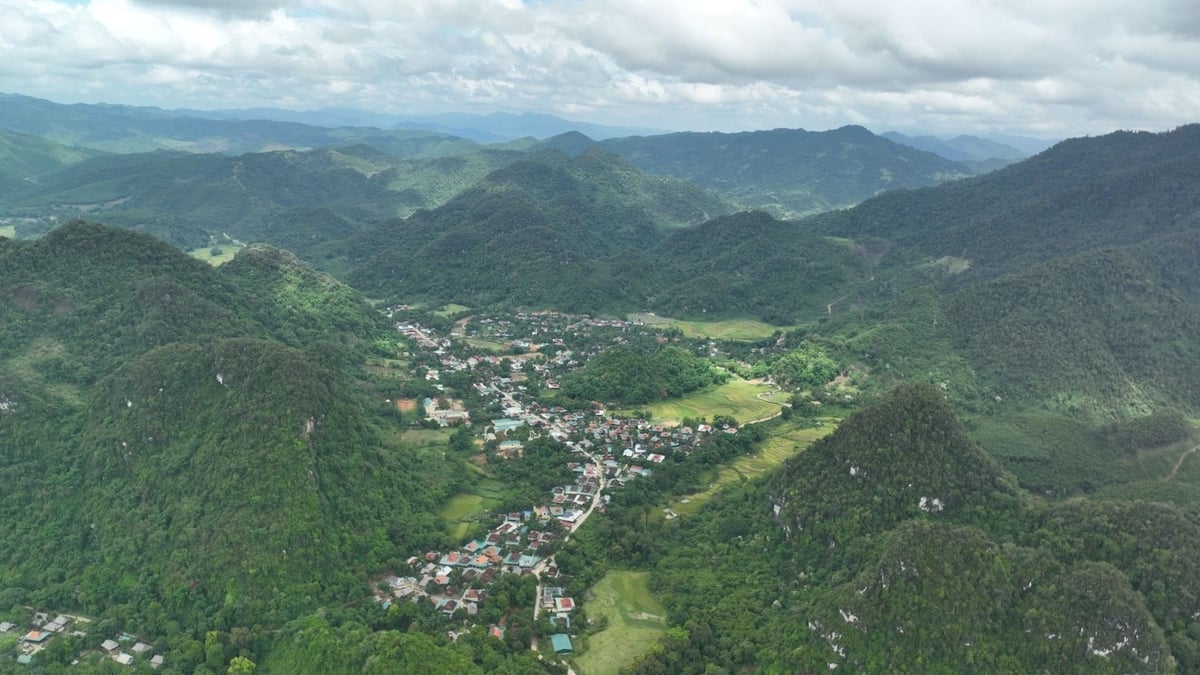
Sustainable forestry development is highly focused on by the Pu Hoat Nature Reserve Management Board. Photo: Dinh Tiep.
Fourth, building community development projects: Implementing the Sustainable Forestry Development Program, ERPA Program, in 2024 and 2025, the unit supported 106 rural development projects for 54 buffer zone villages and hamlets, contributing to improving infrastructure conditions and improving people's lives.
In addition to supporting livelihoods, the consumption of forest products, medicinal herbs and local agricultural products is still a problem for many households. Could you share more about the solutions that the Board has been implementing to connect the market, especially the application of information technology and digital transformation in the product consumption stage for people?
The biggest and most obvious difficulty for mountainous areas in general is the problem of consuming forest products, medicinal products and local agricultural products. This can be considered the bottleneck, the biggest "bottleneck" in the local agricultural production chain. This "bottleneck" is the main reason that is holding back the development process in the locality. Most forest products, medicinal products and agricultural products in the area are purchased by traders; prices and consumption markets are not stable. The development of models and goods is mainly spontaneous, not linked to the market, to the commodity value chain and there is no link between production and consumption of agricultural products to increase production scale, ensure product and food safety, and meet market requirements.
The above difficulties and challenges of local people always raise concerns and worries in finding solutions. Especially in the period when Vietnam is shifting to a new development stage - where poverty reduction is associated with green transformation, improving people's capacity and promoting innovation and creativity in rural areas. In recent times, the Management Board of Pu Hoat Nature Reserve has initially implemented a number of solutions as follows:
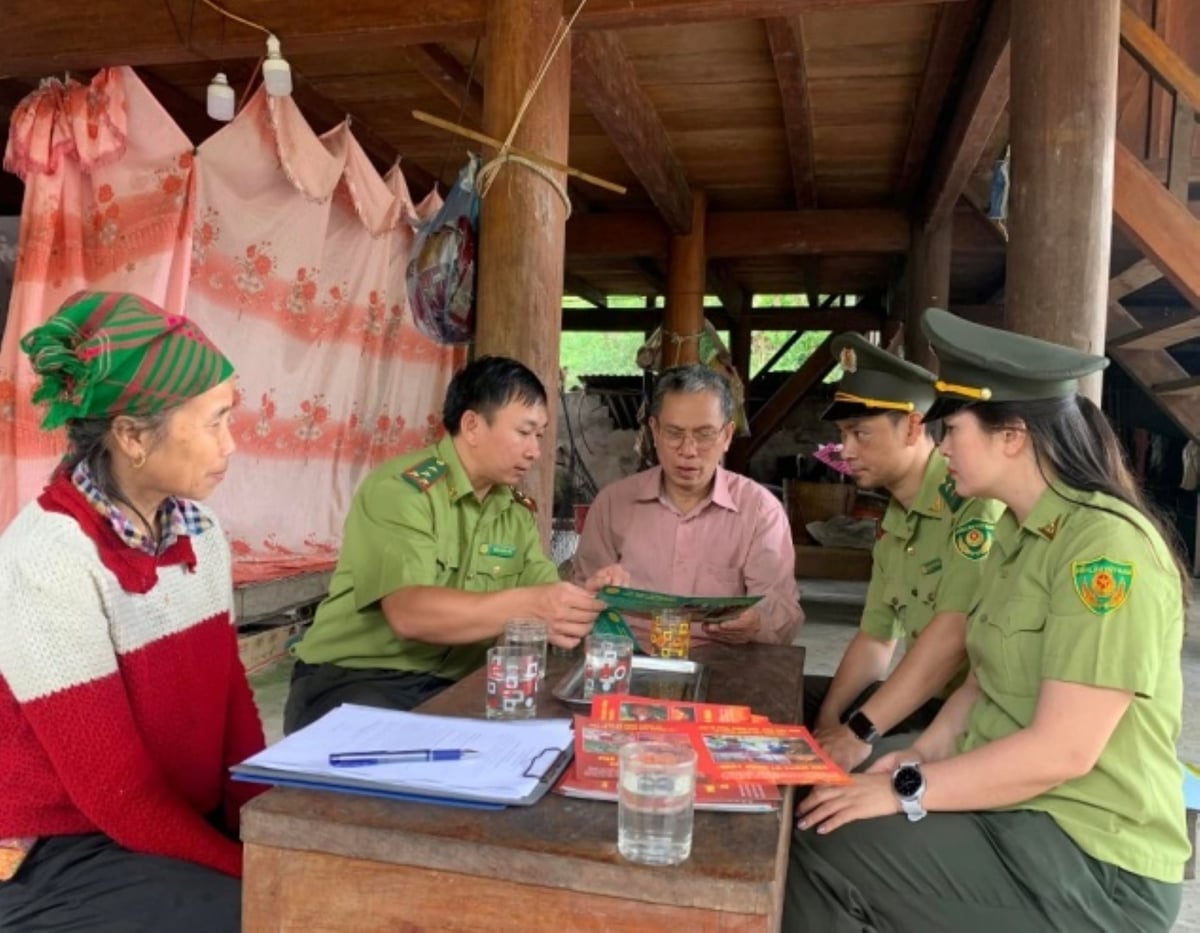
Pu Hoat Nature Reserve Management Board staff went to the grassroots to propagate. Photo: Pham Tuan.
Strengthen training and transfer of knowledge and advances in science and technology for people to apply in practical production processes in the locality, with special attention paid to the application of digital technology and basic knowledge so that people can confidently access the market.
Instruct people on how to exploit network information to serve production and promote local products.
Connecting and calling for projects and domestic organizations to coordinate and support the construction of a production chain in the direction of linking farmers with enterprises, thereby increasing production value through deep processing and accessing the consumer market. In recent times, some organizations such as CIDOMA, the Center for Humans and the Biosphere, etc. have provided very effective initial support.
Coordinate with local authorities to call on investors to survey and build factories for processing and extracting essential oils... to create output for products and create confidence for people to invest in production.
People access information and use digital platforms to... escape poverty
It is known that in recent times, the Board has also paid great attention to propaganda and training activities, helping people access information and use digital platforms in production and business. Could you tell us more about the effectiveness of this activity and the changes in awareness and working methods of people in the buffer zone after receiving support?
Currently, digital transformation and green economy are spreading strongly in rural areas, creating a great opportunity for localities to promote sustainable poverty reduction. However, to seize the opportunity and not be "left behind", people in mountainous areas need to be equipped with enough knowledge, skills and self-confidence to escape poverty. From that reality, in recent times, the unit has focused all resources to support people through training sessions, linking knowledge of forest protection with forestry development and digital transformation.
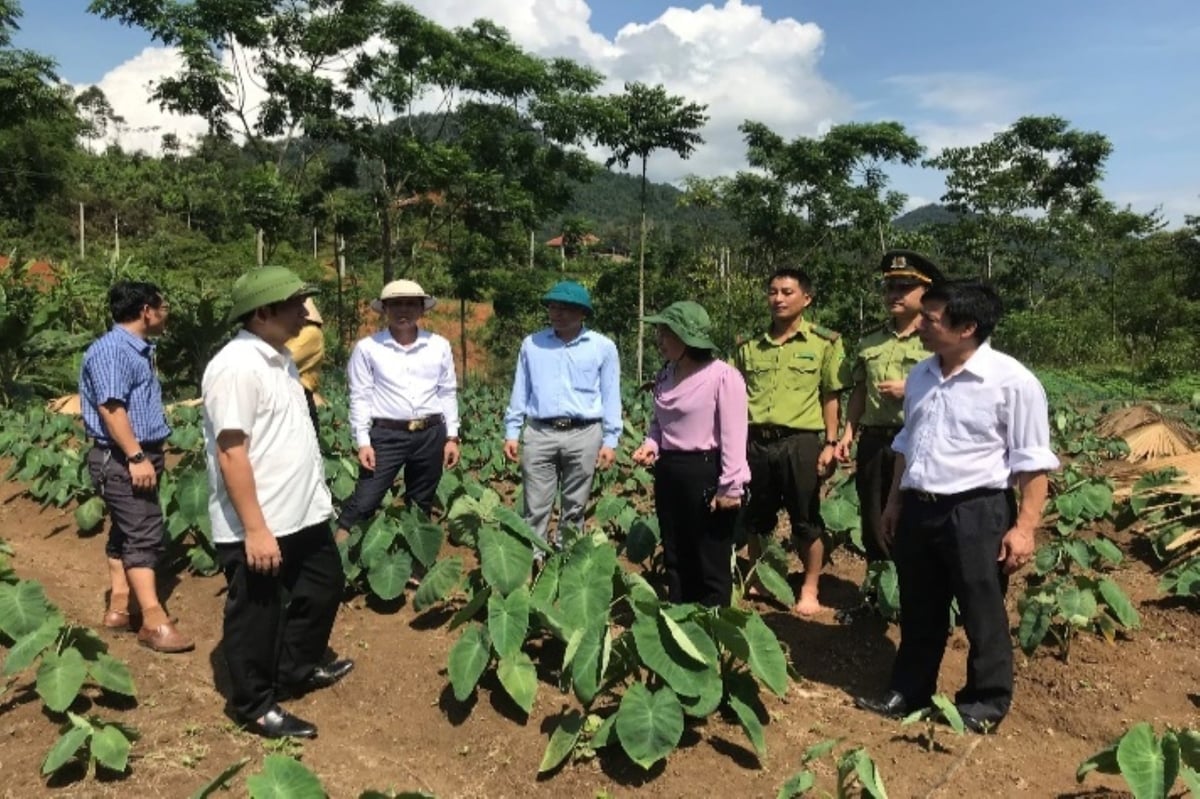
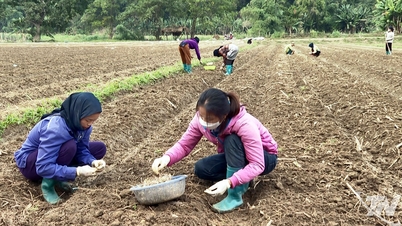
Checking the commercial taro growing model in Que Phong commune. Photo: Pham Tuan.
From the knowledge that has been disseminated and trained, especially knowledge about digital technology, people have been proactive and confident in accessing knowledge, markets and financial services, thereby expanding their livelihoods and increasing production efficiency. Typically, the people of Puc village, Que Phong commune (formerly Nam Giai commune) have established livestock cooperatives; built advanced farming models; the people of Thong Thu commune have gradually switched to local specialty crops such as cinnamon, fat, etc. With the knowledge equipped, people have gradually become confident in getting rich on their land based on indigenous knowledge, combined with science and technology. From the production efficiency, local people are gradually reducing poverty and reducing the impact on forests.
Towards the goal of sustainable poverty reduction associated with nature conservation, in the coming time, what are the key orientations and solutions of the Committee to continue promoting digital transformation, developing green livelihoods and improving the lives of local people?
Aiming at the goal of sustainable poverty reduction associated with nature conservation in the context of digital transformation and green economy, Pu Hoat Nature Reserve Management Board has the following orientations:
Firstly , continue to allocate resources to organize propaganda and training on knowledge and skills on forest protection and management associated with production, especially integrating digital transformation knowledge and IA technology to fully equip people with a foundation of knowledge and skills, creating confidence to integrate and keep up with the general trend of society.
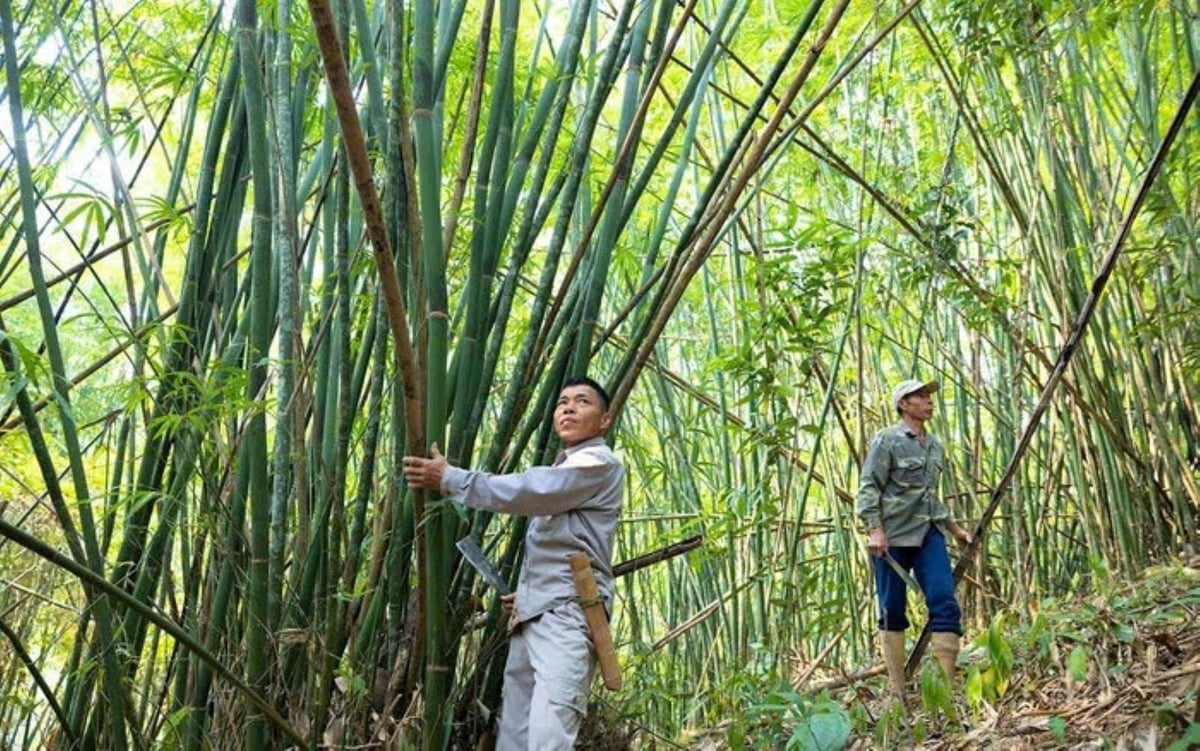
People in the buffer zone of Pu Hoat Nature Reserve have increasingly stable livelihoods. Photo: Pham Tuan.
Second , attract maximum resources from programs, projects and policies in the area to support people to have sustainable livelihoods and gradually escape poverty, while coordinating and integrating mechanisms and policies to create strong enough resources and increase the effectiveness of investment support.
Third , coordinate with local authorities to mobilize people to gradually change the structure of crops to suit local conditions and have high economic efficiency; build joint venture models to create commercial products.
Fourth , coordinate with local authorities to call for and attract investors to build processing facilities in the area to create sustainable output for products.
Source: https://nongnghiepmoitruong.vn/giam-ngheo-xanh-o-pu-hoat--huong-di-tu-chuyen-doi-so-d785957.html

![[Photo] Urgently help people soon have a place to live and stabilize their lives](/_next/image?url=https%3A%2F%2Fvphoto.vietnam.vn%2Fthumb%2F1200x675%2Fvietnam%2Fresource%2FIMAGE%2F2025%2F12%2F09%2F1765248230297_c-jpg.webp&w=3840&q=75)









































![[Photo] General Secretary To Lam works with the Standing Committees of the 14th Party Congress Subcommittees](https://vphoto.vietnam.vn/thumb/402x226/vietnam/resource/IMAGE/2025/12/09/1765265023554_image.jpeg)





















Comment (0)