

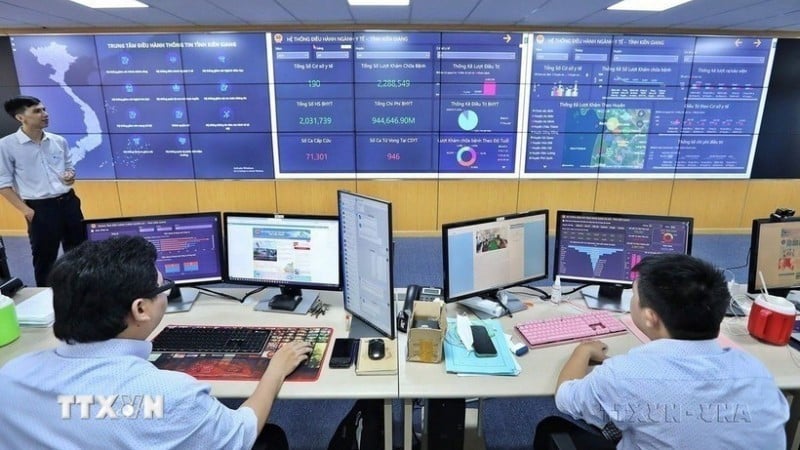
One year after the implementation of Resolution No. 57-NQ/TW, many technological systems have been put into operation, contributing to the modernization of government operations. However, in many localities, grassroots officials are under pressure due to having to work with too many disparate software programs, repeatedly entering data, and still having difficulty connecting information. The need for unified management, streamlined platforms, and the development of shared applications has become urgent.
Too much software makes it difficult for local officials.
At the Hanoi City Party Committee's Steering Committee 57 meeting to evaluate the implementation of Resolution No. 57-NQ/TW of the Politburo and key tasks for the last two months of 2026, Hanoi city leaders stated that each commune and ward in Hanoi is currently using an average of 20 operational software programs. Therefore, officials have to simultaneously remember multiple accounts and repeatedly enter the same type of data, making data interoperability difficult. This also leads to immense pressure on document processing within the system, significantly reducing labor efficiency. For example, after only 4 months of operation, ward officials in a coastal city in central Vietnam had to process nearly 7,000 incoming documents. Furthermore, with multiple software application systems running simultaneously from the central to local levels, officials have to juggle multiple systems, from document management and administration; to suggestion and feedback portals; and Q&A; Supervising and monitoring the tasks assigned by the City People's Committee…
Notably, these systems analyze data in real time, assign tasks within specific timeframes, and require staff to update frequently, leading to overload. Furthermore, current functions in the document management system mainly focus on routing and assigning processing deadlines, lacking tools for analyzing, evaluating, and measuring workload and processing time in a way that reflects reality. Due to the lack of intelligent support tools, digital transformation has not truly helped to "reduce work," and in many cases, it is creating additional administrative procedures. In addition, the technical infrastructure in some areas, especially rural and mountainous regions, remains a "gap" with many old, low-configuration devices and unstable connections, causing frequent interruptions in information flow…
Changing the mindset in software management, unifying governance.
Associate Professor, Dr. Nguyen Xuan Hoai, Director of the Institute of Artificial Intelligence, stated: “The waste of organizational software in Vietnam is probably significant. However, it doesn't stop there; in the era of artificial intelligence (AI) transformation, this is also a major challenge in transforming information systems to a deeply integrated AI platform. Therefore, having a well-structured information system architecture, modeling, and IT architecture is essential. Otherwise, software will continue to be fragmented, and data will be isolated in many places, lacking interconnectedness and therefore impossible to explore...”
This situation necessitates a shift in software management thinking and unified data governance to contribute to further comprehensive transformation in 2026 – the year designated for “breakthrough action and widespread results” to accelerate the implementation of Resolution No. 57-NQ/TW.
The development of digital platforms and shared applications must be based on a well-planned strategy and architectural model. A thorough and urgent review and assessment is needed to put an end to the excessive deployment of software and information systems that lack the necessary foundation and do not meet practical requirements. Consideration should be given to investing in and deploying centralized systems at the central level, followed by decentralization and allocation to local authorities.
This approach will ensure complete synchronization, consistency, and interoperability among agencies within the political system, instead of allowing individual units to invest in separate, interconnected systems.
To support officials in working effectively, the information system for handling administrative procedures and managing operational documents needs to be upgraded from a management-oriented to a support-oriented system. A suggestion from the grassroots level, Comrade Nguyen Duy Ngan, Deputy Secretary of the Party Committee of Cam Binh commune, Ha Tinh province, proposed: “Instead of just using software to streamline documents, the system needs to strengthen the integration of AI to support officials in filtering content, analyzing, evaluating, synthesizing reports, and forecasting the situation... The goal is to have AI handle repetitive tasks, freeing up labor.” Ending the situation of too many software programs is a crucial step in unlocking data resources and building an effective and efficient digital government.
Source: https://nhandan.vn/giam-phan-manh-phan-mem-de-khoi-thong-du-lieu-so-post935867.html







![[GALLERY] Witnessing the first landing of an Italian F-35B fighter jet on a highway.](https://vphoto.vietnam.vn/thumb/402x226/vietnam/resource/IMAGE/2026/05/24/1779625960562_f-35b-della-marina-militare-2-jpg.webp)




















































































Comment (0)