

Located in the East of Cao Bang province, Phuc Hoa commune is a fertile land, a long-standing home of the Tay and Nung ethnic groups.
Life here is closely linked to corn fields, rice fields and especially sugarcane fields - crops that have become an important source of livelihood for the people.
From sugarcane, people have created a unique product with a strong local cultural imprint: Bo To palm sugar, one of the famous specialties of the border region.
The essence of sugarcane
The palm sugar making profession in Bo To was formed in the 1950s and has existed until today. From sugarcane, people have created a type of palm sugar with a golden color and a characteristic honey aroma, which is popular in making many traditional cakes such as Khao cake, Gai cake, Lam cake, Ho Lo cake...
In Bo To, the sugarcane growing area is maintained at about 30 hectares. At the beginning of the 10th lunar month every year, when the weather is cold, the sugarcane loses water and reaches its peak sweetness, which is also the time when the whole village bustles into the sugar production season.
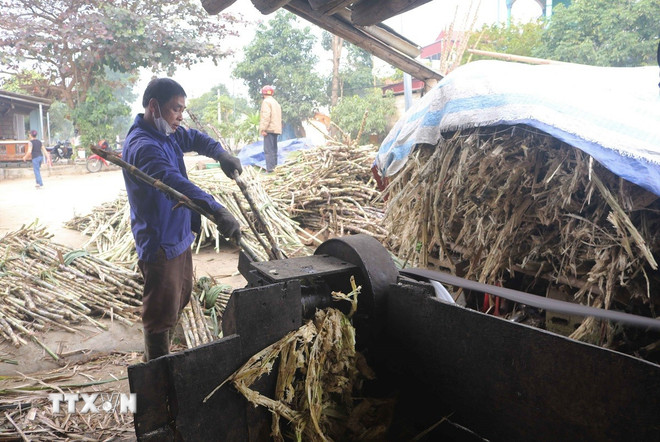
Sugarcane is cut, peeled, and then put directly into an electric press. In the past, people had to use wooden buckets and buffalo power to press sugarcane, but today, thanks to investment in machinery, the work is much less arduous, shortening the time and increasing productivity.
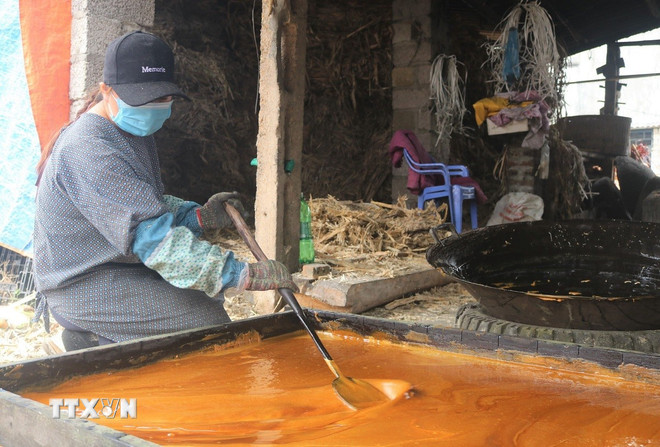
The pressed sugarcane juice is boiled in a large cast iron pan for 4-5 hours.
The cooking stage is the most important step, requiring meticulousness and experience from the craftsman. At first, the heat must be high to make the honey boil strongly, then the heat must be reduced to avoid burning. When the honey turns golden yellow and reaches the right consistency, the craftsman uses his experience to taste to determine the "doneness."
Young honey makes the sugar runny, while old honey has a harsh taste and a burnt smell. Therefore, each batch of sugar is not only a product of labor but also a crystallization of skill and sophistication.
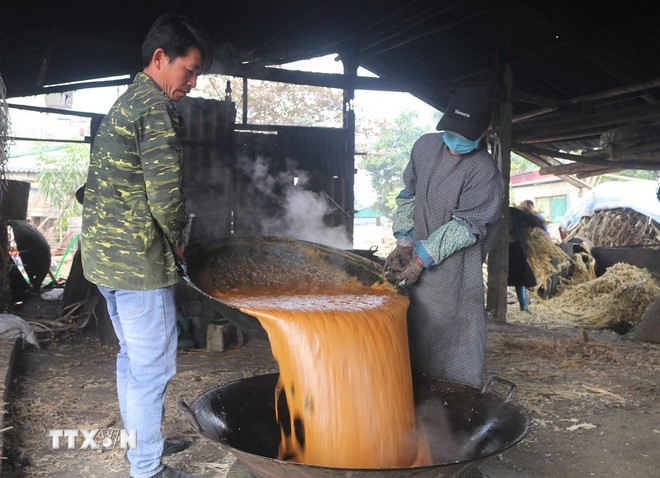
Once the honey has reached the required level, it is poured into a mold, spread evenly and left to cool for about 30 minutes, then cut into pieces.
With the current method, 100kg of sugarcane produces 20-30kg of finished brown sugar.
Each day a family can cook 3-4 batches of sugar, each batch about 60-70kg of finished brown sugar.
Besides, people can use bagasse as fuel, and sugarcane juice to make sugarcane wine.
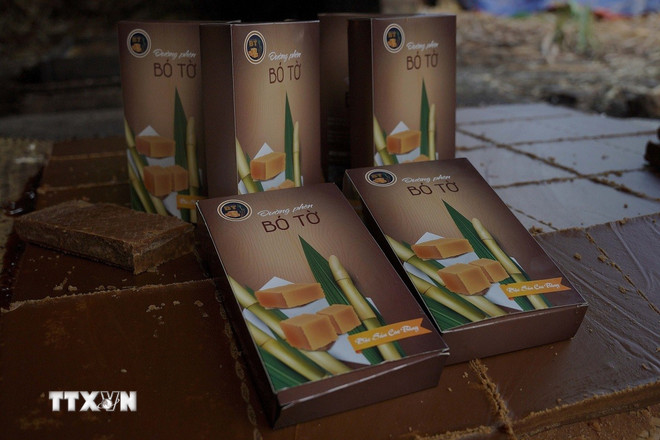
The finished Bo To rock sugar has a reddish-yellow color, smooth surface, sweet taste and absolutely no preservatives. It is this rustic and natural quality that creates a unique flavor that cannot be found anywhere else.
Traditional occupations bring sustainable economic efficiency
Thanks to its special quality, Bo To palm sugar always sells well, especially during the traditional Tet holiday when the demand for making cakes increases.
Each family in Bo To can make 3-4 batches of sugar per day, each batch yielding about 50-60kg of finished product. Many large-scale producers can make more than 10 tons of sugar per year.
Not only producing brown sugar, people also use molasses to make sugarcane wine and taffy - by-products that are also very popular.
Over time, the Bo To palm sugar making profession faced many difficulties when cheap white sugar flooded the market. While many places abandoned the profession, the people of Bo To still persevered in preserving traditional values.
In 2019, Bo To palm sugar craft village was officially recognized as a traditional craft village, and by 2020, Bo To palm sugar products achieved 3-star OCOP at the provincial level. This is an important milestone, opening up opportunities to promote products more widely.
To contribute to promoting socio-economic development in ethnic minority areas, in the 2023-2025 period, Cao Bang province has invested more than 23.6 billion VND in traditional craft villages, of which Bo To is one of the localities benefiting.
In the 2026-2030 period, the province plans to increase the support level to 50.72 billion VND, creating a large resource for sustainable development.
Local authorities also regularly promote people's compliance with food hygiene and safety, support the improvement of packaging designs, and the creation of labels, contributing to enhancing brand value.
Producers are encouraged to link together to unify quality, price and boost consumption.
Preserving the profession - preserving the indigenous culture
The craft of making palm sugar in Bo To village not only has economic significance but also contains profound cultural values. It is a story of the ingenuity and diligence of the people in the border region; a taste of tradition preserved through many generations; a symbol of the spirit of overcoming difficulties, creativity and solidarity.
Amidst the hustle and bustle of modern life, the image of glowing red pans of molasses and smoky sugar kilns every cool season always evokes a feeling of warmth and familiarity.
With the cooperation of the government, people and support programs, Bo To palm sugar craft village is gradually affirming its position in the market, becoming a typical product of Cao Bang and promising to continue to reach further in the future./.
Source: https://www.vietnamplus.vn/giu-gin-huong-vi-truyen-thong-cua-duong-phen-bo-to-giua-mien-bien-cuong-cao-bang-post1081591.vnp

![[Photo] General Secretary To Lam works with the Standing Committees of the 14th Party Congress Subcommittees](/_next/image?url=https%3A%2F%2Fvphoto.vietnam.vn%2Fthumb%2F1200x675%2Fvietnam%2Fresource%2FIMAGE%2F2025%2F12%2F09%2F1765253019536_a1-bnd-0983-4829-jpg.webp&w=3840&q=75)
![[Photo] Urgently help people soon have a place to live and stabilize their lives](/_next/image?url=https%3A%2F%2Fvphoto.vietnam.vn%2Fthumb%2F1200x675%2Fvietnam%2Fresource%2FIMAGE%2F2025%2F12%2F09%2F1765248230297_c-jpg.webp&w=3840&q=75)



































































Comment (0)