

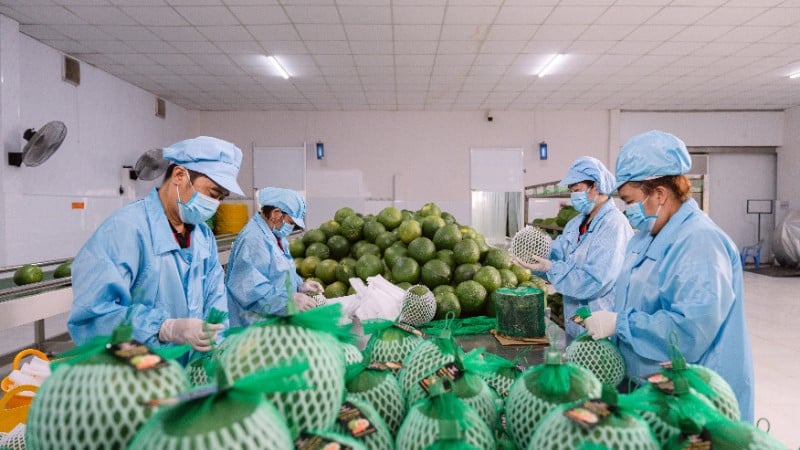
 |
| Packing grapefruit for export at Vina T&T Group Company. (Photo: MINH ANH) |
Tighten regulations, expand supply
According to Mr. Ngo Xuan Nam, Deputy Director of the Vietnam National Information and Enquiry Office on Epidemiology and Animal and Plant Quarantine, in recent years China has continuously improved its legal system on food safety management for import and export and built national standards to ensure the quality of goods imported into China.
Chinese authorities have also increased enforcement of food safety laws on import and export, specifically by conducting on-site inspections of foreign food production establishments/enterprises exporting to China; continuing to improve the registration of foreign food production enterprises; and applying strong sanctions to enterprises violating food safety regulations. Most recently, China announced the issuance of Order 280 to replace Order 248 on regulations governing the registration of imported foreign food production enterprises, effective from June 1, 2026.
With this order, only products on the list announced by China are allowed to be registered through the competent authority instead of self-registration as before. Therefore, businesses need to study the list of products announced by China to ensure that exported products are in the approved group; build or strengthen the quality management system, traceability, ensure food safety requirements; update business information if there are changes in legal entity, address, license. In particular, regularly monitor the transition period until June 1, 2026 and take advantage of this time to train staff and review processes. If businesses do not keep up with the changes, their export codes may be suspended, goods may be returned or customs clearance may be blocked. However, if businesses are well prepared, they can take advantage of the opportunity with the advantage of less complicated procedures, more transparent mechanisms, and more stable access to the Chinese market.
Along with changing regulations, China is also expanding its import market to diversify its supply sources. According to the Vietnam Trade Office in China, in the first 6 months of 2025 alone, China has opened its market to about 15 agricultural, forestry and fishery products from nearly 20 countries and territories. Specifically, durian from Cambodia, fresh coconut from Malaysia, banana from Colombia, mango from Ecuador, cashew nuts from Gambia, medicinal plants from Russia, natural aquatic products from New Zealand, Brazil, Kenya, Denmark, Greece and farmed aquatic products from Croatia, Thailand, Laos; raw and refined bird's nests from Cambodia...
According to the Vietnam Trade Office in China, in the first 6 months of 2025 alone, China opened its market to about 15 agricultural, forestry and fishery products from nearly 20 countries and territories.
As for durian, at the end of September, Guangxi imported 19.8 tons of fresh durian from Cambodia. This is the first batch of fresh durian that Guangxi imported after the China-Cambodia agricultural promotion conference in June. Although the quantity is not much, it also adds competitive pressure for Vietnamese durian in this market. Meanwhile, bananas - a major export item of Vietnam to China - are also facing competition as China is promoting the cultivation of high-quality bananas. Specifically, in Shanxi province, bananas have been successfully grown in greenhouses, adjusting the temperature according to the season to meet quality standards. Previously, in Shaanxi, bananas grown in greenhouses also bore fruit successfully.
Find advantage from challenge
Vietnam is geographically close to China, so it has a great advantage in terms of transportation time and freight costs. In addition, China has now opened its market to many types of Vietnamese agricultural products as well as many other items that are being exchanged through traditional trade. Nong Duc Lai, Trade Counselor of the Vietnam Trade Office in China, said that in order to increase the competitiveness of high-end foods and tropical fruits, businesses should promote trade deep into the interior and localities in the northern and northwestern regions of China where the standard of living is high and consumer demand is high.
To increase the competitiveness of high-end foods and tropical fruits, businesses should step up trade promotion deep into the interior and localities in the northern and northwestern regions of China where living standards are high and consumer demand is high.
Commercial Counselor, Vietnam Trade Office in China Nong Duc Lai
Regarding seafood products, according to the Vietnam Association of Seafood Exporters and Producers (VASEP), China still maintains its No. 1 position in importing shrimp from Vietnam. However, Ms. Phung Thi Kim Thu, Shrimp Market Expert (VASEP), commented that competition in the Chinese market is becoming fiercer than ever because Ecuador and India are selling frozen shrimp at low prices to popular restaurant channels. Therefore, to gain market share, businesses need to focus on high-end products.
China’s shrimp imports are forecast to increase slightly in the fourth quarter thanks to demand for the festive season and the Lunar New Year of the Horse in 2026; in which the trend of consuming high-end products such as live shrimp, lobsters and large-sized tiger prawns will continue to lead the growth. “However, risks from border control policies and changes in customs regulations are still factors that businesses need to pay attention to because even a small change in traceability or food safety can disrupt the flow of goods,” Ms. Thu recommended.
Currently, China's demand for agricultural, forestry and aquatic product imports is very large, with an annual scale of up to 210-230 billion USD. This is a wide open market but also one that frequently changes, requiring Vietnamese enterprises to be professional, standardize processes and closely follow new regulations to take advantage of export opportunities.
Source: https://huengaynay.vn/kinh-te/giu-thi-truong-nong-san-trong-boi-canh-moi-160497.html


![[Photo] National Assembly Chairman Tran Thanh Man receives First Vice Chairman of the Federation Council of the Federal Assembly of the Russian Federation](/_next/image?url=https%3A%2F%2Fvphoto.vietnam.vn%2Fthumb%2F1200x675%2Fvietnam%2Fresource%2FIMAGE%2F2025%2F12%2F02%2F1764648408509_ndo_br_bnd-8452-jpg.webp&w=3840&q=75)











































































Comment (0)