

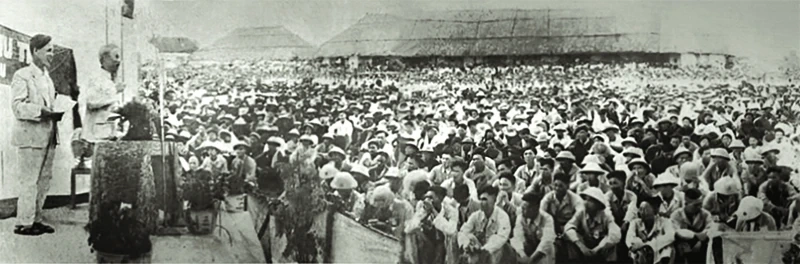
President Ho Chi Minh speaking to people from all walks of life in Thanh Hoa on June 13, 1957. Photo: Archival material.
In late 1958 and early 1959, at the time of summarizing 30 years of the Party's leadership and reflecting on his life experiences, President Ho Chi Minh wrote "Revolutionary Ethics" under the pseudonym Tran Luc. According to him, revolutionary ethics is the lifelong determination to fight for the Party and the revolution; to work diligently for the Party, uphold Party discipline, and effectively implement the Party's guidelines and policies; to place the interests of the Party and the working people above personal interests; to wholeheartedly and tirelessly serve the people; and to constantly study Marxism-Leninism, regularly engage in self-criticism and criticism to improve one's thinking, refine one's work, and progress together with one's comrades.
Reading "Revising Working Methods," a work written by President Ho Chi Minh in 1947, becomes even clearer how he analyzed the character of revolutionaries and the issue of building the Party on moral foundations. The morality of a ruling Party and the exemplary conduct of its cadres and members are the core elements that convince the people to trust and follow them, thus successfully carrying out the revolutionary cause.
According to Associate Professor Bui Thi Ngoc Lan of the Ho Chi Minh National Political Academy, a ruling party that creates an intersection between revolutionary ideals and the people's beliefs through leadership capacity and moral qualities will awaken and unleash the strength of the masses, making the people trust, follow, and support it. Through this, the Party can maintain its ruling position and leadership role in the struggle for liberation.
The ethical standards for cadres and Party members are a synthesis of the rules, requirements, and demands of the new social system on each cadre and Party member. These are the limits of what is permissible, permissible, and mandatory to maintain discipline, order, and social development. They also guide and regulate the behavior of cadres and Party members in social life and work; and serve as a yardstick for the people to monitor in the current process of national construction and defense.
According to Lenin's view, only by combining all three elements—intelligent leadership capacity; honor and responsibility before the destiny of class liberation and the liberation of society from oppression and exploitation; and a clear conscience and moral dignity—can a combined strength be formed to maintain the Party's leading role over the State and society. The most crucial element of communist morality is the unity of interests between the Party, the class, and the people. This is what creates the immense strength to attract the working class and the working people to follow, becoming the broad political and social foundation to firmly secure the Party's ruling position.
The founders of Marxism asserted that moral education is not merely about transmitting behavioral norms, but also about creating social conditions that are in line with the inherent goodness of human nature. This is particularly significant because, in modern management psychology, only by understanding the pure motives of human beings, establishing and creating conditions that satisfy those healthy motives, can we consciously unleash the immense power of the core values of revolutionary morality. The necessary and sufficient condition for convincing moral and revolutionary education is: creating an environment, and more broadly, a society, where there is unity between individual and social interests. "If legitimate interests are the principle of all morality, then we must strive to make the individual interests of man conform to the interests of all mankind," Friedrich Engels once wrote. This viewpoint remains highly relevant and profoundly humanistic today.
Social ethics is not something immutable but is always in motion, coexisting with society. The basis for the formation of ethics is the socio-economic foundation, closely linked to the process of education, training, and practical activities of human beings. Therefore, in the face of the changes of the new era and new socio-economic conditions, it is essential to continue clarifying the content and necessary qualities of revolutionary ethics for cadres and Party members today.
The 21st century stands out as an era of unprecedented change, marked by the rapid development of technology, globalization, and profound transformations in social life. This change places new demands on leaders: not only professional competence but also strategic vision, a spirit of innovation, the ability to collaborate, respect for diversity, and a commitment to sustainable development.
According to institutional and organizational development strategists, the new generation of leaders needs outstanding qualities such as strategic thinking, the courage to think outside the box, take action, and assume responsibility. But the most impressive and important quality is building trust and credibility. Integrity, transparency, and accountability are always the foundation for building trust with the people, investors, and international partners.
Returning to President Ho Chi Minh's article "Revolutionary Ethics," it is clear that he recognized early on that the journey of building socialism would be fraught with difficulties and challenges. Therefore, he affirmed: "Making a revolution to transform the old society into a new society is a glorious undertaking, but also a very heavy task, a complex, long, and arduous struggle. Only with great strength can one bear the heavy burden and go far." According to him, that "strength" is, first and foremost, revolutionary ethics.
So, is revolutionary morality difficult to cultivate? Certainly, it's difficult for those still heavily influenced by individualism. But it won't be difficult for those who possess a heart devoted to the Party, the people, and the nation. As President Ho Chi Minh said: "Revolutionary morality doesn't fall from the sky. It develops and strengthens through daily struggle and persistent training. Just as a gem becomes brighter the more it's polished, and gold becomes purer the more it's refined."
According to Ho Chi Minh's ideology, under any circumstances, a Party member must always put the interests of the Party above all else. When the interests of the Party and personal interests conflict, personal interests must be subordinate to the interests of the Party. A Party member represents the interests of the working class and the working people; therefore, personal interests cannot be separated from the interests of the Party and the people.
In the "Communist Manifesto," C. Marx and F. Engels wrote: Communists are the most resolute section, always driving the movement forward. They surpass the rest of the proletariat in that they understand the conditions, process, and general outcome of the revolutionary movement.
In his 1844 "Economic-Philosophical Manuscripts," Karl Marx asserted: "If you want to influence others, you must actually stimulate and motivate them." This means that the greatest persuasive power lies not in words, but in the actions and character of a person.
Today, as the country enters a new stage of development, the demands no longer remain at the level of awareness but must be transformed into concrete action. In his article "Forward! Complete Victory Will Be Ours!", General Secretary and President To Lam emphasized that the goal of a prosperous people, a strong nation, democracy, fairness, and civilization is not only an aspiration but also a solemn promise to the people. Therefore, every cadre and Party member, especially those "at the forefront," must strive to surpass themselves.
"Actions speak louder than words" is not just a slogan, but must become a principle of action, a measure of the credibility of each official and Party member. A truthful statement that is not followed will gradually lose its value. But a practical action, however small, has a much stronger ripple effect than words.
Revolutionary ethics, ultimately, is the "compass" that helps people avoid losing their way amidst life's vicissitudes. Upholding ethics today is an uncompromising struggle with oneself. Every day, every task, every decision is a test and also an opportunity to improve oneself. Moreover, cadres and Party members must not only cultivate themselves but also spread these positive motivations to their comrades, colleagues, and the community. Clearly, the most important persuasive tool each person possesses is their own integrity.
Nguyen Huong
Source: https://baothanhhoa.vn/giu-tron-dao-duc-nbsp-vi-cach-vang-vi-nhan-dan-288048.htm
























































































Comment (0)