

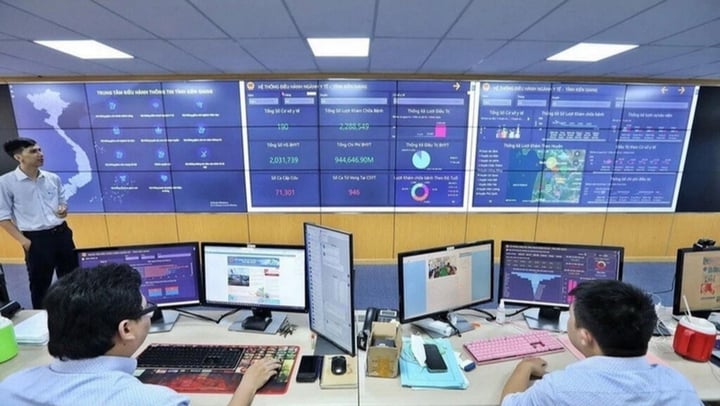
Hanoi strengthens removing bottlenecks in implementing Resolution 57.
According to the Vice Chairman of the City People's Committee, the first bottleneck comes from the inter-sectoral coordination and direction mechanism. Steering Committee 57 has been consolidated and merged with Steering Committee 204, and the City Party Committee Office has been assigned as the standing agency; however, the inter-sectoral coordination regulations have not been issued yet, the city does not have a common "responsibility map" and a mechanism for sharing information in real time. This causes many tasks to still be implemented by each sector, lacking a consistent coordination axis.
The next bottleneck lies in digital data and data connection. Hanoi is operating 62 specialized databases and connecting with 28 national systems, but the data is still scattered, standards are not unified, the connection platform is sometimes interrupted, limiting the ability to integrate and exploit for forecasting and policy planning. In addition, the progress of task implementation in some units has not met the requirements. Of the total 187 assigned tasks, 13 are still overdue, reflecting the lack of determination in implementation and showing that progress discipline has not been strictly maintained.
Another major bottleneck comes from the digital infrastructure at the commune and ward levels, where many operational devices are old, the internal network system is weak, and the apparatus has to operate nearly 20 different software. Such platform fragmentation overloads grassroots staff, creates fear in using technology, and creates the risk of errors when handling work. Along with that, the issue of ensuring information security is still a challenge. The city does not have a centralized information security monitoring center; some units have not assessed the level of information security, lack backup processes, leading to high risks in the context of increasingly complex cyber attacks.
Although the quality of online public services has improved, the rate of online application submission has increased rapidly and data has been fully synchronized, the effectiveness is still uneven across sectors. The speed of processing procedures in some work groups is still slow, not creating consistent satisfaction for people and businesses. The final bottleneck identified is Hanoi's innovation ecosystem, although many important elements have been formed such as start-ups, research institutes, universities, large technology enterprises, but the level of connection is still not deep, not creating a strong enough driving axis to spread and support new models.
Faced with these limitations, the Vice Chairman of the City People's Committee said that Hanoi will immediately move to a new state of action, with the spirit of "leading with vision - with data - by example; organizing implementation with objectives, key results (OKR), assessment indicators (KPIs) and digital dashboards". From December 2025, all agencies and units must review tasks and update progress in real time on the common monitoring system of Resolution 57.
At the same time, the city will continue to improve Steering Committee 57, establish an Advisory Group, digitize all tasks and standardize four groups of basic data before the end of 2025. The City People's Committee will also complete the dossier to specify the Capital Law (amended), adjust overlapping regulations; issue an information security mechanism, a mechanism for selecting technology-leading enterprises and a mechanism for ordering scientific and technological research.
Regarding digital transformation, the entire task must be completed by 2025. Units will unify the document management platform, review and reduce the number of software operating at the grassroots level, standardize reporting processes and work records in the digital environment. The Public Administration Service Center will deploy a real-time service quality assessment system, complete the authorization of 311 administrative procedures before December 15, 2025, and develop the iHanoi application into a super application serving people and businesses in the first quarter of 2026.
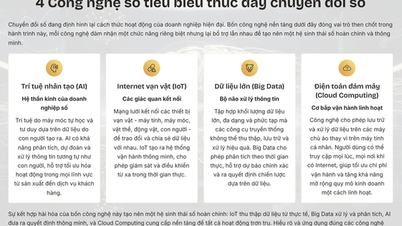
In the field of data and cybersecurity, the city aims to publish shared data before December 31, 2025 and select enterprises to accompany the implementation of information security assurance. Digital infrastructure is also heavily invested with a three-phase roadmap to build the Hanoi Data Center in the 2025-2028 period and establish the Center for Research and Application of AI, Big Data, and IoT from December 2025.
Regarding human resources, Hanoi will cooperate with universities to train 50,000 digital workers each year, and at the same time study the application of the 10-year "Hanoi Talent" visa policy, combined with housing, tax and income incentives for high-tech experts. Along with that, the city will establish the Hanoi Innovation Center Joint Stock Company before December 22, 2025, build a Technology Exchange in the first quarter of 2026 and pilot a Venture Capital Fund in January 2026.
Many large-scale initiatives have also been promoted, such as the 90-day campaign to collect medical data, pilot AI applications in image diagnosis, building a smart hospital project and researching to support businesses in manufacturing Vietnamese-branded computers. The city police will coordinate with relevant agencies to complete the Hanoi Smart City Development Project before December 10, 2025.
Source: https://mst.gov.vn/ha-noi-chi-ra-7-diem-nghen-can-tro-tien-do-nghi-quyet-57-va-yeu-cau-chuyen-ngay-sang-trang-thai-hanh-dong-197251202103653281.htm


![[Photo] Worshiping the Tuyet Son statue - a nearly 400-year-old treasure at Keo Pagoda](/_next/image?url=https%3A%2F%2Fvphoto.vietnam.vn%2Fthumb%2F1200x675%2Fvietnam%2Fresource%2FIMAGE%2F2025%2F12%2F02%2F1764679323086_ndo_br_tempimageomw0hi-4884-jpg.webp&w=3840&q=75)

![[Photo] Parade to celebrate the 50th anniversary of Laos' National Day](/_next/image?url=https%3A%2F%2Fvphoto.vietnam.vn%2Fthumb%2F1200x675%2Fvietnam%2Fresource%2FIMAGE%2F2025%2F12%2F02%2F1764691918289_ndo_br_0-jpg.webp&w=3840&q=75)












































































Comment (0)