

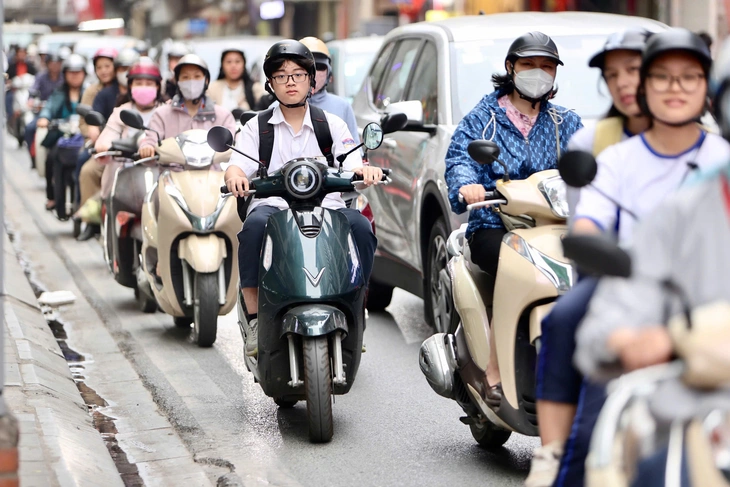
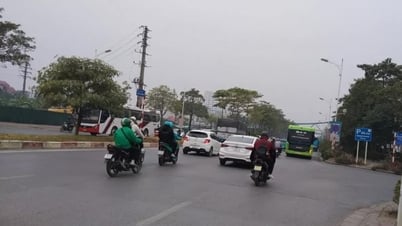
Some people have switched to using electric vehicles to get around the streets of Hanoi - Photo: NGUYEN KHANH
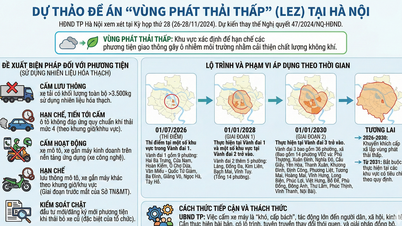
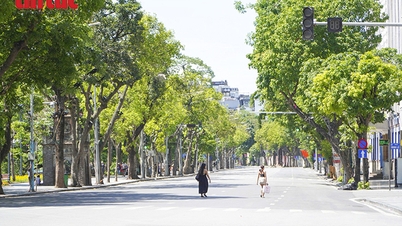
According to the draft, the pilot area for phase 1 has been selected as Hoan Kiem ward.
So what preparations will Hanoi make to implement the pilot program banning gasoline-powered motorbikes?
Combining multiple solutions for low-emission zones.
According to the draft Low Emission Zone (LEZ) project developed by the Hanoi People's Committee, the city has allocated 20 parking lots for cars and motorbikes around the planned LEZ pilot area. At the same time, Hanoi is planning to develop approximately 80 bus stations and parking lots within the Ring Road 1 area. Specifically, Hoan Kiem ward will have 3 lots, Cua Nam 2 lots, Ngoc Ha 8 lots, Giang Vo 7 lots, Hai Ba Trung 19 lots, Van Mieu - Quoc Tu Giam 3 lots, O Cho Dua 7 lots, Ba Dinh 11 lots, and Tay Ho 20 lots.
The city plans to add approximately 30-35 rental stations/points for bicycles and electric bicycles, with a capacity of 250-300 vehicles. Regarding the locations for battery swapping cabinets and charging stations for electric vehicles, the city will study placing them within the first ring road.
In addition, Hanoi has adjusted and reorganized its bus network to utilize electricity and green energy in areas within the ring roads 1, 2, and 3. Simultaneously, it has replaced and opened new smaller bus routes operating on narrow streets, connecting to major transfer points.
According to the Hanoi People's Committee, the infrastructure supporting electric vehicles continues to be improved with the installation of more charging stations and battery swapping cabinets in many areas. In addition, a traffic camera system using artificial intelligence (AI) will be deployed to monitor and control vehicles, combined with traffic signs, surveillance infrastructure, and a synchronized data management system.
"The city is also developing a plan to install air quality monitoring sensors, combined with modeling to evaluate the effectiveness of emission reduction solutions," according to the Hanoi People's Committee.

How do you support the transition?
According to a draft resolution being developed by the Hanoi People's Committee, the city budget will provide direct support to individuals with permanent or temporary residence in Hanoi for two years or more. These individuals are owners of gasoline-powered motorcycles or scooters registered before the resolution's issuance, and who convert to clean energy vehicles costing 10 million VND or more. Specifically, each individual will receive support for one vehicle from the resolution's effective date until January 1, 2030.
The subsidy is 20% of the vehicle's price, but not exceeding 5 million VND. Poor households receive 100% of the vehicle's value, but not exceeding 20 million VND, while near-poor households receive 80%, but not exceeding 15 million VND.
In cases where cash assistance is not available, residents can choose to receive assistance in the form of tickets for public transportation services of equivalent value. Hanoi will also subsidize 30% of the interest on the entire loan contract value when individuals purchase motorcycles or electric scooters on installment plans for a period not exceeding 12 months.
For businesses and organizations, the budget will subsidize 30% of the interest on commercial bank loans for the loan period (maximum of 5 years) for units providing public services, passenger transport, and freight transport in Hanoi when investing in green transportation vehicles.
Specifically, this will include types of vehicles such as ambulances, postal vehicles, specialized vehicles (street sweeping, washing, garbage transport), school buses, taxis, contract vehicles with fewer than 8 seats, and rental vehicles serving urban public transport.
Similar interest rate support policies also apply to businesses providing self-driving vehicle rental services when investing in green transportation for public purposes.

Prepare all necessary supporting tools.
Associate Professor Bui Thi An, former National Assembly representative and Director of the Institute of Resources, Environment and Community Development, assessed the draft pilot project for LEZ (Land Use Zone) recently released by the Hanoi People's Committee as "on the right track". According to Professor An, Hanoi's decision to pilot the project in a limited area first, instead of the entire Ring Road 1, demonstrates the "correct thinking" of the capital's government.
The draft shows that Hanoi did not impose a complete ban immediately, but rather followed a specific roadmap with three phases, which is important and appropriate to Hanoi's reality. Regarding the pilot areas, Ms. An believes that starting with Hoan Kiem ward is "absolutely correct," reflecting modern governance thinking.
Further evaluating the project, Ms. An stated that Hanoi has integrated multi-sectoral thinking from transportation, environment, and police, combined with data and AI cameras for implementation. A noteworthy point is that Hanoi has developed a specific roadmap, demonstrating a cautious, non-extreme approach. "This is a commendable approach, reflecting modern governance thinking instead of administrative imposition," Ms. An remarked.
However, Ms. An also noted that Hanoi currently lacks a complete policy framework, the infrastructure is not yet fully adequate, and the control tools are not ready to effectively implement restrictions, and eventually bans, on gasoline-powered motorbikes.
Specifically, the city needs to implement policies to support people in switching to other modes of transportation first, before deciding to ban gasoline-powered motorcycles.
In addition, Hanoi needs to prepare all necessary supporting tools before implementing the ban on gasoline-powered motorcycles. These include an AI camera system capable of identifying and distinguishing between gasoline and electric motorcycles; and improved emission control systems to ensure effective enforcement.
Regarding infrastructure, Ms. An pointed out that Hanoi currently lacks the necessary infrastructure to support the transition from gasoline-powered to electric vehicles.
"Parking spaces are still very limited, electric buses are not yet fully developed, and public transport is not sufficient to replace them," she said. In addition, Hanoi currently lacks specific quantitative environmental targets. According to her, clear key performance indicators (KPIs) need to be developed, such as how much the reduction in fine dust or CO₂ emissions will result from restricting gasoline-powered motorbikes.
"There should be specific quantitative criteria to ensure fairness in evaluation and decision-making," Ms. An emphasized.
Professor Tu Sy Sua, former head of the Department of Road and Urban Transport at the University of Transport, assessed that Hanoi's argument that when wanting to expand the entire Ring Road 1, it needs to limit the use of emission standards to restrict, rather than completely ban, gasoline-powered motorcycles.
"To avoid widespread impact on the public, a specific roadmap is needed, along with emissions testing. Because there are many types of gasoline motorcycles, not all vehicles that have been registered for a long time are exempt from emissions standards and should be banned."
Furthermore, air pollution control and emission testing should also be applied in neighboring provinces, not just in Hanoi's inner city, because pollution sources from outside the city also have a significant impact on the capital's environment. Therefore, when we do this, we must do it comprehensively, not just in Hanoi," Mr. Sua said.
Charging station infrastructure is being developed.
Mr. Dao Viet Long, Deputy Director of the Hanoi Department of Construction, stated that the city has made early preparations regarding public passenger transport capacity. Currently, the Ring Road 1 area has two urban railway lines (lines 2A and 3.1) with a total capacity of approximately 462,000 passengers per day, along with 45 subsidized bus routes serving more than 903,000 passengers per day.
In the coming period, Hanoi aims to maximize the proportion of green buses operating within the Ring Road 1, prioritizing routes passing through the pilot area. It is expected that in the second quarter, Hanoi will add more public bicycle stations to improve connectivity for the final leg of the journey, and will also study the possibility of opening more small electric bus routes, suitable for the narrow alleys and streets.
In addition, Hanoi is developing a plan to arrange parking lots at the gateways bordering the pilot zone, creating conditions for people to switch from private vehicles to public transport. Initially, more than 210 locations within Ring Road 1 have been identified, and this process is still ongoing.
Regarding charging station and battery swapping infrastructure, particularly fire safety regulations for charging stations located in the basements of old apartment buildings, a representative from the Department of Construction stated that the legal framework is currently being finalized by the relevant authorities.
Accordingly, the inter-agency task force of the Hanoi People's Committee has developed a plan to deploy a network of compact battery swapping cabinets in public spaces, allowing people to swap batteries in just 2-3 minutes. This simultaneously addresses fire safety issues and space limitations in old residential areas and the Old Quarter. This plan has now been submitted to the Hanoi People's Committee for consideration.
Information regarding the energy infrastructure supporting electric vehicles is needed.
Speaking to Tuổi Trẻ newspaper , Mr. Nguyen Huu Phuoc Nguyen, CEO of Selex Motors, an electric vehicle and energy start-up in Vietnam, stated that to realize the goal of limiting or banning gasoline-powered motorcycles, energy infrastructure needs to be developed in a shared, public direction with sharing among businesses. This aims to avoid a situation where a few car manufacturers monopolize charging stations, limiting people's choice of electric vehicles to suit their needs.
"Hanoi also needs a comprehensive plan for energy infrastructure and should make it widely available to the public and businesses. From there, businesses can collaborate with the city to develop energy infrastructure. In addition, besides support policies and subsidies for the people, the city needs to simultaneously have mechanisms to support businesses in the field of electric vehicle development and energy infrastructure."
"This will not only contribute to the popularization of electric vehicles but also promote the development of Vietnam's electric vehicle industry," Mr. Nguyen emphasized.
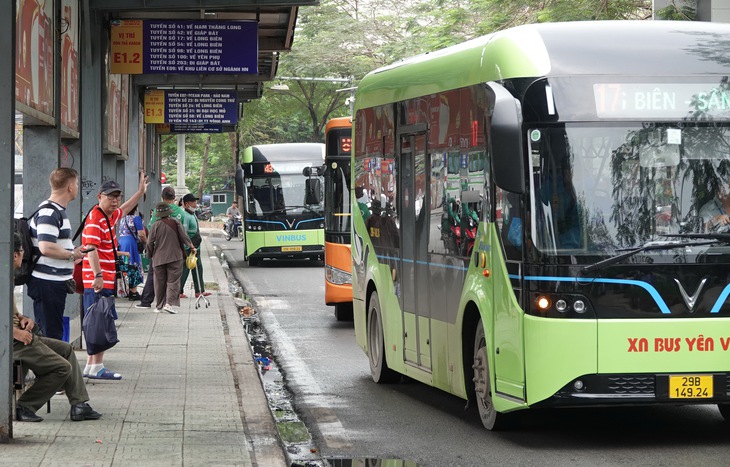
People board electric buses at Long Bien station, Hanoi (photo taken on April 19) - Photo: TTD
The philosophy of "fairness - transparency - practicality" should be emphasized.
According to Associate Professor Dr. Mai Tuan Anh - Ho Chi Minh City Water and Environment Association (HAWE), to effectively implement LEZs, cities need to pay attention to 5 pillars, including:
1. Develop transparent criteria for establishing LEZs to help people understand that LEZs are intended to address areas with the highest health risks to residents, not to create privileges for any particular group. Therefore, instead of selecting areas based on subjective feelings like the administrative center, the city needs a publicly available Scoring Matrix based on health indicators, such as areas with the highest rates of respiratory diseases and high child/elderly population density, and areas with PM2.5 concentrations exceeding limits at "hot spots"... and only implement LEZs when the density of electric buses, metros, and charging stations meets standards.
2. The scale of the LEZ (Levelized Access Zone) should be implemented gradually, following a "ripple effect," to avoid shocking the economic system and allowing people time to prepare financially when they need to switch modes of transportation. A static LEZ should not be applied; instead, it should be tiered to allow residents and visitors to adapt. Multiple levels could be considered.
3. The conflict of "urban flow" must be resolved to avoid disrupting the lives of commuters traveling through the city center. Technical solutions are needed, such as building large-scale parking lots in the LEZ ring road, directly connecting them to free or low-cost public transport to the city center. Simultaneously, mechanisms should be in place for local residents, such as special tax incentives, charging fee reductions, and a longer transition period for those living within LEZ zones...
4. LEZ must go hand in hand with "population decentralization" and "overall sustainable development," emphasizing that LEZ should not be a standalone solution but must be part of a comprehensive plan. Synchronized control, alongside restricting gasoline-powered motorcycles in the city center, must be implemented, along with strict 24/7 online monitoring of factories in suburban areas to ensure fairness.
5. Utilize digital tools to build consensus. This includes enabling citizens to check the air quality in their homes compared to the LEZ; transparently disclosing the revenue collected from "emission fees" and demonstrating that the money is reinvested in electric buses and green spaces.
"To move towards a LEZ model that is not a 'forbidden zone,' but a 'model zone,' managed not only by orders but also by persuasion through data and social welfare policies," Mr. Tuan Anh expressed.
Ho Chi Minh City will implement this after Hanoi by a certain period of time.
In Ho Chi Minh City, the LEZ construction project is also being finalized for submission to the Ho Chi Minh City People's Council for approval. "Ho Chi Minh City may start after Hanoi for a while," said Mr. Bui Hoa An, Deputy Director of the Ho Chi Minh City Department of Construction.
Mr. Cao Tung Son, Deputy Head of the Ho Chi Minh City Environmental Protection Agency, stated that pollution originates from three main sources: traffic, which accounts for over 60%; and production activities from industrial facilities and factories, as well as daily life activities.
The Ho Chi Minh City Department of Agriculture and Environment has advised the city's leaders to issue an action plan with specific tasks, such as establishing LEZs (Leaked Zones) in the transportation sector, conducting pilot programs, and evaluating their implementation over time.
Accordingly, by 2030, all public transport and services must switch to 100% electric vehicles, gradually reducing the number of private vehicles that do not meet emission standards. The city will implement this in Can Gio district and Con Dao special economic zone, expected to be completed by 2027. Research will also be conducted on the application of clean fuels by promoting the transition to using E10 gasoline.
Source: https://tuoitre.vn/ha-noi-chuan-bi-gi-de-cam-xe-may-xang-20260426085009261.htm





























































































Comment (0)