Amidst wind and sand, between mountains and sky, Mongolia emerges as a rare haven of tranquility in the modern world – a place where every movement slows down to make way for emotion. There, people don't walk to conquer nature, but learn to listen to the silent breath of the earth and sky. In April, when winter still lingers on the Altai slopes and summer is still far in the distance, my journey takes me away from the familiar image of endless steppes, touching the two silent extremes that define this nomadic land: the vast Gobi Desert, swept by layers of wind, and the majestic Altai Mountains, closing the western horizon. Within this space, each frame reveals a Mongolia that lives slowly, lives deeply – enduring through time, silently imprinted in the emotions of the person behind the lens.

Golden Eagle Hunting Festival
When space becomes memory
The Gobi Desert doesn't present itself with ferocity, but gently, like a long breath of the earth. The sand dunes stretch endlessly, soft and silent, reminiscent of caravans on the Silk Road amidst seas of sand and rock. Light glides softly across the desert's surface, tracing delicate curves – where golden hues fade into the pale blue sky. Wind rises over the Khongor dunes, carrying the deep, resonant sound of "song sands" passed down through generations of nomads. Its shape is indistinct, its direction undefined; sometimes calm, sometimes soaring, sometimes whispering softly, yet enough to reveal that the desert is never a void. It preserves memories in its own unique way, silently and earnestly.
Not far from those sand dunes, Tsagaan Suvarga emerges like a slice of time amidst the dry, cold light. Layers of white, orange, and red rocks are stacked upon one another, gently telling a geological story spanning millions of years.

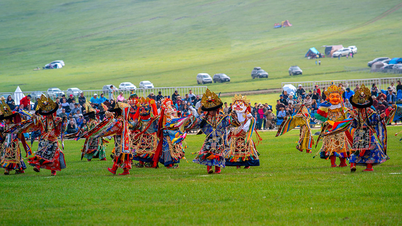
Traditional nomadic clothing
In the vast expanse of Mongolia, people appear ever so subtly. A caravan of camels slowly crosses the sand dunes in the late afternoon. The shadows of the nomads stretch across the sunset before fading into the earth's hues. There is no urging, no hurry. Life here is measured by the seasons and the direction of the sun, not by time. White Ger tents (also called Yurt tents) are scattered across the desert and steppe. Inside, fires burn steadily, illuminating the faces of people accustomed to a life of constant movement.
As night falls, the sky reveals a different depth. The Milky Way stretches across the silent expanse. In that moment, the boundaries between past and present blur, leaving only humanity standing between heaven and earth, as small as a dot in the vast, boundless space.
Where memories take flight
Leaving the Gobi Desert, I embarked on a journey northwest, where the Altai Mountains rise like an ancient stone wall of Central Asia. The landscape changed. Sand gave way to rock. The horizon became rugged. A cold wind carried the lingering scent of snow on the high peaks. Altai has long been considered the birthplace and repository of many layers of nomadic culture.

The wild Gobi Desert
In Bayan-Ölgii, the Kazakh community still preserves the tradition of eagle hunting – a bond passed down through generations. Eagles are trained from a young age, growing up alongside the hunters, sharing the winter, the snow, and the harshness of the plateau. The moment the bird spreads its wings in the arms of its handler doesn't convey a sense of dominance. It's a moment of quiet trust, a bond that endures through the years. I kept taking pictures, then suddenly fell silent. I realized: in the nomadic world, love always goes hand in hand with freedom.
As horsemen galloped across the Altai plains and eagles soared in the cold wind, I felt as if I were touching the vibrant pulse of history – where culture is not confined to museums, but continues to breathe amidst everyday life.

A peaceful afternoon in Altai
The quiet moment at the end of the journey
The Gobi and Altai – one soft as sand, the other hard as rock – seem opposite, yet they nurture a nomadic spirit that has endured for thousands of years. In Mongolia, people don't try to conquer nature. They learn to understand the sky, listen to the wind, and leave when the land needs rest. Life unfolds in rhythm with the grass growing, with the seasons' water levels, with the subtle signs that only those who have lived long enough with the land can recognize. Amidst an increasingly noisy and fast-paced world, this land maintains a different rhythm – slow, calm, and profound. Leaving that land, the photographs remain, but the feeling of stillness stays with us. It permeates daily life like a very gentle breath. This nomadic land reminds me that the greatest luxury is not traveling further, but being able to pause and understand where we are and what we need amidst the vast expanse of time.
Source: https://heritagevietnamairlines.com/hai-sac-thai-cua-xu-so-du-muc/





























































































Comment (0)