

- General Secretary and President : Village elders and community leaders contribute to strengthening national unity.
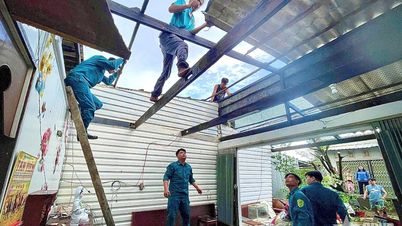
- Phuoc Long begins construction of 4 solidarity houses to celebrate the Congress of the Vietnam Fatherland Front.
- Promoting solidarity and innovating people-to-people diplomacy.
For 80 years, ethnic and religious affairs have been closely linked to the nation's destiny, from strengthening faith during the resistance war to improving living standards, education , and culture in peacetime, thereby maintaining public support and strengthening national unity. Through various stages, ethnic affairs have expanded in depth and strategic scope, evolving from mere support to a pillar of sustainable development, cultural preservation, and the promotion of national strengths. As Mr. Trieu Quang Loi, former Head of the Provincial Ethnic Affairs Committee, concluded, every step of the sector's development is linked to improving the material and spiritual lives of ethnic minorities. Policies on infrastructure, social security, employment, education, and healthcare not only address immediate needs but also gradually narrow the gap, creating a foundation for the shared development of all ethnic groups.
When policies are implemented effectively, people's loyalty to the government becomes even stronger.
In Ca Mau, that spirit has been concretized through practical action programs. Over the past 15 years, more than 3,200 billion VND has been invested in ethnic minority areas, focusing on transportation, education, healthcare, livelihoods, and cultural preservation.
Over 500 km of rural roads have been newly built or upgraded; schools and health stations have received comprehensive investment; thousands of households have stable housing; over 90% of people in disadvantaged areas have access to health insurance; and many workers have received vocational training, creating long-term livelihoods.
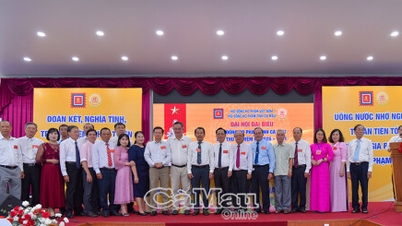
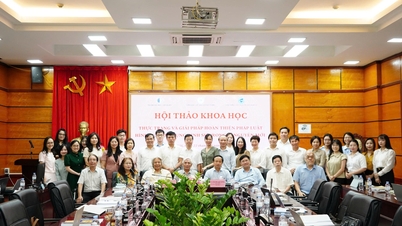
 Central and provincial leaders, former leaders of the ethnic affairs sector from various periods, and delegates pose for a commemorative photo at the ceremony celebrating the 80th anniversary of the Traditional Day of the Ethnic Affairs Sector. Photo: CAM NHI.
But the greatest value lies not in the numbers, but in the fact that the roads are no longer muddy during the rainy season, children in ethnic minority areas can go to school easily and safely; people can access timely medical services; sturdy roofs replace makeshift ones; and people are starting to think about long-term business instead of just relying on seasonal harvests.
Ms. Huu Thuy Dung, from Cai Bat hamlet, Luong The Tran commune, shared: "In the past, life was very difficult, transportation was difficult, and our children lacked education; but today, with improved roads and stable housing, the burden of life has been greatly lightened."
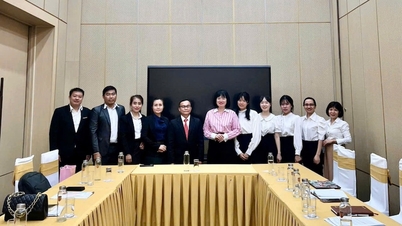
 Ms. Nguyen Thu Tu, Director of the Department of Ethnic Minorities and Religions of Ca Mau province, discussed with Mr. Trieu Quang Loi, former Head of the Ethnic Affairs Committee of Ca Mau province, the orientation of ethnic affairs work in the new period.
These tangible changes have become the clearest measure of policy effectiveness. As living standards improve, trust is strengthened, and social consensus is consolidated from its roots.
Venerable Thach Ha, Head of the Executive Board of the Vietnam Buddhist Association in Ca Mau province and Permanent Vice Chairman of the Patriotic Monks' Solidarity Association of Ca Mau province, stated: "The current ethnic and religious policy not only supports the development of people's lives but also creates conditions for religious organizations to work alongside localities in building the homeland, maintaining unity, and connecting the Party's will with the people's hearts."
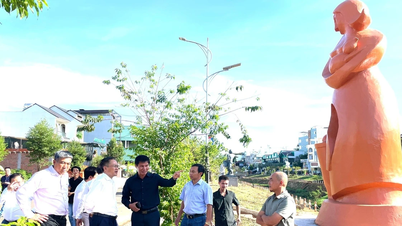
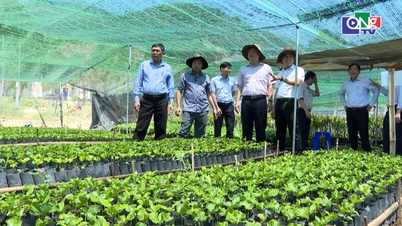
 Local leaders and respected figures among the ethnic minority communities of Hoa Binh commune visited the livelihood support model of melon farming implemented by Ms. Danh Thi Ha's household in Thi Tran A1 hamlet.
Preserving cultural heritage creates a foundation for long-term development.
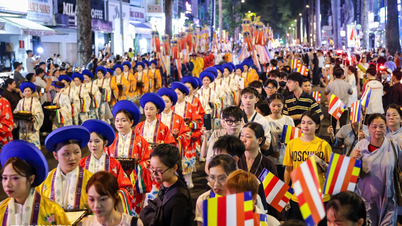
Along with economic development, cultural preservation has been emphasized. Traditional festivals of the Khmer and Chinese communities; Dù kê art, five-tone music, lion and dragon dances; and the continued teaching of Khmer and Chinese languages... continue to be preserved, contributing to the preservation of cultural identity and passing it on to the younger generation. Education has also seen positive changes, with the school attendance rate in ethnic minority areas reaching over 96%.
Education continues to play a crucial role. Mr. Du Quoc Kiet, Principal of Bac Lieu Ethnic Boarding School, affirmed: "Investing in education in ethnic minority areas is investing in local human resources, for a sustainable future."
 The ritual of drawing lots and offering prayers to the Goddess at Thien Hau Temple is a distinctive spiritual belief of the Chinese community in Ca Mau.
Currently, the school attendance rate in ethnic minority areas is over 96%, indicating positive changes in both awareness and access to education.
In addition, nearly 200 influential community members continue to play an important bridging role between the Party, the government, and the people.
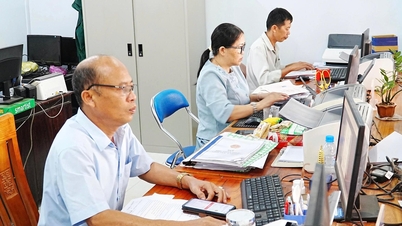
 The staff and civil servants of the Department of Ethnic Minorities and Religions of Ca Mau province are always united and strive to successfully complete their assigned tasks.
Mr. Ly Khon, former Deputy Director of the Local Affairs Department III, Committee for Ethnic Minorities: “For policies to truly be implemented, the core principle is to promote the role of ethnic minorities as the main actors, selecting the right people with prestige and the ability to lead and mobilize the community to implement policies and maintain security and order at the grassroots level.”
A new turning point in the era of development.
The period 2021-2030 marks a significant transformation in ethnic affairs work: from support to sustainable livelihood development, from scattered efforts to focused efforts, and from administrative management to effective governance linked to digital transformation. The establishment of the Ministry of Ethnic Minorities and Religions (March 1, 2025) and the streamlining of its organization in Ca Mau demonstrate the determination to streamline and improve the effectiveness and efficiency of the apparatus.
The biggest goal in this new phase is to enhance policy implementation capacity from the provincial to the grassroots level, ensuring that officials thoroughly understand the policies, are close to the people, conduct regular inspections, and provide timely support to maximize the resources allocated to ethnic minority areas.
Eighty years is a long enough period to affirm a consistent truth: National unity has always been the source of national strength. From the first decrees of the revolutionary state to today's national target programs, ethnic and religious affairs have played a vital role, connecting the Party's will with the people's aspirations, consolidating political and social stability, and creating a sustainable foundation for national development.
 Students at Bac Lieu Ethnic Boarding High School enjoy playing during recess, a testament to the attention and investment in education for ethnic minority communities.
Entering a new era, with increasingly high demands for rapid, sustainable, and comprehensive development, the Resolution of the 14th National Congress of the Party and Resolution 80 continue to identify the comprehensive development of ethnic minority areas, including cultural preservation, maintaining identity, and improving the quality of human resources, as a long-term strategic task. This shows that the 80-year journey of ethnic affairs is not only a historical milestone but is also continuing to become a driving force for future development. Because more than any other resource, when the people's hearts are held firm, identity is preserved, and national unity continues to be nurtured, it will always be the most solid foundation for the country to move forward.
Hong Nhi - Phong Nguyen
Source: https://baocamau.vn/hanh-trinh-80-nam-giu-mach-doan-ket-a128441.html




















































































Comment (0)