

Lesson 1: Decoding the Dark Side of International Publication
The lack of control mechanisms and the pursuit of quantitative criteria are pushing internationally published scientific papers to a "surreal" level, beyond the control of even the regulatory bodies.
Pressure from reality
Scientific publications are now a key metric among many standards for university lecturers. The Ministry of Education and Training has established rigorous professional standards, making international publications a necessary condition for every stage of a lecturer's career.
Firstly, the criteria for awarding the titles of Professor and Associate Professor require a mandatory number of reputable international publications; Associate Professor candidates need at least 3 publications, and Professor candidates need 5 publications listed in the WoS/Scopus database. Secondly, the requirement for supervising doctoral students stipulates that the supervisor must have international publications to meet the standard. Furthermore, in university quality accreditation, the number of international publications per faculty member is a key indicator for ranking and granting autonomy to universities.
On the other hand, according to the draft Regulations on training programs at various levels of higher education currently under review, the Ministry of Education and Training requires that the average number of scientific articles published per full-time lecturer per year in the WoS or Scopus databases must be at least one. Within a minimum of three years prior to the implementation of the training program, the average number of scientific articles published per year by a leading lecturer in the WoS or Scopus databases must be at least one.
In the recently issued circular stipulating professional standards for university lecturers, the Ministry of Education and Training requires senior lecturers to have at least 3 scientific articles published in internationally recognized ISSN journals; for senior lecturers, this number is 6 scientific articles.
This pressure creates a "publish or be eliminated" mentality among faculty members and universities. Many faculty members are burdened with excessive teaching hours and lack in-depth research skills, making "buying a name" in international research groups a shortcut to meeting professional standards.
A university lecturer revealed he is in a difficult situation. His university has a generous reward policy for scientific papers published in top international journals, with a maximum of 500 million VND per person per year. The lecturer stated that, due to his age, he can only co-author about one paper per year, receiving around 20-30 million VND in rewards. However, the problem arose when some other lecturers at the university published very high amounts, around 10-15 papers per year. With the maximum reward of 250 million VND per paper, these individuals quickly reached the 500 million VND ceiling set by the university.
To avoid losing the excess funding, some lecturers suggested that the aforementioned lecturer be credited as a co-author in their publications. Formally, this lecturer would have an additional place in the scientific publication catalog, while the other colleagues would have an additional "slot" for receiving the award. The entire amount of the award money credited to the co-authors would then be transferred back to the actual authors.
According to calculations, if an individual is limited to 500 million VND, but by having many others act as nominees, the total amount of bonuses this group could collect could reach billions of VND annually. Faced with this proposal, the lecturer felt extremely conflicted. On one hand, they worried that refusing would alienate colleagues. On the other hand, accepting would leave them uneasy about professional ethics and long-term security.
To improve their rankings on international rankings such as QS or THE, many universities have adopted a policy of directly rewarding publications with cash bonuses. These figures have inadvertently turned scientific papers into a highly profitable commodity. The University of Economics Ho Chi Minh City once offered bonuses of up to 200 million VND per paper for top-ranked ISI/Scopus journals (in 2017); the highest bonus for 2025 is projected to be 110 million VND per paper.
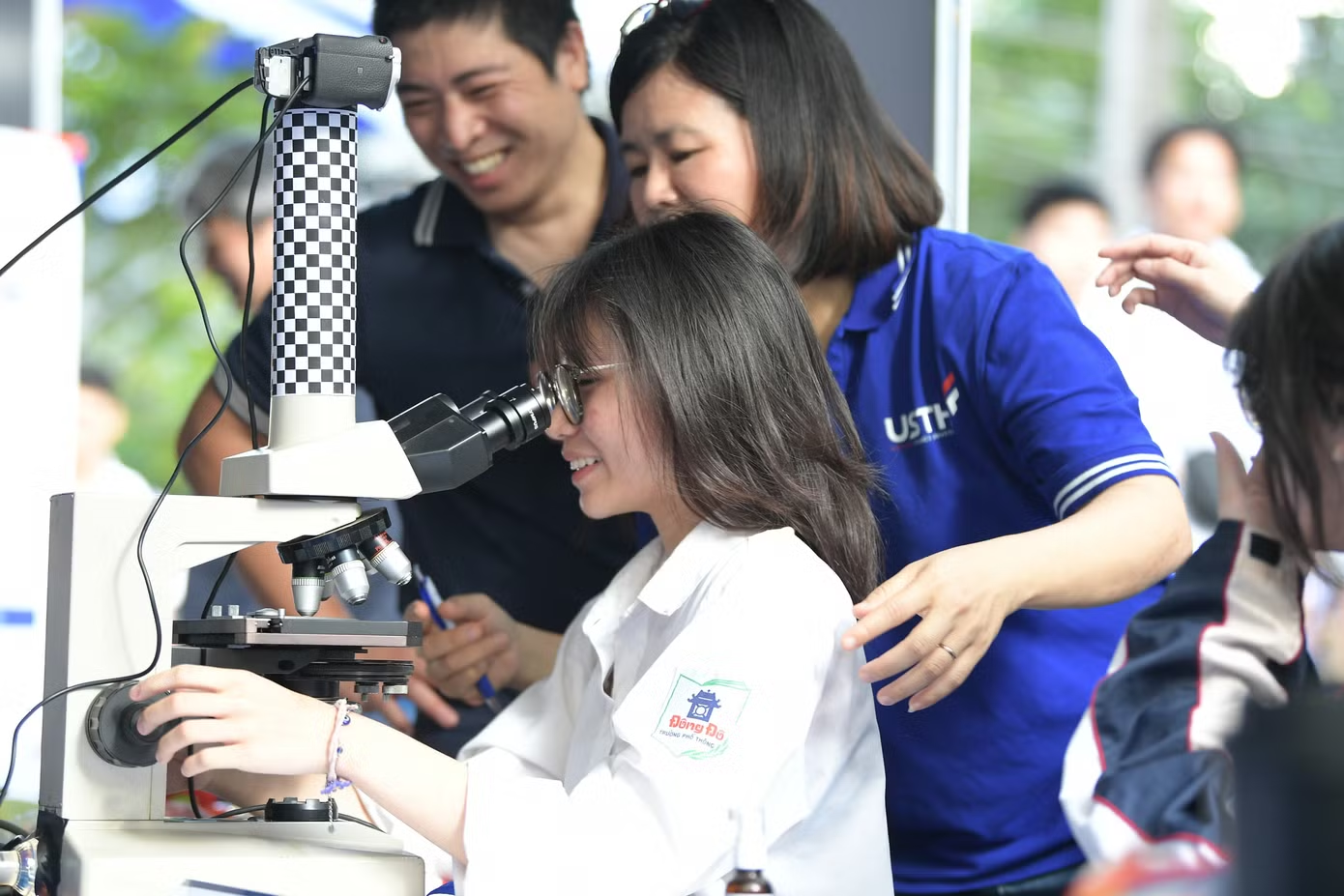
In 2023, Ton Duc Thang University offered a reward of up to 360 million VND for an outstanding international research paper. Hanoi National University had a policy of rewarding up to 150 million VND per paper in the top 1%.
The spark that ignites fraud.
With large bonuses (20-100 million VND) and lax control mechanisms, especially without a common regulation on scientific integrity throughout the education system, it is difficult to control quality and prevent fraudulent practices.
International organizations are offering Vietnamese lecturers the opportunity to co-author pre-written papers at publicly advertised prices. Lecturers can pay out of pocket to "buy" an authorship position, then use the paper to receive awards from the university and pocket a significant profit margin.
In reality, there is also the practice of "selling research papers": lecturers at university A falsely claim to be from university B (where the rewards are higher) to profit. The synergy between pressure for advancement and economic gain has led to harmful distortions, such as a decline in the quality of education. Instead of focusing on researching and solving practical problems facing the country, many lecturers spend their time "hunting for papers" or finding ways to circumvent regulations to meet their quotas.
Large rewards are a necessary incentive to promote science, but without mechanisms for verifying the author's actual contribution, they can fuel fraud. To prevent the buying and selling of research papers, the education sector needs to shift its evaluation mindset: from "counting the number of papers" to assessing the "quality and value of the contribution" of the work, while tightening the academic integrity assessment process at each educational institution.
Break free from the mindset of "counting" articles per year.
Recently, Minister of Education and Training Hoang Minh Son worked with higher education institutions under the Ministry on the implementation of Resolution 57-NQ/TW of the Politburo on breakthroughs in the development of science, technology, innovation, and national digital transformation (Resolution 57). The Minister emphasized that the scientific output of universities must aim to solve "major problems of localities and the whole country," and cannot simply stop at counting the number of publications or comparing the annual growth in publication volume. Science and technology must contribute directly to the economy through research products that can be transferred and applied in practice; and through scientific projects and tasks that address urgent national issues.
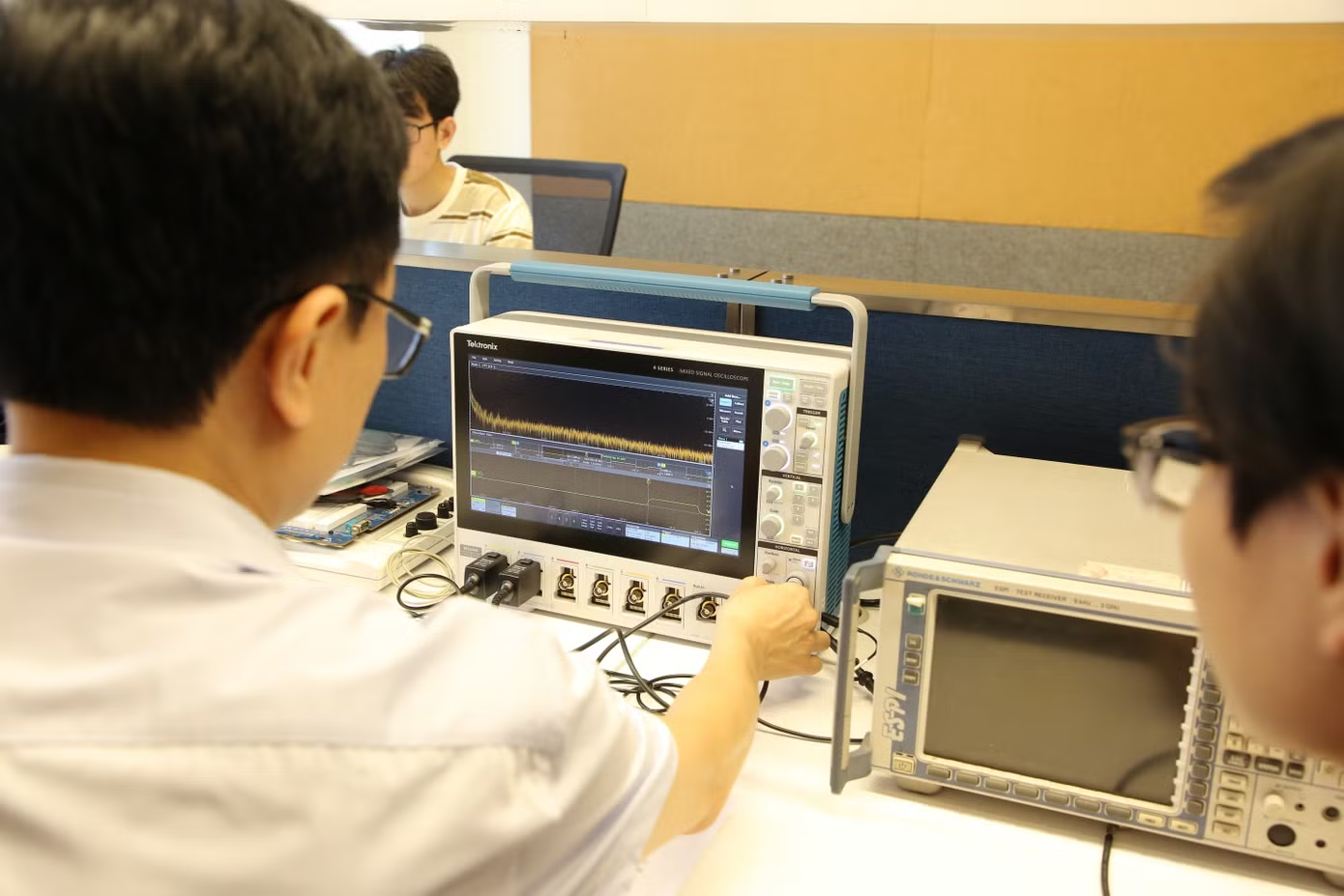
Associate Professor Dr. Do Van Dung, former Rector of Ho Chi Minh City University of Technology, believes this is a clear and strong message about a new approach to scientific research aimed at building a healthier and more substantive research ecosystem in Vietnam. According to Dr. Dung, research activities need to contribute directly to the economy and society through concrete results. Research products must be transferable and applicable in practice; scientific projects and tasks must contribute to solving urgent national problems. At the same time, science must play a role in training high-quality human resources, a key force driving socio-economic development. These contributions need to be demonstrated by concrete results, not just numbers on paper.
A recent investigation has revealed a worrying underground market worldwide, where for as little as $1,000, anyone can buy first authorship in an upcoming scientific paper. These positions are openly offered by "paper mills," organizations that produce fake or low-quality manuscripts for profit. The study analyzed nearly 52,000 timestamped price quotes from almost 19,000 advertisements, involving more than 5,500 products, but this is only a small fraction of the true scale of the operation.
This approach can be seen as a groundbreaking and practical step forward, as it addresses an issue that has been debated globally by scientists for many years: the "publish or perish" pressure. Mr. Dung argues that this pressure has resulted in too many low-quality papers, even leading to a situation of "scientific garbage."
Minister Hoang Minh Son's viewpoint doesn't deny the value of international publications, but rather highlights the next steps. In fact, many universities and research foundations worldwide are shifting towards evaluating the practical impact of research, such as the number of patents, research-derived businesses (startups), the ability to solve social problems, or the commercialization of products.
Source: https://tienphong.vn/he-luy-dem-bai-bao-khoa-hoc-post1841509.tpo






















































![[Photo] Hue: Admire the 2.4 trillion VND sea bridge, the longest in Central Vietnam.](https://vphoto.vietnam.vn/thumb/402x226/vietnam/resource/IMAGE/2026/05/24/1779614018347_anh-man-hinh-2026-05-24-luc-16-13-29.png)

























Comment (0)