


Fertilizing by agricultural drone at Kien Thanh Agricultural and Service Cooperative in Vi Thanh 1 commune, Can Tho city.
Many benefits
Proper fertilization not only helps rice farmers improve efficiency but also saves fertilizer, reduces costs, and lowers greenhouse gas emissions. However, many farmers are not familiar with the process, techniques, and solutions, leading to high production costs and reduced profits. Therefore, farmers are very enthusiastic about the support and implementation of proper fertilization practices by the city's Department of Agriculture and Environment and other units and businesses.
Mr. Huynh Van Dung, Chairman of the Board of Directors of Kien Thanh Agricultural and Service Cooperative in Vi Thanh 1 commune, said: “The cooperative has more than 270 members and households involved in production, with a total rice cultivation area of over 300 hectares. This summer-autumn rice crop, the cooperative received support from the Department of Agriculture and Environment of Can Tho City, along with IRRI and other relevant units and businesses, to implement a model of proper fertilization practices according to the Project on 1 million hectares of high-quality and low-emission rice associated with green growth in the Mekong Delta by 2030 (the Project). Although the implemented area is only 4 hectares, through the model, farmers have received training, access to useful information and knowledge, as well as new equipment, technologies, and digital tools such as the application of proper fertilization (RCM). This is a favorable foundation for the cooperative to expand the implementation area in future rice crops.”
Mr. Phan Van Moi, a member of the Kien Thanh Agricultural and Service Cooperative, happily stated: “Fertilizer prices are rising, while rice prices are low. Farmers urgently need guidance on how to use fertilizers economically and efficiently. The model of proper fertilizer application implemented at the cooperative is an important practical basis that helps farmers confidently apply solutions to reduce fertilizer costs and other input materials...”

Fertilizing by agricultural drone at Kien Thanh Agricultural and Service Cooperative in Vi Thanh 1 commune, Can Tho city.
Providing support and guidance to farmers in cooperatives.
Can Tho City is implementing the project in 64 communes and wards, with an expected area of over 170,800 hectares by 2030, involving 171 cooperatives and cooperative groups. Of this, the area already implemented by the end of 2025 reached 104,500 hectares, and is projected to reach 76,000 hectares in 2026. The implementation of pilot rice production models under the project in Can Tho City has shown very clear effectiveness, helping farmers increase profits by 1.3-6.5 million VND/ha and reducing greenhouse gas emissions by 6-12 tons CO2/ha.
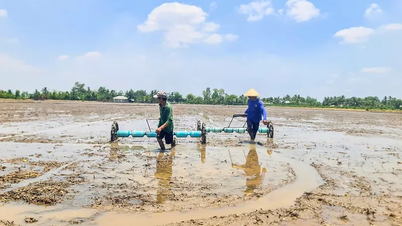
To improve fertilizer efficiency, the Department of Agriculture and Environment of Can Tho City is focusing on disseminating information and supporting farmers in cooperatives and cooperative groups participating in the Project. Rice-growing cooperatives and cooperative groups are developing and replicating models of proper fertilizer application and applying standardized technical procedures. In the 2025-2026 winter-spring and 2026 summer-autumn rice seasons, many cooperatives will receive support to implement models of proper fertilizer application, such as Kien Thanh Agricultural and Service Cooperative in Vi Thanh 1 commune; Thuan Loi Cooperative in Xa Phien commune… Farmers in these cooperatives are guided on proper fertilizer application, applying the "1 must, 5 reductions" principle linked to specialized regional nutrient management. They will use certified seeds, with seed rates of only 60-80 kg/ha. Water management will follow the alternating wet-dry (AWD) irrigation method, adjusted to local farming conditions. The model will also incorporate digital technology (RCM) for smart fertilizer and irrigation management. At the same time, various mechanized solutions suitable to the production conditions of each locality are being applied, such as applying mechanized row sowing combined with burying fertilizer, applying sowing and fertilizing using agricultural aircraft, etc.
According to Associate Professor Dr. Nguyen Van Hung, a senior expert at IRRI, improving fertilizer efficiency is not limited to the "four correct fertilization techniques"—correct type, correct dosage, correct timing, and correct application method—but also includes other supporting technologies. Specifically, with precision mechanized sowing combined with burying fertilizer, farmers can reduce input costs by 20-30% while maintaining or even increasing rice yields.
According to Ms. Nguyen Thi Giang, Deputy Director of the Department of Agriculture and Environment of Can Tho City, based on the results and evidence of the models, the city's Department of Agriculture and Environment has determined to shift from a mindset of "productivity-driven production" to "efficient, high-quality, and low-emission production." This is an inevitable trend to enhance the value of rice grains and ensure sustainable income for farmers. Therefore, coordination between the city's Department of Agriculture and Environment, IRRI, businesses, cooperatives, and relevant parties to implement models of proper fertilization practices and practical models tailored to farmers' needs is a practical approach. In the future, the Department of Agriculture and Environment will continue to strengthen coordination with international organizations, businesses, and localities to support cooperatives and farmers in expanding the application of advanced farming solutions, promoting digital transformation in agricultural production, and contributing to the successful achievement of the goal of developing a high-quality, low-emission rice industry in the Mekong Delta region.
Text and photos: KHANH TRUNG
Source: https://baocantho.com.vn/ho-tro-nong-dan-su-dung-phan-bon-hieu-qua-a205073.html










































































Comment (0)