

The story of buying and selling has now gone beyond the familiar streets, spreading to online platforms, social networking sites, and even phone transactions take place every minute.
Many years ago, when trading mainly took place in stores and record keeping was simple, lump sum taxation was considered a suitable method.
In that context, the method of calculating taxes based on fixed revenue has revealed shortcomings and businesses also clearly feel this.
Ms. Nguyen Thi Chi, a restaurant owner in Thuy Nguyen ( Hai Phong ), recalls the first days of learning to issue electronic invoices: “At first, I was very nervous, afraid that if I pressed the wrong button, I would be fined. But when the tax officer came to my place and showed me step by step, I found that everything was not difficult. Now, checking daily revenue by phone is very convenient.”
Stories like Ms. Chi’s are becoming more common as the campaign to convert from lump-sum tax to declaration tax is deployed nationwide. More than 18,500 lump-sum tax households have proactively converted and thousands of declaration households have boldly become enterprises, something previously considered unimaginable.
In Hanoi , which has the largest number of business households in the country, training sessions are held continuously from many locations. At a support session in Cau Giay district, Mr. Truong Van Trung, owner of a car dealership, said: “I am not familiar with technology but still send my employees to training because I know that sooner or later I will have to do it. Electronic invoices and sales software help me see profits and losses more clearly, this is the first benefit for me.”
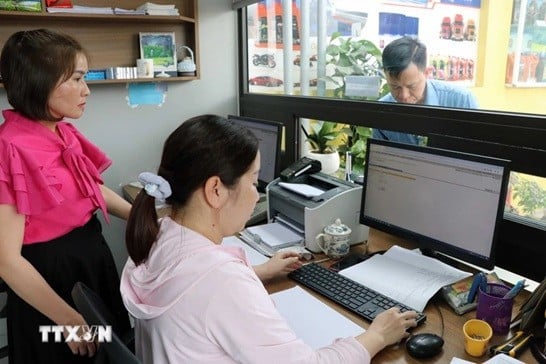
Electronic invoice issuance activities at the store. (Photo: Hoang Ngoc/VNA)
Elderly households, who rarely use digital devices, are also enthusiastically supported. “At every step, there is someone standing by to guide me, I try and do it again. They not only teach me theory but also install the software for me,” shared a grocery store owner on Kham Thien Street.
Hai Phong chose to “stick to the market, stick to the street”. Each tax officer is in charge of each group of households, going to each store to guide from installing the eTax Mobile application to opening an electronic invoice account.
Many households were initially afraid that "declaring would result in higher taxes", but after a clear explanation, they gradually felt more secure.
Ms. Nguyen Thi Sen, a food service business owner in Thuong Ly ward, shared that when she first heard about the change from contract to declaration, she was very worried because her technological skills were limited, and she was afraid that if she made a mistake, she would be fined or incur higher tax obligations.
However, after training sessions and receiving support from tax officers and technical staff at the store to install the software, provide instructions on creating electronic invoices and declarations, I gradually understood the process, performed the operations more proficiently and felt secure when all the content was explained specifically and easily understood.
Meanwhile, in Nghe An , the campaign was shortened to “30 days and nights” but implemented with no less determination. Working groups went to each commune and market to guide the installation of software, synchronize data and create electronic invoices from cash registers.
On the provincial tax department's social network, short instructional videos are posted continuously for businesses to review when needed.
A mini supermarket owner in Do Luong said: “Previously, handwritten notes took a long time and were prone to mistakes. Now, all import and export of goods are done on software, and you can see at a glance how much stock is left and what the profit or loss is.”
Many households in Yen Thanh district even jokingly said that since getting used to the sales software, they… don't have to remember the price of each item, because everything is recorded by the computer.
However, the conversion is still not without difficulties, especially for households used to traditional business methods.
In Hai Phong, Mr. Nguyen Huu Tho, Deputy Head of Tax Department 1, said that many households are still afraid of change because they are "afraid of trouble, afraid of complications, afraid of costs." But when tax officers accompany them step by step, from installation to operation, these concerns are gradually removed.
In many localities, ward and commune authorities also participated in the campaign, clearly explaining the benefits of revenue transparency, especially as January 1, 2026, the important milestone when the lump-sum tax model will be officially eliminated, approaches.
According to the Tax Department, during the implementation process, the whole country currently has nearly 2 million business households paying lump-sum tax. Each year, this group contributes about 26,000 billion VND in tax, with an average of 672,000-700,000 VND/month.
As the level of transactions becomes more and more complex, management based on the contract mechanism is no longer as effective as before and easily creates inequality among households.
Deputy Director of the Tax Department (Ministry of Finance) Mai Son emphasized that the tax sector has carefully prepared the necessary conditions for business households to convert without interrupting production and business activities.
At the same time, many technology solution providers join in and provide free initial support to reduce compliance costs for taxpayers.
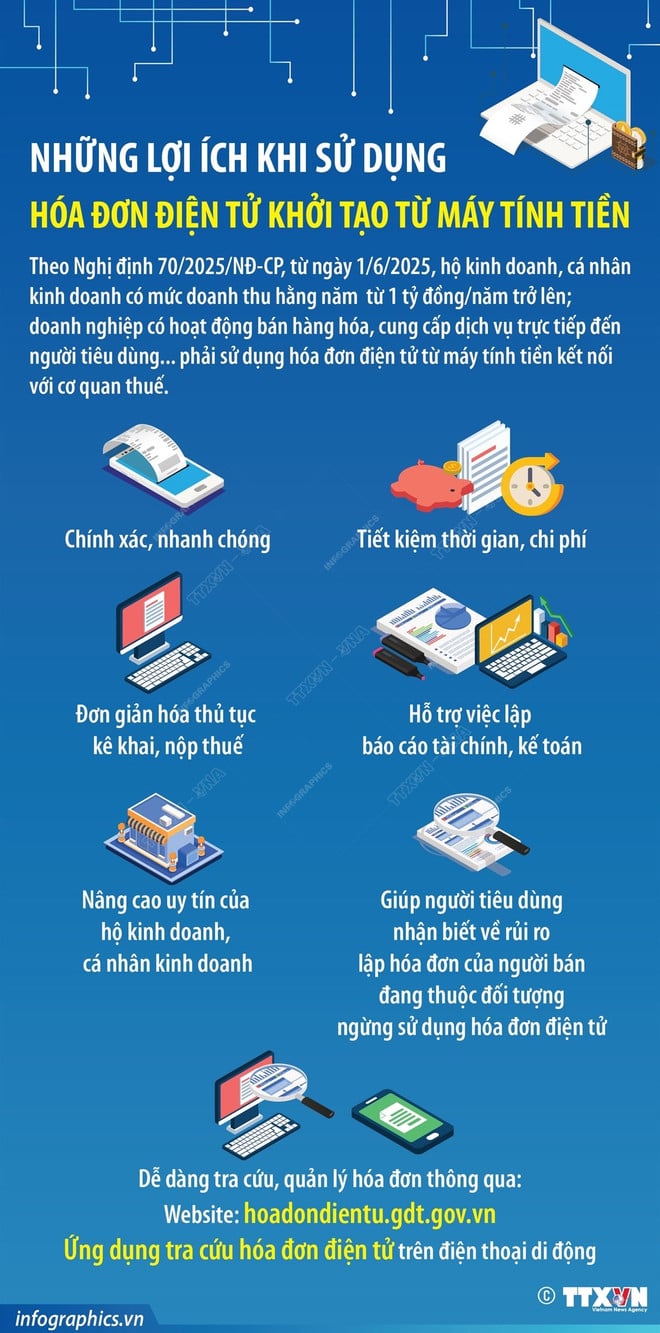
Initial results show a positive shift as more than 18,500 households have proactively switched to declaration and more than 2,500 households have declared and transferred to enterprises even though they are not required to.
Through the implementation process in many regions, it is easy to see that the change does not only come from the tax authorities but also from the business households who seem to be the most hesitant, but are showing a proactive spirit in approaching the new when they see practical benefits such as clearer money management, more accurate inventory control, reduced risk of disputes and transparency in business operations.
For management agencies, when all business households switch to declaration, data will become unified and transparent, helping to reduce revenue loss and increase monitoring efficiency.
This is also an important step in the process of modernizing the tax sector and building a fair business environment for the private economic sector, in line with the spirit of Resolution 68/NQ-TW on private economic development and Resolution 198/2025/QH15 on a number of special mechanisms and policies for private economic development.
This transformation is not simply a change in tax collection method, it is a change in the thinking of the whole system. When each business household understands correctly, can do it and sees the benefits for themselves, the path from lump-sum tax to declaration will no longer be an obstacle, but will become a new journey that is more transparent, proactive and sustainable./.
(TTXVN/Vietnam+)
Source: https://www.vietnamplus.vn/hoa-don-dien-tu-va-phan-mem-ban-hang-hanh-trinh-moi-cua-ho-kinh-doanh-post1080449.vnp


![[Photo] Worshiping the Tuyet Son statue - a nearly 400-year-old treasure at Keo Pagoda](/_next/image?url=https%3A%2F%2Fvphoto.vietnam.vn%2Fthumb%2F1200x675%2Fvietnam%2Fresource%2FIMAGE%2F2025%2F12%2F02%2F1764679323086_ndo_br_tempimageomw0hi-4884-jpg.webp&w=3840&q=75)


![[Photo] Parade to celebrate the 50th anniversary of Laos' National Day](/_next/image?url=https%3A%2F%2Fvphoto.vietnam.vn%2Fthumb%2F1200x675%2Fvietnam%2Fresource%2FIMAGE%2F2025%2F12%2F02%2F1764691918289_ndo_br_0-jpg.webp&w=3840&q=75)













































































Comment (0)