

On the afternoon of December 9, the National Assembly discussed in the hall the draft Law amending and supplementing a number of articles of the Law on Value Added Tax.
Participating in giving comments, delegate Tran Huu Hau ( Tay Ninh delegation) agreed to remove point c, clause 9, Article 15 on tax refund conditions. Specifically, the Draft Law omits the provision on tax refund conditions: Buyers are only entitled to tax refunds when the seller has declared and paid tax at point c, clause 9, Article 15, Law on Value Added Tax 2024.
According to Mr. Hau, this has freed businesses from a responsibility that is often impossible and risky: "Having to check the tax compliance status of their sellers, reminding them to declare and pay taxes so that they can get a tax refund. Even though their records, documents and payments are complete, clear and in accordance with regulations."
According to delegate Hau, the current regulations are "unreasonable and in reality cause difficulties and risks for businesses" because the seller and buyer are two entities that agree to buy and sell.
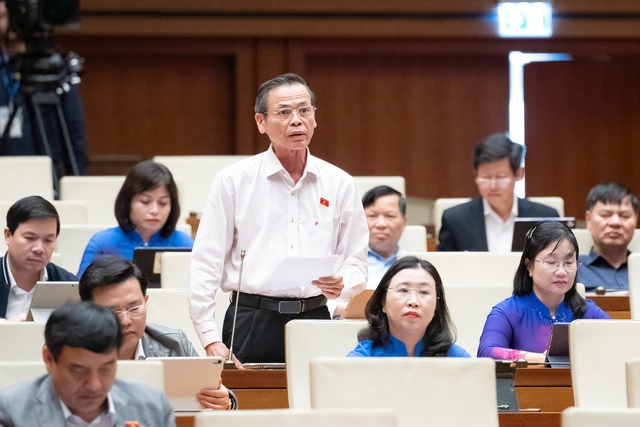
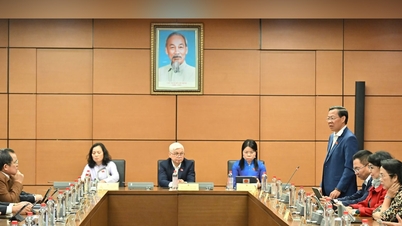
Delegate Tran Huu Hau (Tay Ninh delegation)
"Buyers have no right or responsibility to interfere in the business activities of sellers. In fact, buyers do not have the tools to check and request sellers to fulfill their tax obligations. Therefore, they cannot be responsible for the compliance of others and can only receive their money when the seller declares and pays taxes. Because the responsibility for tax collection belongs to the tax authority," said delegate Tran Huu Hau.
Also giving comments related to tax refund conditions, delegate Tran Anh Tuan ( Ho Chi Minh City delegation) said that abolishing point c, clause 9, Article 15 of the Law on Value Added Tax means not setting tax refund conditions depending on whether the seller has declared and paid tax or not, and this is appropriate.
The reason is that the buyer of the goods has actually borne and paid the value added tax; this tax is included in the purchase price and has been paid into the budget. Whether the seller pays the tax correctly or not is the responsibility of the tax authority and the State management agency, and the burden cannot be shifted to the buyer.
He also said that tax management for sellers is currently limited, so if we continue to maintain the condition of depending on whether the seller has paid tax or not, it will invisibly force the buyer to bear the risk and responsibility instead of the seller, which is inappropriate.
Therefore, delegate Tuan agreed to abolish this regulation so that the tax refund process can be carried out faster.
According to the report of the Ministry of Finance, the problems in tax refunds in recent times have been very large, especially for key export products such as coffee, pepper, and cashew nuts, which account for 90-95% of export output.
"When export enterprises have to depend on whether the seller pays tax or not to get a tax refund, the enterprise's working capital is limited, even occupied, directly affecting production and business activities," said Mr. Tuan.
Therefore, according to delegates, removing this condition is necessary to upgrade the method of tax collection and refund management, while creating conditions for businesses to receive tax refunds faster, promptly meeting production and business needs.
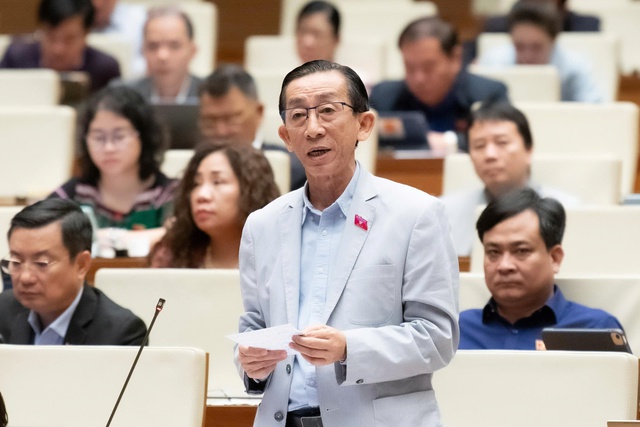
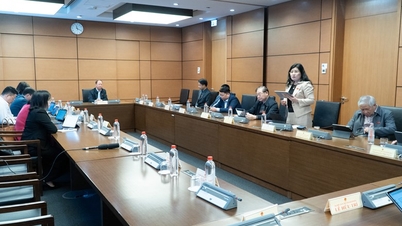
Delegate Tran Hoang Ngan (Ho Chi Minh City delegation)
Sharing the same view, delegate Tran Hoang Ngan (Ho Chi Minh City delegation) stated that value added tax is a tax levied on the added value of goods and services arising in the production, circulation and consumption process. This is an indirect tax and only the final consumer is the one who actually pays this tax, while businesses or cooperatives only pay the difference between output tax and input tax.
Recently, businesses have encountered many difficulties related to the conditions for VAT refunds. Currently, the Law stipulates 3 conditions, of which the 3rd condition requires: The seller must declare and pay VAT on invoices issued to the business requesting the refund.
However, this is a factor that buyers cannot know or control at all. Therefore, businesses are constantly in a state of waiting, wondering, going to the tax office to ask "when will I get a tax refund" and getting stuck in this condition.
Therefore, delegates support the abolition of Point c, Clause 9, Article 15, to remove obstacles and create more favorable conditions for businesses in the tax refund process.
Source: https://vtv.vn/hoan-thue-vat-khong-the-bat-nguoi-mua-chiu-trach-nhiem-thay-nguoi-ban-100251209164310668.htm
![[Photo] Urgently help people soon have a place to live and stabilize their lives](/_next/image?url=https%3A%2F%2Fvphoto.vietnam.vn%2Fthumb%2F1200x675%2Fvietnam%2Fresource%2FIMAGE%2F2025%2F12%2F09%2F1765248230297_c-jpg.webp&w=3840&q=75)


























































![[Photo] General Secretary To Lam works with the Standing Committees of the 14th Party Congress Subcommittees](https://vphoto.vietnam.vn/thumb/402x226/vietnam/resource/IMAGE/2025/12/09/1765265023554_image.jpeg)


























Comment (0)