

Preserving the craft means preserving the soul of the homeland.
According to the elders, the craft of making black incense in Choa village has a history of about 300 years. Mr. Ngo Ba Dong (born in 1949) said: “In the past, almost every family in the village knew how to make incense. Children as young as 4 or 5 years old were taught by their parents and grandparents to roll incense sticks; as they got older, they would split bamboo, whittle bamboo, grind charcoal powder, and knead dough… In the 1980s and 1990s, every December, the whole village would be bustling with activity for Tet (Lunar New Year). In the old days, people in the village didn't make incense year-round, but only during the last two months of the year. Back then, people would carry bundles of incense to markets throughout Ha Bac province (formerly), Thai Nguyen, Hai Phong … to deliver to traders. Kinh Bac Tet incense spread to all regions.”
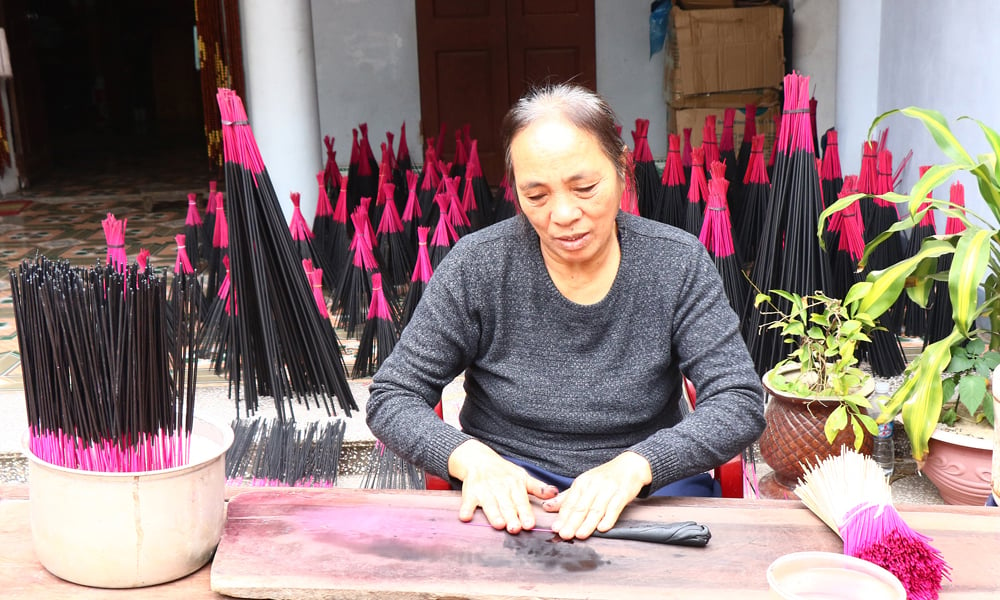 |
Handmade black incense is produced at the home of Mrs. Nguyen Thi Tap. |
However, in recent years, with the influx of cheap industrial incense into the market, the black incense making industry in Choa village has faced considerable difficulties. Many households have abandoned the craft and switched to other jobs, the number of households remaining committed to the profession has decreased, and the scale of incense production has gradually shrunk. Currently, only 30 households in the village are still practicing the craft, and nearly 20 households are involved in the incense business. Although the number is no longer large, the villagers still cherish and preserve the traditional craft. Mr. Nguyen Huu Tu and Mrs. Nguyen Thi Tap, now 65 years old, are still diligently preserving the craft. Mr. Tu shared: “Despite facing many difficulties, my family still strives to maintain the craft. It is not only a means of livelihood but also a way to preserve the culture and soul of our homeland. With each incense stick we make, we express our reverence to our ancestors and deities, and at the same time, we hope to spread the traditional flavor and culture to people inside and outside the province, especially the younger generation.”
Black incense is made entirely from natural ingredients: resin from the Terminalia catappa tree, charcoal, and bamboo, without any harmful chemicals. To produce a beautiful, high-quality incense stick, many elaborate and meticulous steps are required. Having been involved in the black incense making craft for over 70 years, Ms. Duong Thi Hien said: “In the steps to create standard incense sticks, careful and meticulous selection of materials is extremely important. The resin from the Terminalia catappa tree and charcoal used must not be dirty or mixed with impurities. As for the bamboo, it is soaked in a pond for 1 to 3 months, then whittled into sticks and dried in the sun.”
The process of rolling incense sticks requires meticulousness and skill to ensure the incense powder is evenly wrapped around the bamboo stick. The more tightly the incense is rolled, the denser, shinier, and more beautiful the stick becomes, and the better it is preserved and burns longer. A medium-sized incense stick (50 to 80 cm) can burn for 2 to 3 hours. A long incense stick (100 to 120 cm) can burn for 8 to 12 hours, withstands tropical weather, and has a lifespan of 2.5 to 3 years without affecting its quality.
Let the fragrance spread far and wide.
Along with preserving the traditional craft, many families have explored and learned to manufacture various types of incense-making machines, powder mixers, etc., to reduce labor, increase productivity, and still maintain the traditional formula. As a result, incense production has increased, quality is more consistent, and it meets the growing demands of the market. Mr. Dao Si Binh's family was the first in the village to successfully manufacture an automatic powder mixer and incense-making machine, significantly improving labor productivity in 2005. According to Mr. Binh, handmade incense has low productivity and high production costs, while market incense is quite cheap. Without change, the craft would surely disappear. "I taught myself how to create incense-making machines and powder mixers... suitable for the specific production of black incense. Initially, we only improved simple machines, utilizing readily available materials. Gradually, through trial and error, the machines became more and more perfect. As a result, productivity increased nearly tenfold compared to manual incense making, while the quality remained more consistent. Currently, my family produces over 30,000 incense sticks daily in various sizes, from 30 cm to 120 cm," Mr. Binh said.
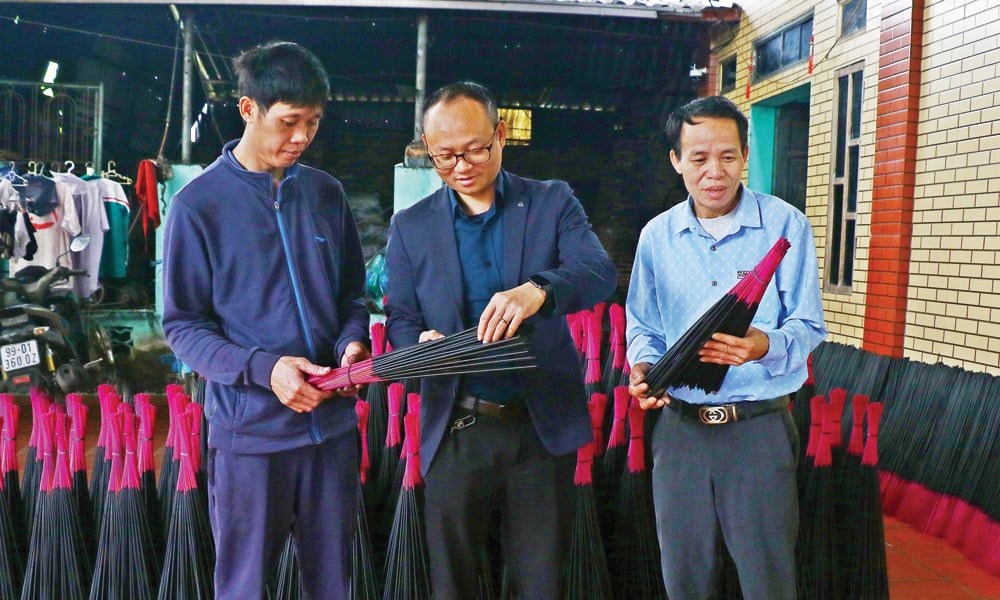 |
Customers visit and select black incense products from Chóa village. |
Besides applying machinery to production to increase labor productivity, many households focus on developing sales channels on social media platforms. Ms. Nguyen Thi Tinh, owner of a black incense production and business, shared that the black incense from her hometown is a natural product that meets consumer safety standards. With that in mind, Ms. Tinh has built online sales fan pages on e-commerce platforms such as Shopee, Lazada, TikTok, and Sendo, promoting the brand of her village's traditional products on social media. In addition, she also focuses on creating attractive designs and packaging to increase the recognition of Choa village's black incense products, ensuring consumers are completely confident in their origin. Ms. Tinh said: “I have been building my online sales channel for nearly ten years now, and it has gained the trust and high praise of customers. Many customers from all over the provinces and cities, especially in the South, also trust and use it. This is because Choa village incense is not only safe and environmentally friendly, but also brings back the scent of traditional incense, evoking the ancient culture of our nation.”
“I stumbled upon Chóa village incense on social media, ordered some to try, and found the scent to be light, not irritating to the eyes, burning evenly, and fragrant, creating a warm and cozy feeling. Importantly, I felt reassured knowing the incense was made from natural ingredients. Many friends who visited my home loved this traditional scent and asked me to buy some for them. Therefore, every time I return to my hometown, I go down to Chóa village to buy incense, not only for my family's needs but also as gifts for close friends,” said Mr. Lê Văn Long, a native of Kinh Bắc currently living in Hanoi .
Besides the local market, Chóa village's black incense is sold in many provinces and cities such as Hanoi, Hai Phong, Tuyen Quang, Yen Bai, Lang Son, Ho Chi Minh City... and is also exported to several countries such as China, Laos, and Cambodia. To ensure the stable and sustainable development of the craft village, the people of Chóa village hope to continue receiving attention and support from all levels and sectors, especially support in promoting products and building the village's brand; guidance and support in registering collective trademarks, designing packaging, and creating traceability labels to enhance product value. In addition, they hope for attention to participating in trade fairs and trade promotion programs, connecting with craft village tourism ... so that Chóa village's black incense can reach a wider market.
Source: https://baobacninhtv.vn/bg2/dulichbg/huong-den-lang-choa-postid438883.bbg






























































































Comment (0)