

- Boldly seek new directions for economic development.
- Connecting, transforming, and adapting: A path forward for fisheries workers.
- Vinh Thanh water spinach - A new direction and market challenges.
Proactive technical approach, reduced risk.
Cai Nuoc commune currently has over 6,500 hectares of aquaculture, of which more than 1,080 hectares are used for intercropping blood cockles in shrimp ponds. Previously, people mainly released cockle juveniles directly into large ponds, resulting in high mortality rates, difficulty in controlling the environment, and heavy dependence on weather conditions. When heavy rains occur, salinity changes or diseases break out, farmers easily suffer losses.
In recent years, the three-stage blood cockle farming model has gradually been adopted by many households. Instead of directly releasing the larvae into large ponds, the larvae are nurtured and raised in stages within netted areas or cages before being transferred to commercial farming ponds. This process allows farmers to easily monitor the development of the cockles, proactively control the environment, and filter out weak larvae from the beginning.
 Blood cockles are initially raised in netted enclosures to improve their survival rate.
With a farming area of approximately 14,000 m², Mr. Nguyen Van Doan, from My Tan hamlet, is one of the households effectively applying this model. He said that previously, when oyster spat were released directly into the ponds, there were often high mortality rates due to their inability to adapt to the environment. Now, the oysters are nurtured for about 1-1.5 months in a small area for monitoring, then transferred to an intermediate farming stage of about 2 months before being moved to larger ponds.
"This method of farming makes it easier to manage. The clams are healthier, grow uniformly, and have a much higher survival rate than before," Mr. Doan shared.
According to the farmers, the key aspect of the model is that it allows for proactive control from the seed selection stage to the farming environment. When cared for in a small space in the early stages, the oysters are less affected by weather fluctuations, and it is easier to detect and remove weak oysters, reducing risks when farming for commercial purposes.
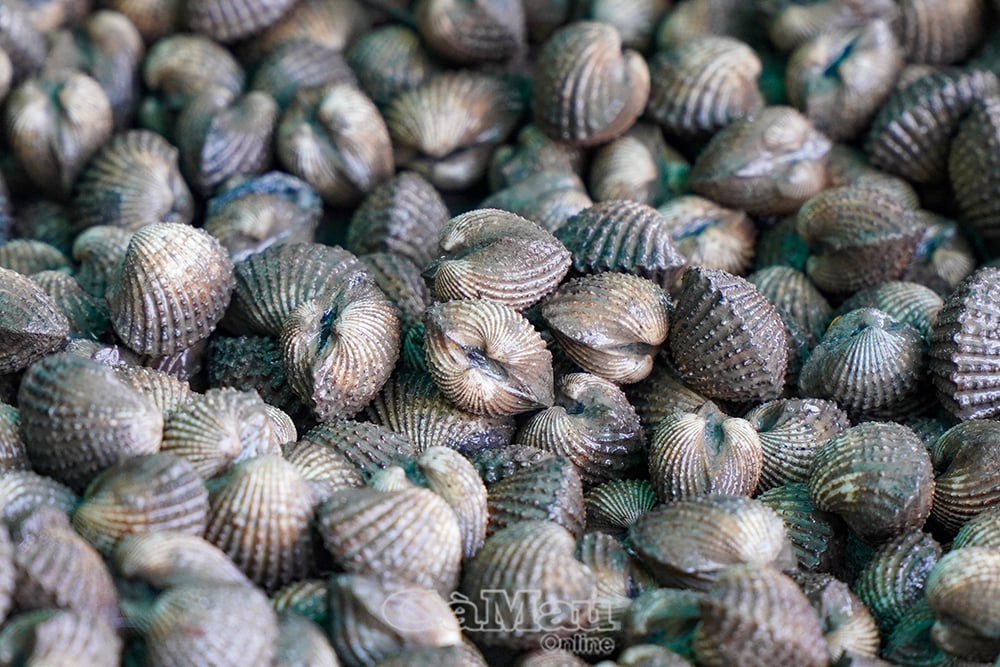 Blood cockles grow uniformly thanks to a three-stage farming process.
In Binh Thanh hamlet, this model has also been effectively applied by many households. Mr. Tran Van Quang, Secretary of the hamlet's Party branch, shared: "Raising clams in combination with shrimp and crabs requires technique. Newly released clam seedlings must be fenced off and only released when they grow larger. Crabs must be released after the clams are strong enough, usually after 2-3 months, to avoid losses. Following the correct procedure significantly increases the survival rate of the clams."
In addition, many households have switched to applying biological methods to replace chemicals in environmental treatment. According to Mr. Nguyen Nhu Le, an official at the Cai Nuoc Commune Public Service Center in charge of agricultural extension, the use of organic fertilizers to color the water, create a natural food source, combined with probiotics, helps stabilize the pond environment, reduce toxic gases at the bottom of the pond, and reduce the risk of disease outbreaks.
Increase crop yields, increase income.
Currently, the price of commercially farmed blood cockles in Ca Mau ranges from 90,000 to 120,000 VND/kg, depending on size and time of year. At this price, the three-stage blood cockle farming model is providing a fairly stable source of income for many local households.
Compared to traditional farming methods, the new model increases the survival rate of oyster spat, shortens the farming time, and increases the number of harvests per year from 1 to 2-2.5. In addition, the integrated farming of oysters, shrimp, and crabs utilizes natural food sources within the ponds, reduces investment costs, and minimizes the use of chemicals.
 Harvesting commercial blood cockles provides a stable source of income for the family of Mr. Nguyen Van Doan (far right).
"Previously, profits depended heavily on luck, but now the three-stage model helps stabilize economic efficiency, increasing profits by 1.5-2 times. With an area of about 12 acres of land, many households can earn over 200 million VND/year from the integrated farming model," Mr. Doan affirmed.
This model not only brings economic benefits but also aligns with the local orientation towards ecological agriculture development and climate change adaptation. The use of biological products, limited chemical use, and rational arrangement of farmed species help balance the ecosystem within the ponds, reducing environmental impact.
Based on the successful implementation in Cai Nuoc commune, the three-stage blood cockle farming model shows great promise for replication. With continued support in terms of technology, breeding stock, and product consumption linkages, this could become one of the sustainable aquaculture development directions, contributing to increased income for people in coastal areas.
Truc Linh - Phong Nguyen
Source: https://baocamau.vn/huong-di-moi-o-vung-vuong-tom-a129009.html

























































































Comment (0)