

Faced with this issue, the Hung Yen Education Department has issued a plan, setting a goal that by 2030, 100% of staff and teachers in educational institutions will have correct pronunciation, and 80% of students' mistakes will be corrected.
Not just a movement
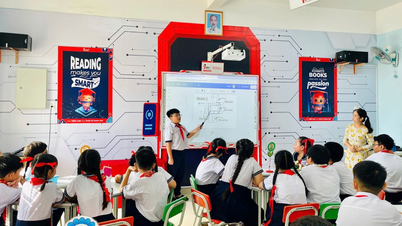
Teacher, did I read it correctly: “Ni-cô-lai-no-phở” – the clear voice of an elementary school student echoed in the middle of a special class. On the board, the words “Practice reading difficult words” were written briefly, below were words containing the consonant L/N that are easily confused: “Color of water”, “na na”, “long eyelashes”, “luật đầu”… are images that are easily encountered in many classrooms in Hung Yen recently.
According to Ms. Tran Thi Anh Dao - Vietnamese teacher (Le Hong Phong Primary School, Thai Binh Ward), this situation is quite common among Hung Yen students, affecting their language ability: Writing, reading incorrectly, expressing incorrectly; Students lose confidence when communicating or reading in front of the class, having difficulty learning advanced Vietnamese, as well as learning foreign languages.
Sharing the same opinion, Ms. Nguyen Thi Thuong - Head of the Social Science Group (An Vu Primary and Secondary School, Phu Duc Commune) said that mispronunciation makes it difficult for listeners to grasp the content of the communication, even causing misunderstandings or reactions from the listeners. In the long run, this error can affect students' future career development opportunities, especially for professions that require high standards and confidence in communication.
According to Dr. Luong Thi Hien - Deputy Head of the Faculty of Literature, Hanoi National University of Education, the cause of confusion and mispronunciation of L/N is due to several main factors. First of all, due to the influence of the living environment. From a young age, students are influenced by the local accent of their parents, grandparents or people around them - people who have already mispronounced L/N.
Next is the school factor. In schools, teachers' attention is not uniform. While some teachers pay close attention and ask students to correct their mistakes immediately, others only give superficial reminders, making students not realize the importance of correcting their mistakes.
Finally, the problem lies in the personal subjectivity of the speaker himself. They often think that mispronunciation does not have a big impact, leading to the mistake continuing and being difficult to fix.
According to the Department of Education and Training of Hung Yen, through a survey of educational institutions in the province, this error is quite common, especially in preschool and primary schools, significantly affecting students' language ability, learning outcomes and confidence.
Realizing the importance of the problem, right from the beginning of the school year, the Department issued Plan 878-KH/SGDĐT dated September 10, 2025 on "Overcoming the situation of mispronouncing the two initial consonants L/N for cadres and teachers; the situation of mispronouncing and spelling the two initial consonants L/N for students in preschools, general education institutions, vocational education centers - continuing education centers in the province in the period 2025 - 2030", at the same time launching a widespread and comprehensive movement in all levels and grades in the whole province.
The goal by 2026 is that 80% of staff and teachers will be able to correct pronunciation errors and 50% of students will not make pronunciation or spelling mistakes with the two consonants L and N. By 2030, 100% of staff and teachers in educational institutions will pronounce correctly and accurately; 80% of students with these errors will be corrected.
According to Deputy Director of the Department of Education and Training of Hung Yen, Ha Thi Thu Phuong, correcting pronunciation and spelling errors in confusing the first two consonants LN is not only a movement, but also a regular and continuous task of schools.
In just a short time of implementation, many schools have had good, creative, practical ways of doing things, initially creating positive changes for students, teachers as well as awareness and companionship of families and society. Accordingly, many schools have organized collective activities at the flag-raising ceremony at the beginning of the week or extracurricular activities, inviting parents to participate; integrating them into class hours; using AI technology to compose songs and poems, integrating them into lessons on the consonants L and N.

Many ways to forge
At Le Hong Phong Primary School (Thai Binh Ward), Ms. Ha Thi Xuan - Principal of the school said that immediately after the Department of Education and Training issued Plan No. 878, the school developed a plan to train standard Vietnamese language skills in the language education program for students.
The activity is widely promoted to all staff, teachers, students and parents, and is considered a key task in teaching and learning. Integrate the task of practicing standard pronunciation into Vietnamese language teaching activities, experiential activities, flag-salute activities, and clubs. Assign professional groups and homeroom teachers to monitor, record, and regularly practice common spelling errors, including L/N errors.
Ms. Tran Thi Anh Dao - a teacher at the school shared that to correct pronunciation and spelling mistakes in confusing the first two consonants L and N, in every Vietnamese lesson, she incorporates the task of practicing standard pronunciation with many activities: Instructing students to distinguish the position of the tongue when pronouncing; practicing reading pairs of opposite words ("len - so", "la - na", "lam - lie", "loi - noi"...); organizing the game "Who is right and who is wrong", the teacher reads the words, students raise the L or N board.
“Thanks to the application of many diverse and close methods, the rate of students making spelling mistakes, especially with the two consonants L/N, has decreased significantly. Those who made mistakes have pronounced clearly and are more confident when reading and communicating in front of the class. From there, the habit of using standard and pure Vietnamese has gradually formed,” said Ms. Dao.
Clearly identify the role and importance of speaking and writing correctly as well as the consequences of mistakes on students' development. For many years, An Vu Primary and Secondary School (Phu Duc commune) has focused on training all students to speak and write correctly.
Mr. Nguyen Van Chung - Vice Principal of the school said that since the beginning of the school year, the Board of Directors and especially Principal - Meritorious Teacher Mai Thi Bich Nguyen have directed the development of a plan to practice correct pronunciation, including correcting the error of writing L/N. Assigned professional groups and homeroom teachers to deploy to each class.
Not only organizing educational activities in the classroom, aiming to create an environment for students to listen and speak correctly, the school has established the "I love Vietnamese" club, which regularly meets periodically with activities such as communication, role-playing, reading poems and telling stories... The school also regularly organizes extracurricular activities such as "Vietnamese Language Festival", "I love my mother tongue" to create a vibrant competitive atmosphere, helping students practice correct pronunciation and writing.
At the same time, promote propaganda to parents, closely coordinate with schools in training children at home... Up to now, students' mistakes in pronouncing and spelling the two consonants L/N have decreased significantly, showing the daily efforts of teachers and students in practicing reading and writing in recent times.
Having had difficulty confusing the two consonants L and N in communication, Nguyen Nam Phong - a 5A student at An Vu Primary and Secondary School, shared: "Not only did I pronounce wrongly, I also sometimes wrote the spelling wrongly. That affected my learning results, especially in Vietnamese. When I mispronounced, I was even teased by my friends."
However, with the guidance of teachers in class and also actively practicing at home, Phong gradually overcame his mistakes. According to him, reading many dictation texts containing both consonants L and N is a good method to practice. In addition, participating in many games or communicating in society will also help children become more confident.

Need synchronous and effective solutions
According to teachers' practical experience, primary school students are the age group that makes the most L/N mistakes. The level of confusion decreases as they move up to secondary school. Therefore, overcoming them is not without difficulties.
Ms. Tran Thi Anh Dao said that primary school students are still young and have limited self-regulation ability; they do not have a clear language awareness, and often do not recognize the difference between the two sounds L and N. When teachers correct them, students easily forget or repeat the mistake because they have not yet formed the correct pronunciation reflex. Many students pronounce correctly when practicing, but when speaking naturally, they make mistakes. In addition, coordination between schools and parents also faces many difficulties. Some parents do not realize the importance of correct pronunciation...
In addition to the above difficulties, according to Ms. Nguyen Thi Thuong, students speak incorrectly from a young age, forming a habit. Many students do not realize the importance of speaking and writing correctly, leading to a lack of awareness of regular practice. "Therefore, coordination with parents is very necessary. When schools increase coordination and guide parents on how to accompany their children in practicing at home, it will bring clear results," Ms. Thuong said.
To completely overcome pronunciation confusion, teachers and experts all agree that synchronous and effective solutions from many levels are needed.
Firstly, improving teaching methods and techniques. Teachers must select and apply appropriate techniques in the teaching process to help students master correct pronunciation.
Second, it is necessary to focus on building motivation and psychological support to turn correct pronunciation into a habit. Teachers need to recognize and encourage students when they encounter difficulties, are easily discouraged, or are impatient because they want to change quickly but do not see results. This is an important psychological measure to help students persevere with their learning path.
Third, there must be a clear roadmap and quality control. Do not stop at launching a general movement, but need to determine specific goals, build a detailed implementation roadmap, and most importantly, have an assessment and quantify the quality after implementation. This control will ensure that the solutions are deployed effectively and achieve the best results.
Recently, the Department of Education and Training of Hung Yen organized a workshop on "Solutions to overcome the problem of mispronouncing and spelling the initial consonants L/N" with the participation of more than 41,000 managers and teachers at preschool, general education, vocational education and continuing education institutions in the province.
At the workshop, Dr. Luong Thi Hien (Deputy Head of the Faculty of Literature, Hanoi National University of Education) provided basic scientific knowledge, answered questions and shared practical experiences on methods of organizing activities to practice pronunciation and spelling L/N suitable for each level of education, helping managers and teachers to apply effectively in practice.
Source: https://giaoducthoidai.vn/huong-toi-moi-truong-ngon-ngu-chuan-post758852.html


![[Photo] National Assembly Chairman Tran Thanh Man receives First Vice Chairman of the Federation Council of the Federal Assembly of the Russian Federation](/_next/image?url=https%3A%2F%2Fvphoto.vietnam.vn%2Fthumb%2F1200x675%2Fvietnam%2Fresource%2FIMAGE%2F2025%2F12%2F02%2F1764648408509_ndo_br_bnd-8452-jpg.webp&w=3840&q=75)
































































































Comment (0)