

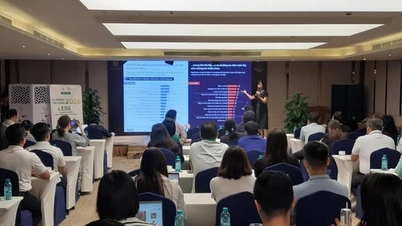
On May 13th, the Ho Chi Minh City Real Estate Association (HoREA) held a conference to implement Directive 45/CT-UBND dated May 5th, 2026, of the Ho Chi Minh City People's Committee on continuing to resolve difficulties and obstacles for long-standing stalled projects. The conference took place immediately after the Ho Chi Minh City Department of Finance requested the association to cooperate in compiling and supplementing the list of private investment projects and foreign direct investment (FDI) projects facing difficulties but not yet included in the list of 838 stalled projects that the city had reviewed.
Many positive signs
According to Mr. Le Hoang Chau, Chairman of HoREA, the list of 838 land plots and projects is not just a statistical figure but reflects a very large amount of assets that are "frozen". Notably, the group of "prime land" projects belongs to group 5, which includes land plots that cannot be put into use due to complex legal obstacles.
Mr. Chau believes that reactivating these projects will bring three core values to the city and the economy . Firstly, it will create momentum for economic growth. When large-scale projects are restarted, it will contribute to stimulating investment and creating more jobs in the construction, real estate, and related service sectors.
Secondly, it helps combat the waste of land resources. Bringing vacant "prime land" into operation will generate significant additional revenue for the budget through taxes, land use fees, and other economic activities.
Thirdly, it strengthens market confidence. According to Mr. Chau, the decisive actions of the Ho Chi Minh City government in removing legal obstacles will help businesses and investors, especially foreign investors, have more confidence in the investment and business environment in Vietnam.
Mr. Chau stated that resolving difficulties for the 838 stalled projects and land plots is not only an administrative task but also a crucial shift in management and operational thinking. Therefore, he suggested that businesses proactively review and fully compile the legal status of their projects, especially those with FDI and private investment projects not previously included in the review list.
Meanwhile, Mr. Nguyen Van Doi, Vice Chairman of HoREA and General Director of Saigon 9 Construction and Trading Joint Stock Company, said he was quite surprised by the speed of administrative procedures in Ho Chi Minh City recently. "There were land allocation procedures that used to take many years, but recently, when businesses submitted their applications to the Ho Chi Minh City People's Committee Office, city leaders signed and approved them within about two weeks," he recounted.
Although resolving outstanding projects cannot be completed "overnight," according to Mr. Doi, many projects that have been stalled since 2015-2020 are now beginning to be resolved. His company alone has successfully resolved two projects since the beginning of 2026. He believes this is a "golden opportunity" to boost economic growth and help businesses avoid stagnation.

Mr. Le Hoang Chau delivered a speech at the conference to implement Directive 45/CT-UBND dated May 5, 2026, of the Ho Chi Minh City People's Committee.
Adding more suggestions from practical experience.
As a company with many years of experience in social housing, Mr. Truong Anh Tuan, Chairman of the Board of Directors of Hoang Quan Real Estate Consulting - Trading - Services Joint Stock Company, said that the company currently has about 50 projects, of which about 30 projects are facing many obstacles, with some projects dragging on for 5 years without being able to resolve the issues completely.
Based on that reality, Mr. Tuan suggested that the city should promptly remove bottlenecks in mechanisms and operational procedures. First, he emphasized the need for coordinated efforts between departments and businesses. Despite the city's strong directives and the involvement of many units, the backlog of applications is overwhelming, causing many agencies to become overloaded. "The principle of 'not criminalizing economic relations' must be strictly implemented so that officials and businesses can confidently cooperate in processing applications," Mr. Tuan stated.
His second recommendation was to clearly define the point of contact for receiving and processing requests. According to Mr. Tuan, with hundreds of pending projects currently underway, the city needs a sufficiently strong coordinating agency to monitor them throughout. He proposed assigning the Department of Finance as the main point of contact. When businesses submit requests, specific officials or departments in each relevant department, such as the Department of Agriculture and Environment, the Department of Construction, the Department of Planning and Architecture, or the local government, should be designated to facilitate businesses in contacting and tracking the progress of the processing. "Businesses commit to proactively reviewing and classifying each group of obstacles according to the city's requirements to ensure faster and more effective processing," Mr. Tuan said.
Furthermore, the leader of Hoang Quan Real Estate believes that the entire process of receiving and processing applications should be digitized soon. This would help management agencies easily monitor progress and reduce the lengthy process of applications being circulated. Finally, he suggested that clear processing deadlines should be stipulated for each group of issues to avoid situations where businesses wait for years without receiving results.
Meanwhile, Ms. Nguyen Nam Phuong, Chairwoman and CEO of Lan Anh One-Member Limited Company, pointed out that the biggest obstacle currently lies in financial obligations and the determination of land use fees. Her company is one of the pioneers in investing in social housing and housing for low-income earners with 100% private capital, yet many projects have been stalled for years.
"The delay in determining land use fees, lasting 4-5 years, causes serious difficulties for businesses, leading to continuous losses. In one case, the tax authorities provisionally calculated the amount at around 24 billion VND, but because it exceeded the 20 billion VND threshold, the file had to be re-examined and transferred to many different agencies, further delaying the process," Ms. Phuong cited as an example.
Furthermore, businesses also face difficulties in deducting expenses. Many roads are funded by businesses themselves for compensation, land clearance, and infrastructure investment, but the actual value is not proportionally deductible when calculating financial obligations. "When tax notices are issued late, businesses are charged additional late payment penalties. This puts even more pressure on businesses and discourages investment," Ms. Phuong said.
She also argued that the current application of the surplus method in land valuation does not accurately reflect market realities. While the output value is calculated based on market prices, the deductible costs are applied according to the much lower state-determined price framework, leading to a lack of balance of interests between the state and businesses.
Furthermore, her company currently has four projects in the Ba Ria - Vung Tau area facing numerous legal and planning obstacles. She requested that the authorities promptly review and resolve these issues, ensuring consistent and transparent planning so that the company can continue to implement social housing projects.
Conflict between laws
Representatives from the Ho Chi Minh City Department of Finance stated that the city is currently reviewing Plan 34/KH-UBND to categorize projects that have and have not yet been resolved. Simultaneously, a comprehensive review of all problematic projects is being requested to focus on resolving them definitively by 2026.
According to a representative from the Department of Finance, many projects are currently facing overlapping issues between laws such as the Land Law, the Housing Law, and the Investment Law. For example, to obtain investment approval, businesses must have land use rights, but the land allocation process is currently stalled. Therefore, businesses need to report concisely and specifically the obstacles encountered and clearly identify the lead agency responsible for handling them so that the issues can be resolved more quickly.
For projects that have dragged on for many years but where the responsible agency has not been identified or the matter is beyond the jurisdiction of the relevant departments and agencies, businesses can petition the Ho Chi Minh City Inspectorate, the Government Inspectorate , or other relevant authorities to intervene and clarify the situation. "The city leadership is also directing the inspection agency to directly participate in resolving difficulties for businesses. Businesses are encouraged to submit their requests through HoREA for compilation and forwarding to the Department of Finance for processing. After the compilation is complete, the departments and agencies will publicly announce the contact person responsible for each field so that businesses can easily contact them and track the progress of their applications," a representative from the Department of Finance informed.
Three major "bottleneck" groups
Mr. Le Hoang Chau believes there are currently three major "bottlenecks" that need to be addressed through administrative discipline and coordinated efforts among departments and agencies. First and foremost are legal obstacles, inspections, and judicial proceedings. Accordingly, it is necessary to focus on resolving projects related to inspection conclusions, audits, or effective court judgments, avoiding prolonged delays that waste land resources and negatively impact the investment environment.
The second group of issues concerns land valuation, which Mr. Chau likened to "the bottleneck of all bottlenecks." He expressed his agreement with Ho Chi Minh City's policy of assigning the Department of Agriculture and Environment to expedite the land valuation process in order to alleviate difficulties for businesses and unlock market resources.
Finally, he suggested that investors should fulfill all financial obligations immediately after receiving notification from the authorities to avoid losses to the state budget and ensure the project's progress.
Source: https://nld.com.vn/khan-truong-thao-go-838-du-an-ton-dong-196260513214519944.htm


































































































Comment (0)