

Water has become the second most important strategic resource after humans and is key to achieving all of the United Nations Sustainable Development Goals. However, this essential resource is being seriously degraded, from depletion, pollution, uneven distribution to growing challenges from climate change and increased demand.
It is forecasted that by 2045, Vietnam's water demand may reach 130 billion m³, an increase of about 30% compared to present. In that context, ensuring water security (ANNN) and the safety of dams and reservoirs becomes a vital task, a responsibility of the entire political system and society.
Faced with such an urgent situation, the Party Central Committee issued Conclusion No. 36-KL/TW (June 23, 2022) on ensuring national security and safety of dams and reservoirs until 2030, with a vision to 2045, clearly defining the orientation and 9 key task groups, emphasizing the requirement of "research, development, application of science and technology (S&T) and digital transformation" as a consistent pillar.
On that basis, on December 1, 2023, the Ministry of Science and Technology approved the National Science and Technology Program for the period up to 2030 "Science and Technology Research to serve the purpose of ensuring water security and safety of dams and reservoirs", code KC.14/21-30, to provide scientific arguments, develop technology and create substantial changes in the management, exploitation and protection of water resources.
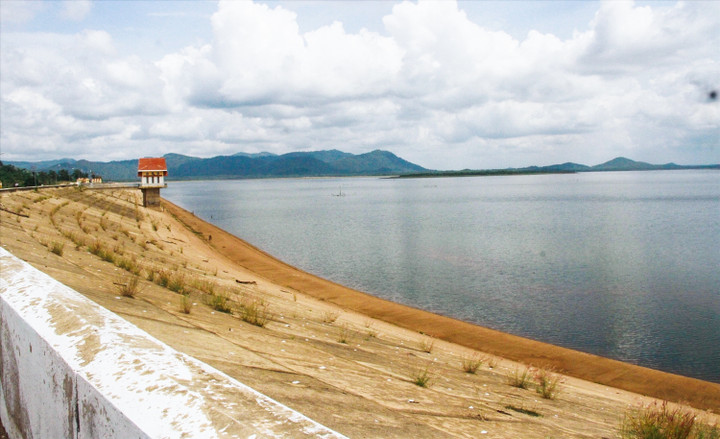
Ia Mor irrigation project's reservoir stores water for many years with hundreds of millions of cubic meters of water. (Photo: Ministry of Science and Technology)
The KC.14/21-30 program aims at the overall goal of providing a scientific basis for improving institutions and policies; developing and applying advanced technologies in assessing, developing, managing and effectively using water resources; modernizing the system of dams, reservoirs and irrigation infrastructure; and enhancing the capacity to forecast, monitor and respond to risks in the context of climate change.
The program's content groups are comprehensively designed, including scientific research for water management; development of technology to assess water quantity, quality and demand; solutions for water source creation, distribution and connection; technology for circulating and saving water use; technology for water environment restoration; solutions to modernize the operation and safety monitoring of dams and reservoirs.
The program also aims to create a diverse system of science and technology products, from scientific foundations, technological processes, technical solutions, databases - digital maps, specialized materials and equipment to international publications, inventions and products for training highly qualified human resources.
The targets are very specific: 60% of tasks have applied results; 40% are published internationally; 30% of tasks have intellectual property applications; 80% participate in postgraduate training. This will be an important basis for forming an innovation ecosystem in the water sector - a field that is predicted to become a "strategic front" in the coming decades.
KC.14/21-30 expects to simultaneously solve many core issues of ANNN, from water source generation technology, groundwater recharge, anti-degradation and depletion, to solutions for demand management, improving water productivity, reducing losses, developing circular water use models and smart monitoring and operation systems for irrigation works. This is also an important orientation to realize the goal of being proactive in all situations, ensuring adequate water supply with appropriate quality for people's lives, production and socio-economic development.
According to Mr. Nguyen Huu Hue, Party Secretary and Chairman of the Council of the University of Water Resources, the team of hundreds of scientists in the fields of hydrology, planning, irrigation, water environment, water supply and drainage, water treatment, dam safety and reservoir operation are fully capable of participating in the implementation of national-level science and technology tasks under the program.
This is a testament to the readiness of the domestic research and training force, as well as opening up opportunities to enhance cooperation between the State - scientists - enterprises to promote innovation in the field of ensuring water security.
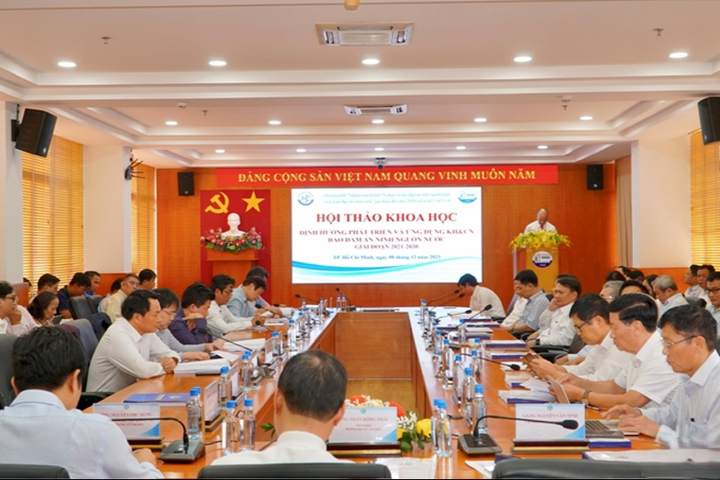
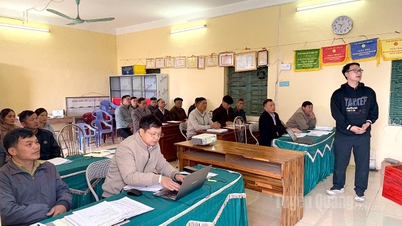
Scientists, experts and businesses participated in the discussion at the workshop "Orientation for development and application of science and technology to ensure water security in the period 2021 - 2030" . (Photo: Ministry of Science and Technology)
With a long-term vision and strong participation of management agencies, scientists and businesses, the KC.14/21-30 Program is expected to become an important foundation to help Vietnam proactively protect water resources and preserve the "lifeblood" of the country; thereby creating new momentum for rapid and sustainable development in the coming decades.
Source: https://vtcnews.vn/khoa-hoc-va-cong-nghe-dan-duong-bao-dam-an-ninh-nguon-nuoc-quoc-gia-ar991986.html
![[Photo] Urgently help people soon have a place to live and stabilize their lives](/_next/image?url=https%3A%2F%2Fvphoto.vietnam.vn%2Fthumb%2F1200x675%2Fvietnam%2Fresource%2FIMAGE%2F2025%2F12%2F09%2F1765248230297_c-jpg.webp&w=3840&q=75)

























































![[Photo] General Secretary To Lam works with the Standing Committees of the 14th Party Congress Subcommittees](https://vphoto.vietnam.vn/thumb/402x226/vietnam/resource/IMAGE/2025/12/09/1765265023554_image.jpeg)
























Comment (0)