

Article 2: Practical "cracks": When will the interconnected network in the Mekong Delta stop being "broken"?
The mechanism is attractive, but the procedures are complicated.
On July 5, 2018, the Government issued Decree No. 98/2018/ND-CP on policies to encourage cooperation and linkages in the production and consumption of agricultural products (Decree 98). This was expected to be the "backbone" legal framework to promote business-cooperative cooperation. However, looking at the actual figures announced at the 2025 Cooperative Economic Forum, after 7 years of implementing Decree 98, only about 1,350 linkage projects have been implemented nationwide – a very modest number compared to the scale of over 31,000 cooperatives across the country. Even in Can Tho, data from the city's Cooperative Union shows a similar situation. Although the city currently has over 320 active cooperatives, only 11 linkage projects/plans were approved to benefit from the policy during the 2020-2025 period. The "reluctance" of the stakeholders is not emotional but stems from "cracks" in the implementation process.
Accordingly, the biggest obstacle lies in the overly complex registration procedures and documentation. Decree 98 requires projects to have a stable linkage period of 3-5 years, while the agricultural production in the Mekong Delta is characterized by seasonal fluctuations. The requirement for transparent documentation and invoices for infrastructure support payments is a "challenge" for the less-than-standardized management skills of most cooperatives. According to the Can Tho City Cooperative Union, cooperatives' capacity to access capital and support policies remains very weak; the percentage of cooperatives accessing preferential capital from the Cooperative Development Support Fund or banks is still modest. This gap in applying mechanisms to practice makes it difficult for even the most humane policies to become a truly effective catalyst. Therefore, agricultural product procurement contracts are often not fully enforced as legally protected economic transactions, but only serve as cooperation agreements and are easily broken under pressure from traders or fluctuations in the global market affecting agricultural prices.

The Ben Ba Chi Agricultural Service Cooperative (An Giang province) is a prime example of a model for linking mango production according to VietGAP standards, helping to increase the value of mangoes and income for farmers. Photo: THANH LONG
Notably, one of the critical bottlenecks in agricultural linkages is the lack of sufficiently strong independent financial resources. According to the Department of Private Enterprise and Collective Economic Development (DEMO), Ministry of Finance, developing linkages is identified as a specific, strategic policy in agriculture, but in reality, the separate budget for implementation is very limited. The majority of current support funds are primarily integrated or "borrowed" from other existing programs or policies. This dependence creates significant obstacles in implementation, as regulations on disbursement and criteria for receiving integrated funds often overlap and are inconsistent, making the already scarce support funds for linkages even more difficult for cooperatives to access.
Data released by the Ministry of Finance partially reveals this reality: During the period 2018-2025, out of a total of over 15,243 billion VND mobilized for nationwide linkage projects, the state budget only supported approximately 20.9%, with the remaining 79.1% relying on counterpart funding. The policy of supporting 30% of equipment and infrastructure (not exceeding 10 billion VND/project), while ostensibly encouraging, is in reality too large a burden for cooperatives in the Mekong Delta. With their small scale and weak financial resources, the 70-80% counterpart funding requirement is beyond the cooperatives' ability to manage. This explains why the number of sustainable linkage chains in the Mekong Delta – a key region for ensuring national food security – is so limited.
Challenging internal capabilities and the “loop of distrust”
If mechanisms and capital are the "hardware," then the internal capacity of cooperatives is the "operating system" for running the supply chain. However, in the Mekong Delta, cooperatives are revealing serious governance gaps, leading to a consequence: a breakdown of trust among stakeholders.
A paradox exists: while the management staff of cooperatives is being rejuvenated and their qualifications improved, their management capacity has not kept pace with reality. According to the Steering Committee for the Cooperative Economy of Can Tho City, the percentage of cooperative staff with university or college degrees or higher has reached over 25.5%. This is an encouraging figure, but the general reality in the Mekong Delta and the whole country shows that this workforce has qualifications but lacks experience and practical skills. Most cooperatives currently suffer from a severe shortage of personnel with in-depth skills in supply chain management, contract negotiation, especially international contracts, and market forecasting capabilities. Furthermore, many localities report a lack of external support resources, particularly independent consultants to help standardize raw material areas, leaving cooperatives at a disadvantage when negotiating cooperation with businesses.
Regarding this issue, Ms. Nguyen Kim Thuy, Director of Ky Nhu Cooperative, Can Tho City, reflected: After more than 6 years of operation, despite having grown to 52 members with a 16-hectare farming area and bringing snakehead fish products into large distribution systems such as MM Mega Market, Co.opmart, and exporting to the US and South Korea, she is still concerned about the "threshold" of management thinking and technology. Ms. Nguyen Kim Thuy frankly shared: “When participating in the linkage, the income of cooperative members increases by about 2-3 million VND/month. However, if the head of the cooperative does not update their knowledge of the market, management, and international standards, it will be very easy to be overwhelmed when participating in the global supply chain. Today's cooperative directors are not only good at production but also must understand the market and know how to connect strategically.” In particular, the issue of digital transformation is a major obstacle for Ky Nhu Cooperative. Ms. Thuy expressed her desire for financial support to invest in machinery, management software, and personnel training because "digitalization not only helps cooperatives become more transparent in the eyes of partner businesses, but also enhances management capacity and meets the requirements of importers."
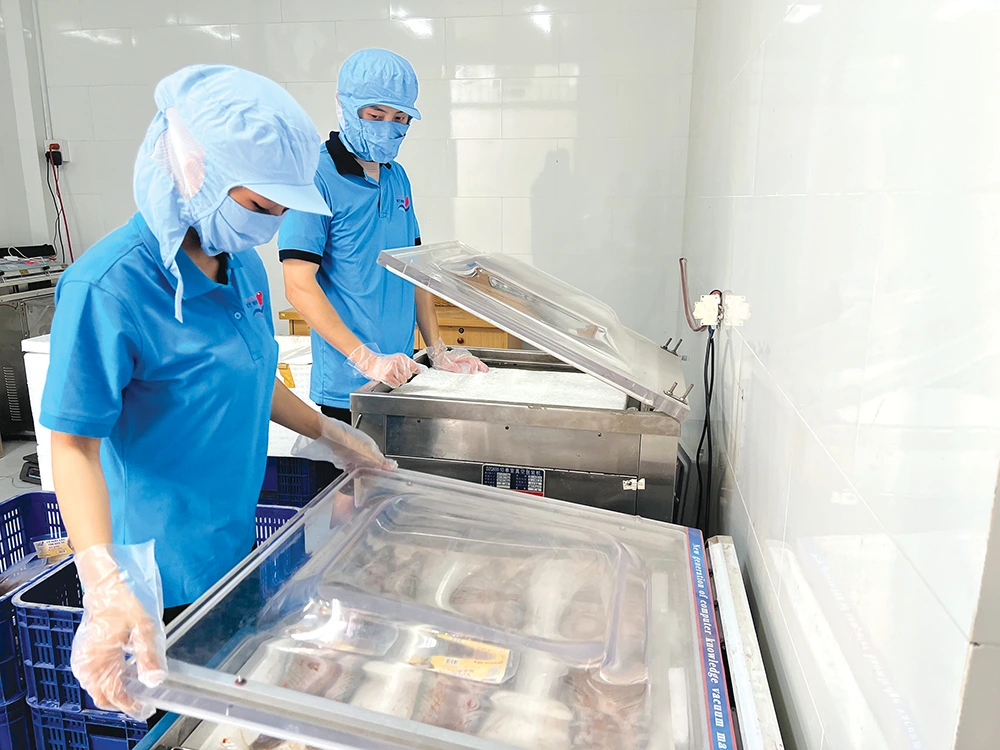
Production activities at Ky Nhu Cooperative, Can Tho City. Photo: MY HOA
The Vietnam Cooperative Alliance also acknowledges that digital transformation in this sector is slow, and technological levels remain outdated. The level of mechanization and modernization is low, with only about 10% of agricultural cooperatives applying high technology at a basic level. The digital transformation process is still hampered by a lack of skilled personnel, insufficient initial investment capital, and especially by a management board that remains hesitant to change. When those in charge still operate with a purely production-oriented mindset, lacking sensitivity to green standards and digital technology, they inevitably lose their negotiating position. This is because businesses, especially large ones, are concerned that cooperatives cannot guarantee stability in numbers, uniformity in quality, and credibility in fulfilling signed contracts.
The issue of cooperative management capacity also pushes all parties into a cycle of trust crisis. According to a VCCI representative, this is a "deadlocked logic": Businesses are hesitant to make long-term contracts without seeing guaranteed capacity from the cooperatives. Conversely, cooperatives cannot professionalize their management or invest in technology without market commitments. This lack of trust keeps both sides at the "exploratory" stage. As a result, when prices rise, members readily break the agreement and sell outside; and when prices fall, businesses use technical barriers to force prices down in order to protect themselves from risk. As long as cooperatives have not demonstrated their capacity through transparent management and practical implementation, and businesses remain defensive, the linkage network in the Mekong Delta will continue to be "broken" at the human link.
***
From the efforts to find solutions to the "rifts" in agricultural linkage practices in the Mekong Delta, the question arises: How did leading agricultural nations like the Netherlands or Germany break this "loop of distrust" to transform small-scale farming collectives into economic entities strong enough to negotiate fairly at the negotiating table with global trading partners?
(To be continued)
Thanh My
Lesson 3: The Strategies of the "Giants" and Solutions for the Mekong Delta Region
Source: https://baocantho.com.vn/khoi-thong-diem-nghen-lien-ket-de-but-pha-a203755.html



























































































Comment (0)