

From agricultural production and livestock farming to the revival of traditional crafts, they are contributing to the creation of effective economic models, spreading the spirit of self-reliance and a persistent will to overcome difficulties.
 |
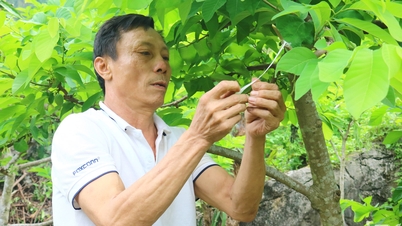
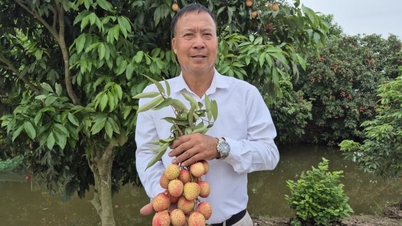
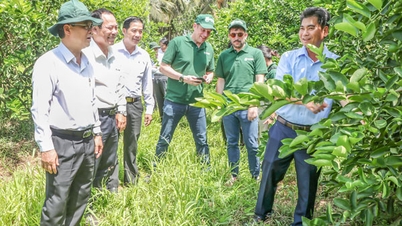
| Veteran Nong Van Thuat takes care of his fruit orchard. |
Life after the war
We arrived at the spacious stilt house of Mr. Nong Van Thuat's family in Bac Kan ward. We were greeted by a man with gray hair, a resolute face, and a slender build.
Mr. Nong Van Thuat was born in 1951. Like many young people during the war, he enlisted in the army in 1971 at the age of 20. At that time, the resistance war was in its most intense phase, and the young man named Thuat took up arms and entered his first battles in Quang Tri .
He recalled: "Right after training, I was deployed directly to the Quang Tri battlefield to participate in the fighting. Those were brutal days that even now I find it hard to fully describe. At that time, I had just gotten married, so initially I was scared, worried about my parents, and worried about my young wife at home..."
But amidst the bombs and continuous losses, the feeling of fear gradually gave way to familiarity with the battlefield. At that point, the soldier was only measuring time in hours of fighting.
Leaving Quang Tri in 1974, he continued fighting in Da Nang. In 1975, he participated in the historic Ho Chi Minh Campaign.
In early 1976, Mr. Thuat was discharged from the army and returned to his hometown, starting a new life with his loyal wife. The war left a significant impact on him, as he was affected by chemical toxins, causing his health to decline. Therefore, he constantly pondered new ways to develop the economy and create a stable source of income instead of relying solely on farming.
With his family's land available, Mr. Thuat researched local production practices, observed market demand, and selected suitable crops. Recognizing that apricot trees were easy to grow, suited the climate, and required little care, he discussed with his wife the idea of introducing this crop into production.
He started cultivating his first apricot trees in 1977. Due to limited financial resources, he only expanded his planting area the following year. Thanks to careful care and mastery of techniques, nearly 200 apricot trees thrived, yielding over 2 tons of fruit annually. For many years, this was the main source of income for his family.
However, around 2005, apricot prices plummeted, and finding buyers became difficult. Mr. Thuat recalled: "At that time, ripe apricots were falling from the trees everywhere, but there were no buyers, and all our hard work was wasted. I encouraged myself not to be pessimistic or discouraged."
Because anyone who participated in the resistance will understand that there were no difficulties or hardships like those times; my return was a stroke of luck, so I must live well and be even more resilient.
From then on, his family shifted their focus to growing persimmons. They learned techniques while working, gradually improving the soil and caring for the orchard. Today, their persimmon orchard, spanning over 3,000 square meters, has developed steadily, generating an income of approximately 200 million VND per year. Now, at the age of 75, Mr. Thuat has gradually handed over the production model to his children and grandchildren to continue.
New paths
 |
| Veteran Trieu Minh Doan produces vermicelli noodles at his family's facility. |
Beyond just farming, many veterans in rural areas are rediscovering their livelihoods through traditional crafts. Con Minh commune is home to a long-standing vermicelli-making tradition. On sunny days, white vermicelli strands cover the yards, stretching from the porches to the alleyways. This old craft has helped many families stabilize their lives, including veteran Trieu Minh Doan.
Mr. Doan joined the military in 1984 and was discharged in 1987, returning to his hometown. Life was difficult; he and his wife mainly relied on farming for their livelihood, resulting in an unstable income. He tried livestock farming but it was unsuccessful, so he returned to his family's vermicelli-making business.
Initially, he only made vermicelli noodles by hand on a small scale, selling them retail at the market. As market demand increased and many customers from far away came to place orders, he began to think about expanding production.
In 2011, he boldly borrowed 100 million VND from the bank to invest in machinery, shifting from artisanal production to commercial-scale vermicelli production.
Mr. Doan recalled: "At that time, 100 million VND was a huge amount for my family. When I borrowed it, I was afraid I wouldn't be able to repay it or that my business wouldn't succeed. But I thought: If I don't start, if I don't make an effort to try, how can I achieve results?"
The biggest challenge was the market. From selling small quantities at local markets, expanding production made a stable outlet a critical need. He proactively introduced his products to many localities and also sought help from acquaintances to distribute them in other provinces.
To date, his family's vermicelli products have reached many locations both within and outside the province. Each year, the production facility produces over 12 tons of product, creating jobs for local workers and providing a stable income for the family.
In many localities in Thai Nguyen province, war veterans are demonstrating a spirit of self-reliance to develop the economy. Farmers, livestock breeders, and those preserving traditional crafts all contribute to a diverse picture of post-war recovery efforts. The province currently has over 1,300 economic models run by war veteran association members, creating jobs for tens of thousands of workers.
From models like those of Mr. Thuat and Mr. Doan, we can see that many veterans today are still persistently seeking new paths, refusing to give up in the face of difficulties. There are successes and challenges, but the common thread is an unwavering spirit.
Emerging from the hardships of war and returning to civilian life, the soldiers of yesteryear still retain a simple quality: the will to overcome adversity. This spirit continues to spread, becoming a source of inspiration for today's generation in their journey to build a new life.
Source: https://baothainguyen.vn/xa-hoi/202605/khong-chon-dung-lai-sau-gian-kho-a7d05cf/




























































Comment (0)