

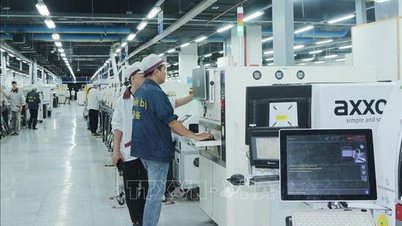
In the first four months of 2026, the total registered FDI capital in Vietnam (as of April 27, 2026) reached US$18.24 billion, an increase of 32% compared to the same period last year. Of this, the processing and manufacturing industry accounted for US$6.12 billion, representing 82.7% of the total investment. This was followed by the real estate business; electricity, gas, hot water, steam, and air conditioning production and distribution, etc.
Over the past period, numerous policies and laws on attracting and managing foreign investment have been enacted, thereby creating a favorable investment and business environment and gradually aligning with international practices. The foreign-invested economic sector has developed rapidly and effectively, becoming an important part of the economy and making positive contributions to the socio-economic development of the country. Many multinational corporations and large enterprises with modern technology have invested in Vietnam; the scale of capital and the quality of projects are increasing, contributing to job creation and income for workers, as well as improving production capacity; increasing state budget revenue, stabilizing the macroeconomy; promoting economic restructuring and innovation in growth models; and enhancing Vietnam's position and prestige in the international arena.
However, it must be frankly acknowledged that attracting and managing foreign investment still faces shortcomings, limitations, and emerging problems. Specifically, the institutional framework and policies regarding foreign investment have not kept pace with development requirements. Preferential policies are scattered, inconsistent, and unstable. While the investment and business environment and competitiveness have improved, many inadequacies remain.
Furthermore, socio-economic infrastructure and high-quality human resources have not yet met the requirements. The mechanisms and capacity for dispute resolution are not yet high; the organizational structure and capacity for attracting and managing foreign investment are fragmented, lacking proactiveness and professionalism. The number of small-scale, low-technology, labor-intensive projects remains large and unevenly distributed. The ratio of implemented capital to registered capital is still low. Linkages and interactions with other sectors of the economy are weak, the spillover effects on productivity and technology are not high, and the localization rate is low. Transfer pricing, "underground" investment, and "disguised" investment are becoming increasingly sophisticated and are on the rise…
Given these shortcomings and limitations, the urgent need now is to change the strategy for attracting FDI. Accordingly, it is necessary to select new-generation FDI projects that are high-quality, technologically advanced, capable of research and development (R&D), and have modern management, instead of relying solely on cheap capital and labor as before. At the same time, the focus should be on technology transfer, promoting linkages and cooperation between FDI enterprises and domestic businesses, and helping businesses participate more deeply in global supply chains.
To achieve this, one expert suggests that the strategy should first shift from attracting investment through tax incentives to attracting it through quality infrastructure, a favorable investment environment, high-quality human resources, and transparent institutions. A new generation FDI attraction strategy is needed, along with national FDI criteria tailored to each locality and region. Furthermore, it is necessary to continue improving the legal framework for green and eco-industrial parks; establish a national FDI data mechanism; and train high-quality human resources.
Furthermore, it must be clearly recognized that relying solely on low-cost advantages is no longer viable; instead, the endogenous capacity of the economy must be enhanced. Businesses need to shift from a participation mindset to one that elevates their position in the value chain, gradually mastering technology and participating in high value-added stages. In particular, institutional issues and the investment and business environment must continue to be central to ensuring that FDI flows into Vietnam truly become a catalyst, helping Vietnamese businesses rise in the value chain.
Source: https://daibieunhandan.vn/khong-dua-mai-vao-loi-the-chi-phi-thap-10417524.html
























































































Comment (0)