

Here, the sound of gongs, epics, and the image of the Ede long house - a symbol of matriarchy - are introduced in an authentic way, helping visitors have a more complete view of the cultural identity of an ethnic community living mainly in Dak Lak .
 |
The Ede long house is restored at the Vietnam Museum of Ethnology. |
The customs of the Ede ethnic group are considered one of the rich cultural treasures of the Central Highlands, from the matriarchal system, the Dam San epic, to festivals such as celebrating the new rice crop and abandoning graves. Among them, the long house is the symbol that most clearly represents the ethnic identity.
At the Vietnam Museum of Ethnology, the highlight of the outdoor exhibition area is the Ede long house, which has been restored to its original traditional architecture. With a low boat-shaped roof structure, made entirely of wood, bamboo, and a length of up to tens of meters, the house gives visitors the feeling of standing in the middle of a Central Highlands village, not in the heart of Hanoi .
The long house is not only a place to live but also deeply reflects the matriarchal system of the Ede people. According to custom, every time a daughter in the family gets married, the house is extended to welcome her husband to live with them. This makes the length of the house a testament to the prosperity and development of the matriarchal family.
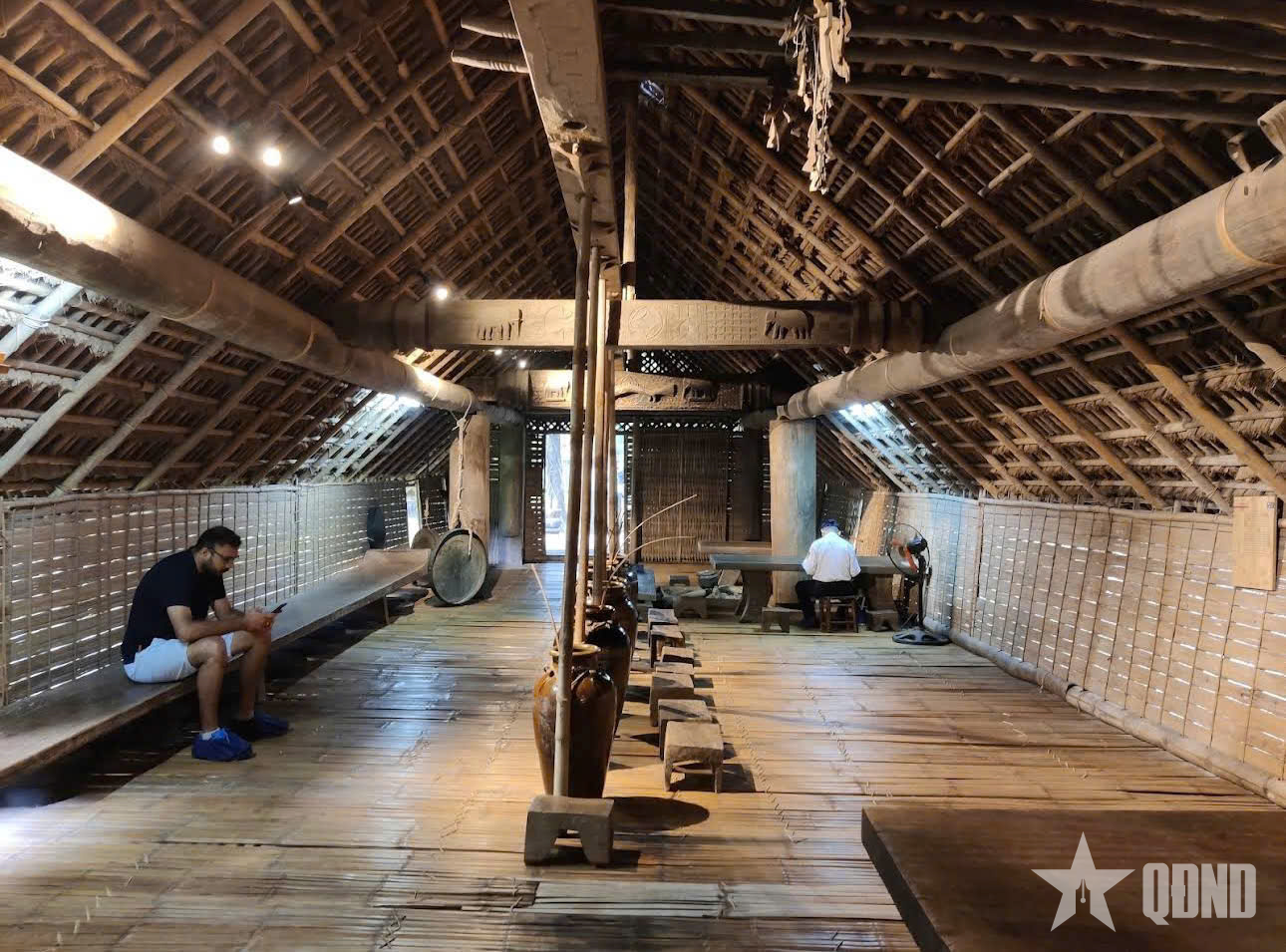 |
The space inside the long house recreates the traditional life of the Central Highlands people. |
The space inside the house is organized according to the traditional layout of the Ede people. The spacious gah (guest house) is where community activities, receptions, and festivals take place. Typical objects such as jars, gongs, and kpan chairs are fully arranged, evoking familiar images of Khan storytelling sessions or gong festivals. Going deeper into the Ok (kitchen) area, visitors can clearly feel the warmth of the fireplace, the center of family life, where customs, work experiences, and village stories are passed down from generation to generation.
The architecture of the long house is unique when the house's base is only about one meter high, the thick thatched roof helps to block the sun and rain, adapting to harsh natural conditions. The process of building a house also requires meticulousness from the stage of choosing wood, weaving walls, preparing thatch to assembling the house's frame parts.
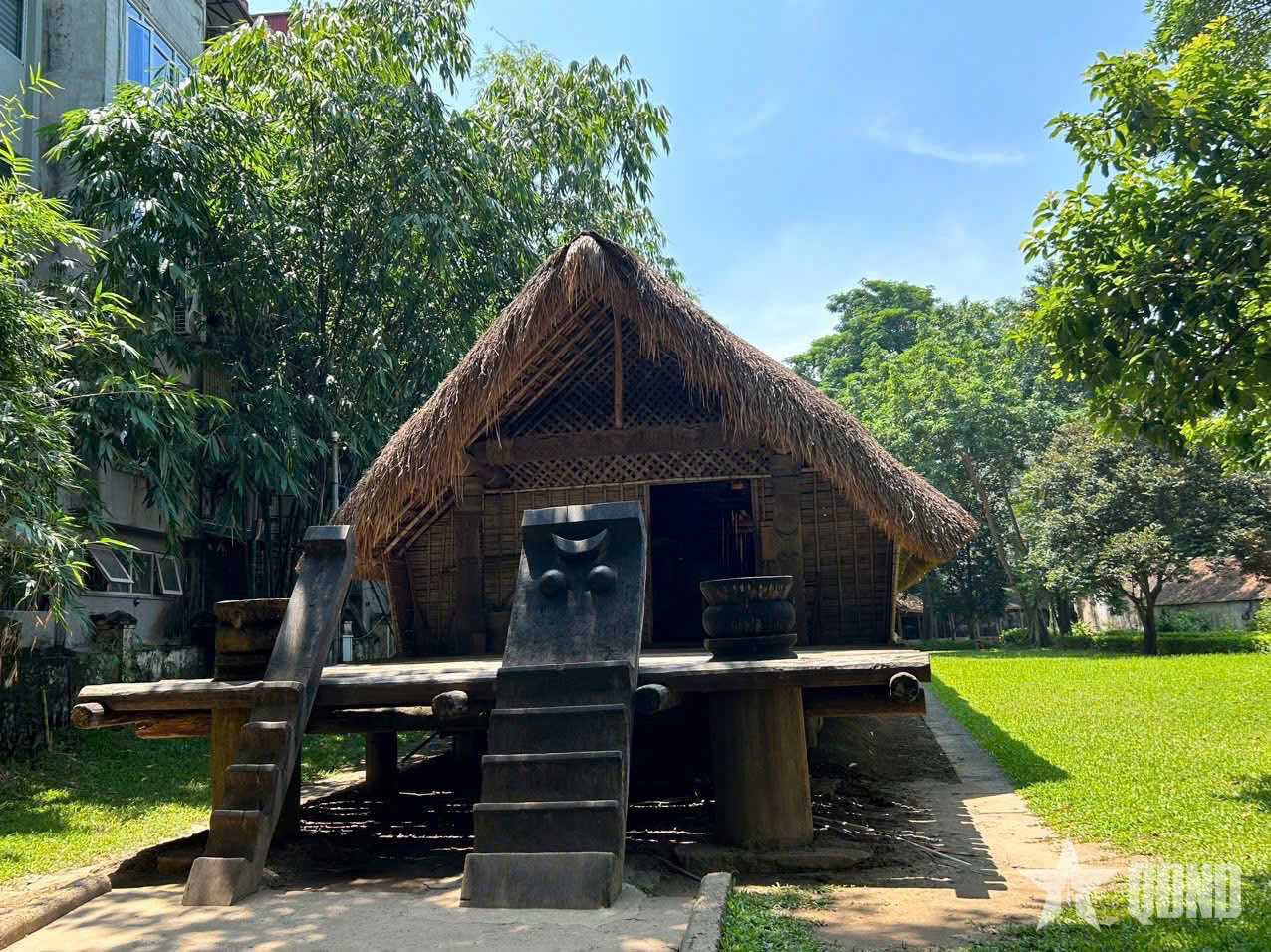 |
The long house staircase is carved with many religious motifs expressing the desire for peace and prosperity. |
The Ede long house space at the museum is also the venue for many exciting experiential activities, attracting a large number of people and tourists. Gong performances, epic stories, cultural exchanges, musical instrument making or educational activities for students have helped the public approach Ede culture in a more intuitive and vivid way than the traditional form through books and newspapers. This is also a way for the cultural values of the Central Highlands people to be closer to the community, especially the youth.
Phuong Thao (a student of the Faculty of Vietnamese Studies, Hanoi National University of Education) shared: “I have read about the Ede long house before, but today I got to experience it firsthand. The space of the long house and the experiential activities at the museum help us understand more deeply about the matriarchal culture, architecture and life of the Ede people. This is a very valuable experience, especially for tourism students like us, as direct access to cultural heritage helps knowledge become more practical and easier to absorb.”
 |
Visitors learn about the architecture and cultural life of the Ede people at the outdoor exhibition area. |
In the context of traditional cultural values facing the risk of being lost, the re-enactment of the Ede space in the heart of the capital has brought a very special meaning. This space not only contributes to preserving and promoting the cultural heritage of the Central Highlands people but also creates a bridge between the past and the present, between village identity and urban life. The Ede long house at the Vietnam Museum of Ethnology has therefore become a meaningful destination, helping Hanoians and tourists understand more deeply about a unique cultural feature of the Vietnamese ethnic community.
Source: https://www.qdnd.vn/van-hoa/doi-song/khong-gian-van-hoa-e-de-duoc-tai-hien-sinh-dong-tai-bao-tang-dan-toc-hoc-viet-nam-1015882
![[Photo] Urgently help people soon have a place to live and stabilize their lives](/_next/image?url=https%3A%2F%2Fvphoto.vietnam.vn%2Fthumb%2F1200x675%2Fvietnam%2Fresource%2FIMAGE%2F2025%2F12%2F09%2F1765248230297_c-jpg.webp&w=3840&q=75)











































![[Photo] General Secretary To Lam works with the Standing Committees of the 14th Party Congress Subcommittees](https://vphoto.vietnam.vn/thumb/402x226/vietnam/resource/IMAGE/2025/12/09/1765265023554_image.jpeg)

























Comment (0)