

At the regular Government meeting in November held last weekend, Prime Minister Pham Minh Chinh requested the Ministry of Construction to urgently submit a plan to establish a real estate transaction center and land use rights managed by the State, to be completed before December 15.
Save time and money
Previously, the Ministry of Construction submitted to the Government a draft Resolution on piloting the model of a real estate and land use rights transaction center, expected to be deployed nationwide in the period of 2026 - 2027. This model aims to connect all procedures, from providing information, legal examination, establishing electronic contracts to granting land use rights certificates, on a unified data platform. The center will also integrate data on housing, land, taxes, transactions and collateral to support management and promote digitalization of the real estate market.
According to Deputy Minister of Construction Nguyen Van Sinh, the establishment of the real estate and land use rights transaction center aims to innovate transaction methods, shorten administrative procedures, save time and costs for people and businesses. At the same time, the model also promotes the application of information technology, promotes digital transformation, contributing to the publicity and transparency of the real estate market. The goal is to stabilize the real estate market with a more synchronous institution, promptly handle cases of manipulation, speculation and price inflation of real estate.
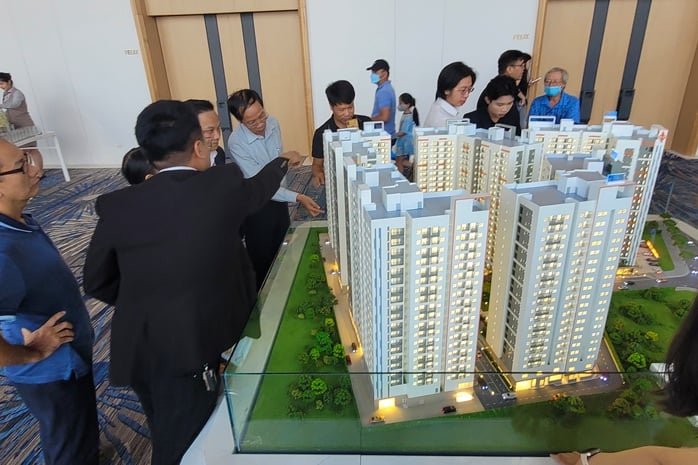
The establishment of a real estate and land use rights trading center aims to innovate transaction methods, shorten administrative procedures, and save time and costs for people and businesses. Photo: TAN THANH
Dr. Nguyen Van Dinh - Chairman of the Vietnam Association of Real Estate Brokers (VARS), Vice Chairman of the Vietnam Real Estate Association - believes that building a national real estate transaction center will be a place to collect, verify and process all information related to each real estate property. When people have a need to transfer or buy and sell, they just need to access this system. The center will automatically contact and verify information with the authorities and return results in a short time. "People just need to enter real estate information into the system. The national data center will check, verify and return official results, affirming the right to legal transactions. At that time, the State will be legally responsible for that data, instead of people having to go through a series of other agencies" - according to Mr. Dinh.
In fact, the procedures related to real estate transactions are still cumbersome, time-consuming and costly. People have to go through many steps such as notarization, tax payment, registration of changes... with an average time of 45 - 60 days. When the transaction center is deployed, these procedures will be carried out quickly, in just 1 - 3 days, helping to reduce costs and hassle. This center does not replace the functions of other agencies but only plays the role of connecting and processing data on a digital platform.
Ms. Hoang Thu Hang, Deputy Director of the Department of Housing and Real Estate Market Management - Ministry of Construction, also admitted that in the past, to create a real estate transaction, people may have to go to many places to buy, sell, transact, do procedures... Besides, people also have difficulty in determining whether a product is qualified for sale or not. If a real estate transaction center is established, the State will manage and be responsible for bringing qualified real estate to the market. Ms. Hang said that the Ministry of Construction has completed the preparation and submission of the project and draft resolution of the Government on piloting this model.
Classify transactions, no additional procedures
From the perspective of businesses participating in the market, Mr. Vo Hong Thang, Deputy General Director of DKRA Group, suggested that when real estate transactions are conducted through official exchanges, information must be accurate, brokers must provide correct data, limit errors, thereby reducing risks for buyers and increasing transparency.
This requires the national real estate trading floor to be designed as a fair playing field, with a strict monitoring mechanism and clear sanctions. "If businesses do not meet the standards and do not comply with transparency, they will be eliminated. However, to be fair, the monitoring and handling mechanism for violations must be designed transparently, avoiding the situation where some places are listed and others are not listed," he said.
A real estate expert believes that the trading floor model still needs time to take shape. According to this expert, if it is just a data listing floor without intervening in selling prices and buyers and sellers, the model will greatly support the State in managing data, reducing duplication, and making it easy to access. In particular, people expect convenience and transparency, not increased procedures or focused punishment. "Just integrate the real estate QR code into the citizen's ID card, when transacting, just scan the code is enough" - this person suggested.
From a policy perspective, Dr. Can Van Luc, member of the Prime Minister 's Advisory Council, also emphasized that when established, real estate transaction centers must comply with two principles: publicity - transparency and no additional procedures or costs.
According to him, the pilot period should only last 2-3 years to evaluate the effectiveness before widespread application. At the same time, it is necessary to clearly classify which types of transactions must be listed on the exchange and which transactions only need to update data. For example, commercial transfers of large value must go through the exchange; while gifts and inheritances within the family may only need to be notified for updating.
Dr. Can Van Luc also proposed to issue criteria for participating in the floor, because not all real estate enterprises are qualified. It is necessary to limit it to groups with clear functions such as: brokerage, valuation, project development, asset management units... At the same time, it is possible to apply the public-private partnership (PPP) mechanism to take advantage of technology, survey, and operation from the private sector while the State plays a guiding and controlling role.
Another requirement emphasized by Dr. Luc is that transaction fees must be at the lowest level, avoiding turning the floor into a barrier. Along with that, the data collection and sharing system must be built synchronously, avoiding the current "data interruption" situation.
In addition, Dr. Luc also warned of the risk of "two markets" arising if the process design is too complicated - one official and one "black market" of underground transactions to avoid procedures. To avoid this, real estate transaction centers must demonstrate real benefits: faster time, clearer information, lower costs.
"Regarding the operating model, we can refer to the trading model of the stock exchange, e-commerce floor, or commodity exchange floor, which is not too complicated. The most important thing is to design a simple, easy-to-operate system that does not create a cumbersome apparatus. Human resources can take advantage of the existing force, and in case experts are needed, we should also boldly recruit to ensure effective operation from the beginning" - Dr. Can Van Luc suggested.
Establishing strong enough legal tools
The Ho Chi Minh City Real Estate Association (HoREA) recommends that instead of creating an additional layer of procedures, the management agency only needs to issue regulations requiring investors to fully disclose the legal status, conditions for opening for sale and product information (available housing, housing in the future, land use rights with infrastructure, etc.) on the housing and real estate market data system of the Ministry of Construction, the provincial People's Committee and on the enterprise information page for the management agency to monitor.
At the same time, HoREA proposed to add regulations to strictly punish acts of publishing false information, delaying public disclosure or putting products that do not meet the conditions for trading. At the same time, it is necessary to urgently amend the Law on Real Estate Business, establishing strong enough legal tools to ensure a transparent and healthy market, limit speculation and protect the rights of buyers.
Source: https://nld.com.vn/ky-vong-san-bat-dong-san-quoc-gia-196251208221835449.htm



![[Photo] Urgently help people soon have a place to live and stabilize their lives](/_next/image?url=https%3A%2F%2Fvphoto.vietnam.vn%2Fthumb%2F1200x675%2Fvietnam%2Fresource%2FIMAGE%2F2025%2F12%2F09%2F1765248230297_c-jpg.webp&w=3840&q=75)
































































































Comment (0)