

From famine relief crops to staple products
Around midday, Mr. Le Viet Ngoc was still hunched over in the purslane patch, using his hands to part the small, vibrant green leaves to check for insects, occasionally standing up and quickly wiping away the sweat with the hem of his dirt-stained shirt.
At the Dong Ngau Crop and Livestock Cooperative (Phuc Gia village, Tho Long commune, Thanh Hoa province), Mr. Ngoc is both the owner and the worker. He not only owns over 2 hectares of water spinach cultivation but also acts as the "engineer" operating the farm, from land preparation, planting, caring for, harvesting to processing, packaging, and marketing the product. Some people say he's taking on too much, doing everything himself, but he just smiles and says, "It's not that I don't trust anyone, it's just that I feel more secure doing it myself."

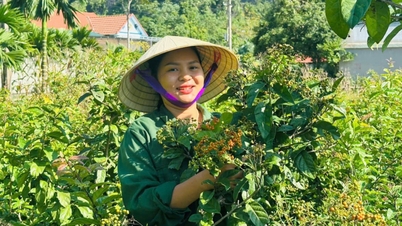
Mr. Ngoc owns more than 2 hectares of water spinach in Tho Long commune, Thanh Hoa province. Photo: Quoc Toan.
For Mr. Ngoc, pennywort is not just a crop for making a living, but also an unforgettable part of his memories from those impoverished years. His family had six siblings, and many days their meals consisted solely of pennywort instead of rice. "Pennywort sustained my siblings and me as we grew up in this region. Thinking back, it still haunts me, but if we didn't eat it, what would we live on? For the poor back then, pennywort wasn't a delicacy, but something that helped many families survive day by day," he recalled.
Speaking about his entrepreneurial journey with water spinach, Mr. Ngoc recalled that in 2017, a major flood swept through, washing away most of the crops in his garden. After the water receded, the land was muddy, trees were scattered everywhere, and it seemed there was nothing left to cling to. Yet, in a corner of the garden, a small clump of water spinach remained, clinging to a high mound of earth.
From just a few initial clumps of purslane, the plants gradually took root and spread over time. Seeing that they could be utilized, his wife harvested them and sold them at the market, earning 25-30 thousand dong per kilogram, enough to buy rice for their daily meals. With the extra income, he began to take better care of the garden. The purslane plants were then propagated into patches and rows, and the area gradually expanded.
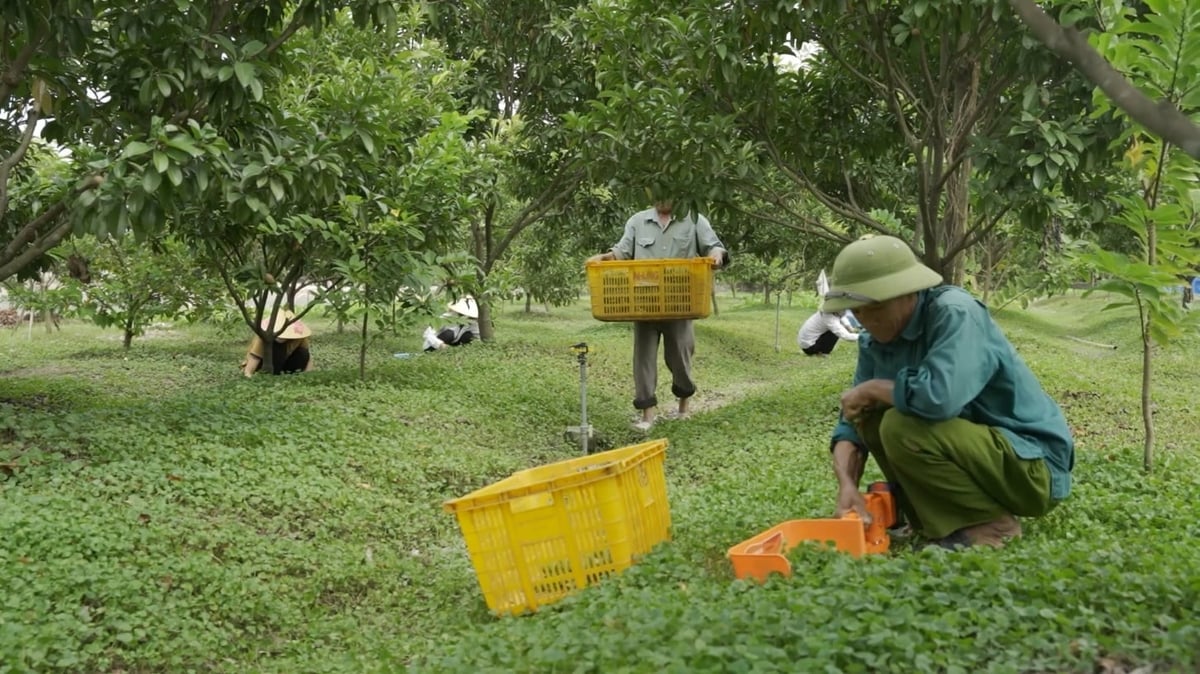
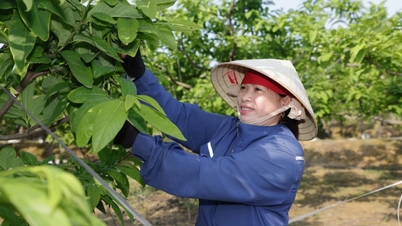
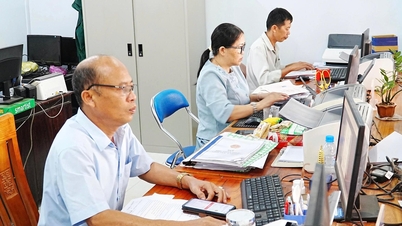
Workers at Mr. Ngoc's farm. Photo: Tho Long.
Mr. Ngoc said that the pennywort he grows is a native variety, a wild plant that has been growing in the countryside for a long time. Its leaves are small, the stems are slender, the stalks are tough, and it has a richer, more fragrant flavor compared to hybrid varieties. However, unlike hybrids which can be grown year-round, the native pennywort is only suitable for a few summer months and is less tolerant of cold. Its yield is not as high as hybrid pennywort, but its quality is superior. Therefore, he accepts the challenge to preserve the unique characteristics of his product.
Taking care of vegetables is like taking care of a newborn baby.
Achieving the lush, clean water spinach cultivation area he has now was no easy feat for Mr. Ngoc. At first glance, growing vegetables seems to revolve around familiar steps like preparing the soil, applying organic fertilizer, and watering regularly, but with water spinach, the most difficult part lies in keeping the vegetables truly clean.
According to Mr. Ngoc, because they don't use herbicides, the most laborious part is manual weeding. This task has to be done three times a month, and hiring people is expensive. Furthermore, soil pests are a constant worry. These pests cause damage silently; they are almost invisible during the day, only crawling up to eat the leaves at night. To effectively control them, growers must time it correctly, usually around 7 PM, bringing lights to the fields to spray biological pesticides. The work is repetitive, requiring patience and meticulous care, like tending to one's own children.
"If you spray pesticides at the wrong time, it's a waste of time and money. And if you use chemical pesticides, the vegetables are no longer clean and it harms the whole plant," Mr. Ngoc explained.

Mr. Ngoc is both a farmer and a "machine operator" engineer. Photo: Quoc Toan.
There were years when the soil pests broke out fiercely, and he lost four crops of vegetables in a row. Not only did he suffer losses in yield, but each pest infestation also required him to rehabilitate the soil, costing him extra effort and expense. Despite this, he accepted it and started over.
Not only does Mr. Ngoc ensure safe production principles for himself, but he also requires the affiliated households to strictly adhere to the following: No pesticides or chemical fertilizers should be used; only biological products should be used in cultivation. "Nitrogen fertilizers leave long-lasting residue, no different from pesticides. The vegetables look green, but they don't taste good. You can tell with the naked eye whether the vegetables have been sprayed with pesticides or not. Vegetables treated with chemical pesticides or nitrogen fertilizers are usually greener, but they spoil quickly," Mr. Ngoc revealed.
After harvesting, the Centella asiatica (Gotu Kola) undergoes a rigorous processing procedure, from sorting, washing, steaming, drying, to grinding and packaging. Each step is done carefully and meticulously. In particular, the packaging process is carried out in a cold room and sterilized with UV rays to ensure safety and maintain product quality.

Mr. Ngoc is directly involved in processing the products. Photo: Quoc Toan.
Deep processing, increasing value.
In 2019, the Dong Ngau Crop and Livestock Cooperative was established, linking with more than 10 households to participate in production. To date, the area planted with water spinach has expanded to over 2 hectares, with an average yield of about 4-6 quintals per sao (approximately 1000 square meters) per month. Overall, the annual production reaches tens of tons.
In recent years, the consumption of fresh pennywort has slowed down. Sometimes, when there's a good harvest, the price drops. Other times, the harvested pennywort wilts before it can be sold. Seeing his produce unsaleable, Mr. Ngoc began thinking about switching to making pennywort powder, which would allow for longer preservation and increase the product's value.
Determined to see it through, he boldly borrowed capital and invested in freeze dryers, roasters, packaging machines, and other equipment, totaling several billion dong. In the early days, he practically lived and breathed the machinery, learning and operating it smoothly. At one point, the product was well-received by the market, and foreign partners came to place orders. But just as joy began to blossom, difficulties arose. Bulky raw materials, high storage costs, and a small-scale production forced him to reconsider his direction.

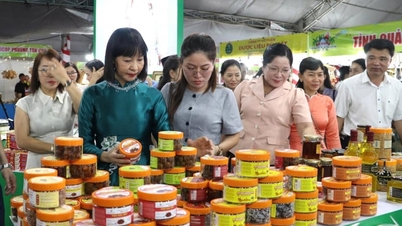
Products made from Centella asiatica (Gotu Kola) by the Dong Ngau Crop and Livestock Cooperative are available in many provinces and cities nationwide. Photo: Quoc Toan.
Before they could even manage to repay their investment debts, natural disasters struck repeatedly. In 2025, massive floods swept through, destroying large areas of unharvested vegetables, causing billions of dong in losses. Wages for the workers remained unpaid, adding to the pressure, and the debts are still outstanding.
However, Mr. Ngoc did not give up. To reduce pressure on sales, he shifted his focus to deeper processing, creating more products from centella asiatica such as pure powder, centella asiatica with mung beans, centella asiatica with lotus seeds, centella asiatica tea, etc. Thanks to this, the shelf life is extended, and the value of the products is also increased. Currently, the products are available in many places, including distributors in the northern provinces. Despite receiving numerous large orders, he maintains a steady approach, not rushing to expand rapidly in order to ensure quality.
After deducting expenses, his family earns approximately 500-600 million VND per year. In 2024, Dong Ngau centella powder was recognized as a 3-star OCOP product and received food safety and hygiene certification.
The centella powder product retains the original flavor, color, and beneficial nutrients of fresh centella, contains no preservatives, and is not mixed with any chemical additives. The Dong Ngau Crop and Livestock Cooperative maintains regular employment for more than 10 workers, mainly elderly people in the area, with an average income of 4-6 million VND per person per month.
Source: https://nongnghiepmoitruong.vn/lam-giau-tu-loai-rau-chong-doi-d809386.html





















































































Comment (0)