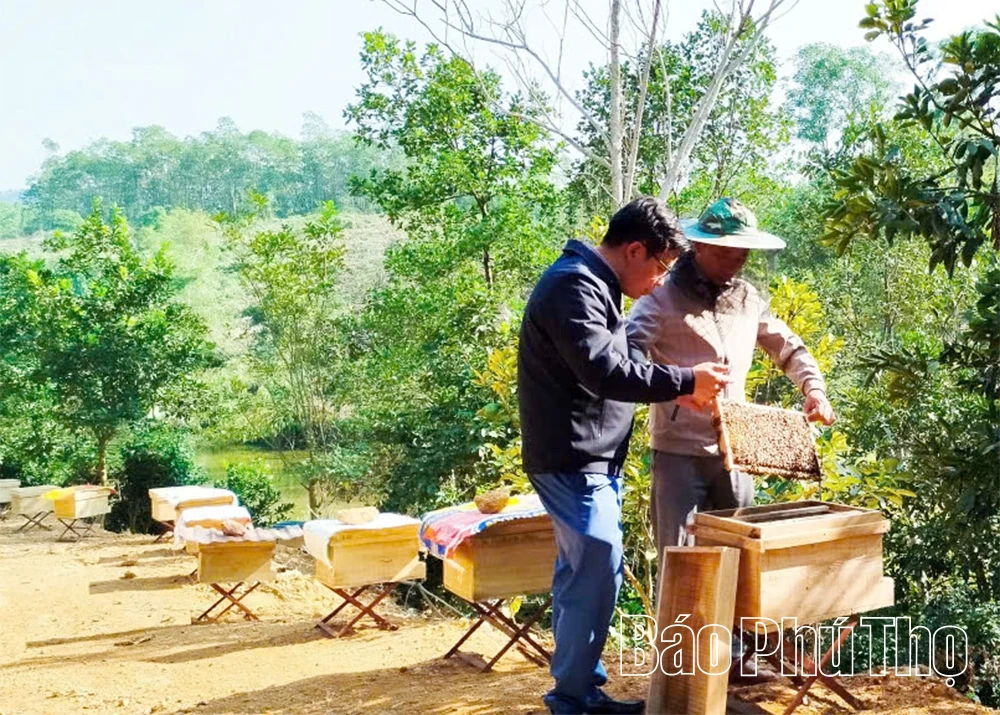
Thanks to beekeeping, the family of Mr. Vu Hong Son in Phu Khe commune has a stable income and has risen to become one of the well-off households in the commune.

 Báo Phú Thọ•29/03/2026
Thanks to beekeeping, the family of Mr. Vu Hong Son in Phu Khe commune has a stable income and has risen to become one of the well-off households in the commune.
Mr. Dinh Trong Tam, Director of My Thuan Agricultural and Forestry Service Cooperative in Minh Dai commune, recalled the early days of the cooperative's establishment: "In 2009, we noticed that many families in the commune raised bees, but the product was very difficult to sell. Sometimes, we saw households with thousands of liters of honey unsold, and the commune government was very concerned and sought many solutions to help the people overcome the difficulties. At that time, the Agricultural and Forestry Service Cooperative was the only unit in the commune capable of attracting bee-raising households to join the collective. With the encouragement of the district and commune leaders, the cooperative gathered the households, developed an operational plan, organized the transportation of bee colonies, moved bees to other provinces to collect honey according to the season, and sought markets for the products. Although I myself did not raise bees, I was trusted by the members, so I had to make every effort to help the people have a stable sales channel. From over 200 initial bee colonies, the total number of bee colonies in the cooperative has now reached over [number]. "With 2,200 hives, honey production reaches approximately 33,000 liters per year."
The My Thuan Agricultural and Forestry Service Cooperative currently has over 70 members, 23 of whom are engaged in beekeeping. The household with the largest beekeeping operation has approximately 600 colonies, while the smallest has nearly 100. Their products are quite diverse, including forest honey, honey from the flowers of the Bidens pilosa plant, mint, longan, lychee, and acacia. With an average selling price of around 130,000 VND/liter, the cooperative's beekeeping revenue exceeds 4 billion VND per year. Thanks to beekeeping, many households have escaped poverty and become well-off in the locality. The cooperative's products have been recognized as achieving OCOP 3-star standards since 2023.
Having been involved in beekeeping for many years, Mr. Le Dinh Thanh - Director of Tu Vu Honey Beekeeping Cooperative, Tu Vu commune, said: "The income from beekeeping is much higher than that from forestry, and it also contributes to forest protection, because the industry can only develop if there are plenty of forests. Beekeeping is not as difficult as many people think; the only hardships are moving the colonies and the initial stages of setting up colonies to feed the bees with pollen, and monitoring for signs that the bees want to split. Due to the nature of the work, after the summer, we move the bee colonies to highland provinces such as Lai Chau , Son La, Lao Cai, and Tuyen Quang... because these areas still have abundant forests and many fruit-growing regions, making it convenient for bees to collect honey. After setting up the colonies, the work is very easy, harvesting honey once a week. The sale of honey is quite favorable, with about two-thirds of the honey production exported to the Chinese market."
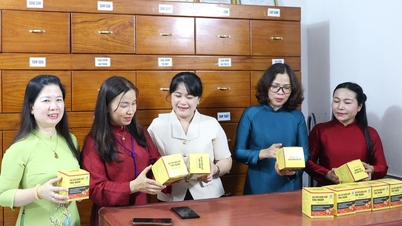
Of the 696 OCOP products in the province, more than 60 honey products have been recognized as meeting standards of 3 stars or higher, produced by over 40 entities including individual households, cooperatives, and associations. These entities currently have approximately 330,000 bee colonies, supplying over 1 million liters of honey to the market annually, generating hundreds of billions of dong in revenue. Besides pure honey, a range of honey-based products such as rose honey, honey-milk cakes, ginseng honey, cordyceps honey, and Polygonum multiflorum honey capsules are also produced by these entities, providing valuable food and medicinal products to those in need.
Currently, beekeeping for honey production is developing rapidly. To remain competitive, cooperatives, associations, and beekeepers need to focus on improving product quality; obtaining food safety certifications, and diversifying designs and packaging to attract consumers. At the same time, these entities need to continue promoting research and innovation to create new products that meet the increasingly high and diverse demands of consumers. Mr. Nguyen Thanh Hiep, Deputy Head of the Rural Development Sub-Department, stated: When products are certified under the OCOP standard, it greatly facilitates sales, especially since consumers can easily access information by scanning QR codes. In the future, the Sub-Department encourages cooperatives and associations to invest in additional machinery such as water separation machines and stratification machines to improve product quality. At the same time, we will strengthen links with cooperatives and beekeeping villages inside and outside the province, establish a beekeeping association, build brands, and serve the goal of exporting through official channels, helping people feel secure in getting rich from beekeeping.
Quan Lam
Source: https://baophutho.vn/lam-giau-tu-nghe-nuoi-ong-250663.htm


















































































Comment (0)