 |
| The main palace area of Lam Kinh. Photo: Binh Nguyen |
KDT (Knowledge Center) attracts tourists not only because it has preserved the unique beauty of its imperial architecture, but also because it is a sacred land with mysterious legends associated with the Later Le Dynasty.
Unique palace architecture
After leading the Lam Kinh Uprising for 10 years (1418-1428), King Le Thai To drove out the Ming invaders and ascended the throne, establishing his capital in Dong Kinh (Thang Long). At the same time, the king ordered the construction of a citadel called Lam Kinh in his ancestral land of Lam Son (the former capital of Dai Viet), with the purpose of worshipping his ancestors and serving as a mausoleum for him to rest in after his death.
Before entering the Lam Kinh historical site, visitors pass along the winding Ngoc River, lined on both sides with ancient trees casting their shadows onto the tranquil water; the curved Bach Ngoc Bridge spans the river; and about 50 meters further is a giant ancient well, built during the time of the great-great-grandfather Le Loi, which remains full of water year-round.
The ancient capital of Lam Kinh was built according to the "mountain-backed, water-facing" principle, with its north side against Dau Mountain, its south side overlooking the Chu River and Chua Mountain, its left side facing Phu Lam Forest, and its right side facing Huong Mountain and Ham Rong Mountain. The Imperial Citadel, palaces, and Thai Mieu (Royal Temple) in Lam Kinh were arranged along a north-south axis on a hilly area shaped like the Chinese character "Wang" (王).
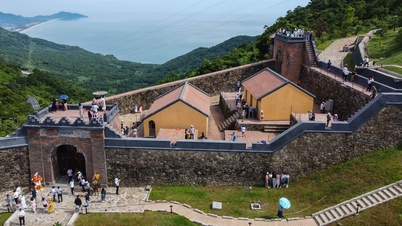
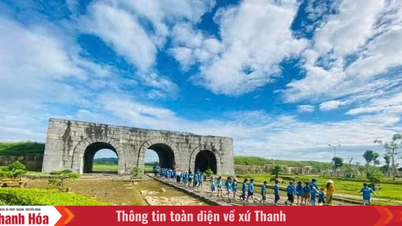
The Ngo Mon Gate, with its three bays, is a grand structure within the Lam Kinh historical site, where rituals took place before the royal audience. The spacious Dragon Courtyard, covering over 3,500 square meters , has three pathways leading to the main hall. This is where ceremonial rituals were performed during major festivals throughout the year. The main hall of the historical site is built in the shape of the Chinese character "Công" (meaning "work" or "achievement"), with three large buildings constructed entirely of wood and supported by massive pillars. The main hall best exemplifies the beauty of ancient royal palace architecture. Immediately behind the main hall are nine Thai Mieu temples, dedicated to the kings and queens of the Later Le Dynasty. The space of the Thai Mieu temples is solemnly and sacredly arranged, with a curved shape embracing the main hall. The roofs are covered with traditional curved tiles. The mausoleum system within the Lam Kinh historical site is also large in scale, serving as the resting place for the kings and queen mothers.
Besides its unique architectural structures, the Lam Kinh historical site also preserves many valuable historical artifacts such as: the Vinh Lang stone stele recording the life and career of King Le Thai To, the stele of Empress Dowager Ngo Thi Ngoc Dao, the stele of King Le Thanh Tong, etc.
A place where mystical legends are preserved.
Lam Kinh National Park also attracts tourists from all over the world because of its legends, steeped in mystery, about the great national hero Le Loi and the existence of a prosperous feudal dynasty.
The most prominent structure here is Vinh Lang, the resting place of King Le Thai To, situated with its back against the mountain and its front facing the mountain, surrounded by two high mountain ranges forming a "tiger crouching, dragon bowing" formation. In front of Vinh Lang are two stone statues of mandarins, and four pairs of statues of mythical creatures: a lion, a horse, a rhinoceros, and a tiger. The Vinh Lang stele is a national treasure, measuring 2.97m high and 1.94m wide, made of a single block of sedimentary rock, and placed on the back of a large turtle also carved from a single block of sedimentary rock. The inscription on the stele was compiled by the national hero and world cultural figure Nguyen Trai, recording the life and career of King Le Thai To.
 |
| Vinh Lang - the resting place of King Le Thai To. |
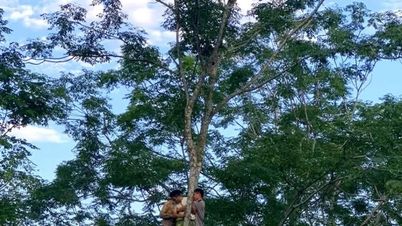
A unique feature of the Vinh Lang area is the story of the "laughing guava tree." In 1933, Mr. Tran Hung Dan from Hanh Thien village, Nam Dinh province (now Ninh Binh province), donated four elephant statues and planted a longan and guava tree at the tomb of King Le Thai To after praying there and having a son. The guava tree, with its slender branches and leaves shaped like a dragon, is planted in a sacred location and has the special ability to "laugh." When someone gently touches the trunk, the leaves will tremble in waves as if laughing, even on a calm day; when the touch stops, the guava tree stands still. Many believe that placing a hand or fist on a branch of the guava tree while closing their eyes and meditating brings a feeling of relief and tranquility, as if a stream of energy and vitality is being transmitted from the tree to the person. Some people who have taken cuttings from this tree and planted them elsewhere do not experience this phenomenon. Everyone believes that only when planted in sacred land does the guava tree know how to "laugh." If we were to study it from a scientific perspective, we would surely find a specific explanation.
In 1962, Lam Kinh Citadel was officially recognized as a National Historical Monument, and was restored in 2002 with its architecture almost completely preserved. In 2013, Lam Kinh Citadel was recognized as a Special National Monument.
Another fascinating legend tells of a giant banyan and persimmon tree, over 300 years old and approximately 50 meters tall, so large that it would take a dozen people to encircle it. The tree was planted right behind the Ngo Mon Gate, to the left of the Dragon Courtyard. According to legend, the spot where the banyan tree once stood was originally a persimmon tree with many ripe fruits, attracting birds that perched on its branches and dropped banyan seeds. The banyan tree grew lush and green, its roots embracing the persimmon tree's trunk, creating a single trunk with two branches. The persimmon tree living within the banyan tree remained vibrant, blooming and bearing fragrant fruit every year, filling the courtyard with its scent. In 2007, the old persimmon tree's trunk withered and died, but then sprouted new shoots. The two trees remained inseparable. This revival demonstrates the enduring vitality of the ancient capital of Lam Kinh amidst the vicissitudes of history.
The magnificent and imposing Lam Kinh Palace, as it stands today, was reconstructed to its original scale, size, and architecture. At the time the Thanh Hoa Provincial People's Committee decided to reconstruct the Lam Kinh Palace, a strange story occurred that people called the "self-sacrificing" story of the ancient lim tree. At that time, a 600-year-old lim tree in the Lam Kinh forest, which had been thriving, suddenly shed all its leaves and gradually withered. This story has many coincidences that science has yet to explain: the tree shedding its leaves coincided with the approval of the Lam Kinh Palace reconstruction project, and the tree died just as the design and construction were completed. Normally, the older the lim tree, the more hollow its trunk becomes. But when the ancient lim tree was felled, from root to tip, it was solid. Even more astonishing was that when the bark was removed, the base of the lim tree, with a radius of approximately 82cm, perfectly fit the stone base of the original main pillar of the palace. Furthermore, the trunks and branches of the ironwood tree fit perfectly to be used as pillars for the main hall, porch pillars, and roof beams in the front and middle halls. This further reinforces the belief that in the sacred ancient capital of Lam Kinh, the landscape and trees themselves possess "spirits" and "souls."
Plains
Source: https://baodongnai.com.vn/dong-nai-cuoi-tuan/202605/lam-kinh-kinh-do-thu-2-cua-trieu-hau-le-5f74274/

























































































Comment (0)