

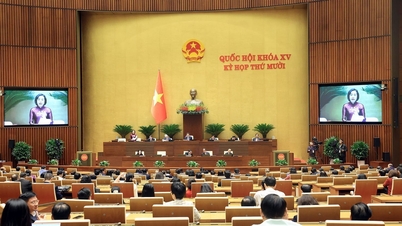
Continuing the 10th Session program, on the afternoon of December 2, the National Assembly discussed in the hall the Investment Policy of the National Target Program on Modernizing and Improving the Quality of Education and Training for the 2026 - 2035 Period (Program).
Agreeing with the National Assembly's consideration and approval of the investment policy for the Program, many delegates stated that this is a decision of long-term strategic significance according to the Party's policies and guidelines; creating a solid foundation for human development, developing high-quality human resources to serve the country's industrialization and modernization in the context of digital transformation and international integration.
Regarding the budget for implementing the Program, delegate Nguyen Tam Hung ( Ho Chi Minh City) expressed his agreement with the total capital scale and capital structure.
However, to ensure effective capital allocation and clear accountability, delegates suggested considering adding an allocation and disbursement mechanism linked to measurable output indicators such as: the number of solid classrooms put into use, the rate of qualified teachers, the number of learners benefiting from capacity building programs, and the level of digital transformation of educational institutions.
"Allocating capital according to output will overcome the request-grant mechanism, promote progress and increase the efficiency of investment budget collection," the delegate emphasized.
Regarding the principle of allocating central budget capital, delegate Nguyen Tam Hung agreed with the principle of prioritizing disadvantaged localities. However, to ensure efficiency and avoid loss, the delegate suggested considering establishing an independent monitoring mechanism for investment in infrastructure and purchasing teaching equipment, in order to end wasteful purchases, wrong needs or unused equipment. This is an urgent matter to protect the state budget and improve the efficiency of public investment in education and training.
Referring to the content related to ensuring equal access to education, delegate Nguyen Hoang Bao Tran (Ho Chi Minh City) said that for many years, when talking about educational difficulties, we often mentioned remote, isolated and island areas.
However, there is another group of people that is rarely mentioned but is in fact equally difficult, which is the children of workers in industrial parks and export processing zones.
The delegate analyzed that, on the surface, the children living in urban areas, near the center, seem to have more favorable conditions. But in reality, the workers' lives are still difficult: cramped boarding houses, unsafe living environments, parents working overtime continuously, unstable income, not enough time to care for and support their children's studies.
Most families only live in 10-12m2 rented rooms. Children have no space to study, lack social connections, and have no access to extracurricular activities.
Compared to children in mountainous areas, the difficulties of the two groups are different in form, but they have in common that they are disadvantaged: lack of quality learning environment, lack of support from family and lack of opportunities for comprehensive development.
In some places, more than 70% of children in industrial zones do not have access to extracurricular subjects, foreign languages or extracurricular activities because their family's economic conditions do not allow it.
Therefore, delegates suggested that the National Target Program must clearly identify children of workers as a group of subjects needing priority support, not as a general group.
This group of subjects is not only prioritized in scholarship policies, but also in contents such as: Support for building public schools near industrial parks; flexible boarding school models for workers' children to ensure lunch, afternoon study, participation in skill activities, safe play, helping parents feel secure going to work, while ensuring children are not interrupted in their studies and comprehensive development.
Along with that is a community learning space in the boarding house; a program to support psychological and skills for migrant children. "Education equity is not only a matter between the mountainous and lowland areas but also equity in the heart of industrial cities," the delegate pointed out.
Concerned about the funding for implementing the Program, delegate Chu Thi Hong Thai (Lang Son) said that the capital structure of the Program is focusing too much on the 2031-2035 period with more than 405,000 billion VND, accounting for 70% of total resources; while the 2026-2030 period only allocates over 174,000 billion VND, equivalent to 30%.
According to the delegate, this allocation method requires the first 5 years to establish fundamental goals such as solidifying 100% of classrooms, ensuring public housing for teachers in difficult areas, key investments for 18 colleges, striving for 50% of higher education facilities to meet standards, at least 30% of educational facilities to be invested in modernly...; the fundamental targets are very large but there are not enough resources to create clear changes.
Concentrating most of the capital to the later stage increases the risk of work accumulation and target accumulation, causing the implementation progress to not closely follow the requirements of the National Assembly's resolution; especially in the context of the ability to balance the budget after 2030 with many unpredictable factors.
Therefore, delegates proposed that the Government study the restructuring of capital allocation towards increasing the proportion for the 2026-2030 period, ensuring sufficient resources to complete fundamental goals such as: solidifying classrooms, public housing, boarding houses, and adding teachers in difficult areas.
At the same time, it is necessary to clearly define the order of capital priority, in which priority is given to ethnic minority areas, mountainous areas, border areas and poor communes to create real changes right from the beginning, avoiding putting pressure on the 2031-2035 period.
In the case of implementing many national target programs, limited resources have not been allocated, delegates said that the targets for the 2026-2030 period should only focus on urgent and fundamental tasks./.
Source: https://www.vietnamplus.vn/lam-ro-co-cau-phan-ky-von-thu-tu-uu-tien-dau-tu-nguon-luc-cho-giao-duc-post1080574.vnp
![[Photo] Parade to celebrate the 50th anniversary of Laos' National Day](/_next/image?url=https%3A%2F%2Fvphoto.vietnam.vn%2Fthumb%2F1200x675%2Fvietnam%2Fresource%2FIMAGE%2F2025%2F12%2F02%2F1764691918289_ndo_br_0-jpg.webp&w=3840&q=75)



![[Photo] Worshiping the Tuyet Son statue - a nearly 400-year-old treasure at Keo Pagoda](/_next/image?url=https%3A%2F%2Fvphoto.vietnam.vn%2Fthumb%2F1200x675%2Fvietnam%2Fresource%2FIMAGE%2F2025%2F12%2F02%2F1764679323086_ndo_br_tempimageomw0hi-4884-jpg.webp&w=3840&q=75)







![[Video] Urgently preparing for the inauguration and groundbreaking ceremony of projects to welcome the 14th National Party Congress](https://vphoto.vietnam.vn/thumb/402x226/vietnam/resource/IMAGE/2025/12/02/1764691316170_dung00-16-00-06still005-jpg.webp)



























































Comment (0)