

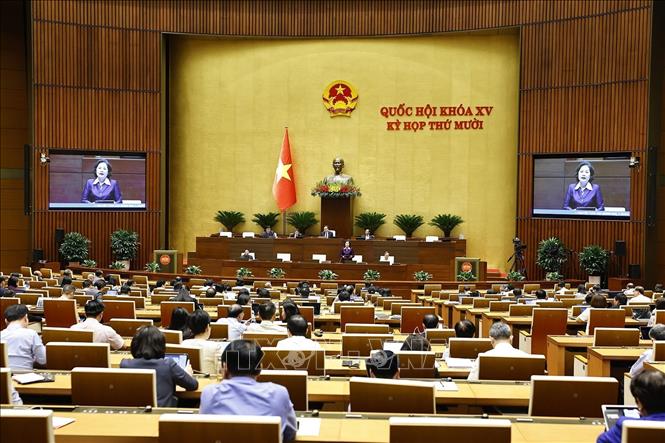
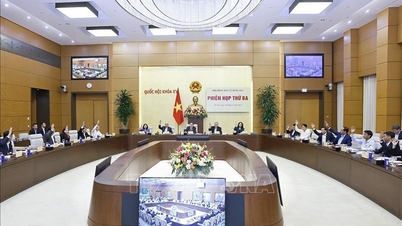
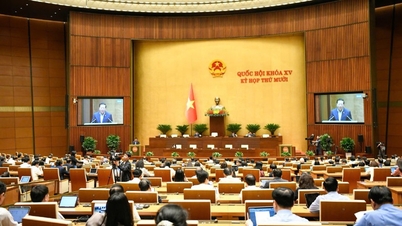
At the meeting, delegates emphasized that the draft Law was built to create a complete and clear legal corridor for deposit insurance organizations to better protect depositors' rights, ensure the stability of the credit institution system, and ensure social security and safety.
Many opinions suggested clarifying the legal value of inspection results conducted by deposit insurance organizations, strengthening information sharing mechanisms, and effectively coordinating between relevant agencies in inspecting, examining, and supervising credit institutions.
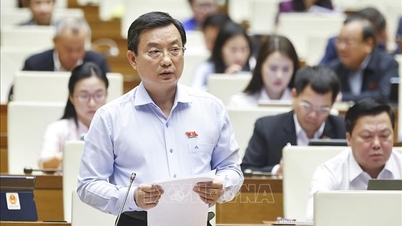
Commenting on the inspection activities of the deposit insurance organization, delegate Thai Quynh Mai Dung ( Phu Tho ) said that, in addition to the task of inspecting the compliance with the provisions of the law on deposit insurance inheriting the current law, the draft Law on Deposit Insurance (amended) has a provision assigning the deposit insurance organization to "Conduct inspections of organizations participating in deposit insurance according to the plan and content assigned by the State Bank".
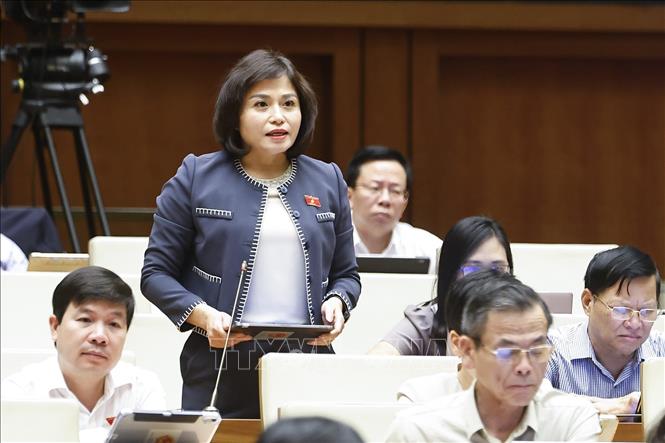
Agreeing with the addition of this provision, the delegate analyzed that the common characteristic of all types of insurance is that the insurance organization needs to monitor the "health" of the organization it insures, from which it can calculate the insurance premium as well as detect and prevent risks that lead to the risk of having to use the insurance fund to pay. This is also true for deposit insurance, so allowing the deposit insurance organization to inspect the organization participating in deposit insurance is reasonable.
According to the delegate, in more than 25 years of implementing the deposit insurance policy, the Vietnam Deposit Insurance has built an operational network with headquarters and regional branches, a team of competent and well-trained staff. "Therefore, assigning the deposit insurance organization to inspect organizations participating in deposit insurance will help take advantage of human resources to support the inspection work of the State Bank; at the same time, bring a multi-dimensional perspective in evaluating the operations of credit institutions", the delegate emphasized.
Along with that, delegate Thai Quynh Mai Dung also requested the drafting agency to clearly distinguish the inspection activities of the Deposit Insurance of Vietnam and the inspection activities of the State Bank, ensuring no overlap and no difficulty for businesses.
In addition, delegate Thai Quynh Mai Dung requested the drafting agency to clarify the legal value of the inspection activities of the deposit insurance organization.
“When inspecting, if there are signs of violations or risks of insecurity, does the deposit insurance organization have the right to recommend or issue warnings to the credit institution? This is an important factor to ensure the effectiveness, efficiency and substance of the inspection activities of the deposit insurance organization,” the delegate suggested.
Also commenting on this content, delegate Thach Phuoc Binh (Vinh Long) proposed adding a regulation allowing the Deposit Insurance of Vietnam to issue warnings and direct recommendations to credit institutions when risks are detected during inspection; and at the same time report to the State Bank for appropriate monitoring measures. The delegate said that this right is not an inspection, not a sanction, but an early warning tool, helping to minimize systemic risks.
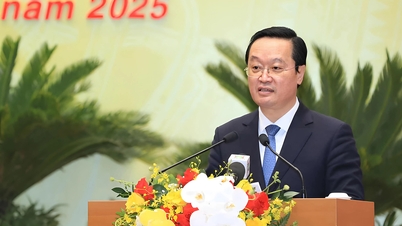
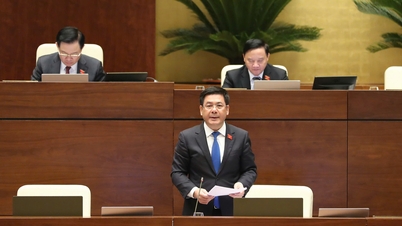
Discussing and clarifying at the meeting, Governor of the State Bank of Vietnam Nguyen Thi Hong said that regarding the inspection activities of deposit insurance, the State Bank, as a management agency, will clearly define the scope and limits of inspection contents of deposit insurance organizations to ensure that they do not overlap with the inspection scope of the State Bank as well as competent agencies in the inspection, examination and supervision of credit institutions.
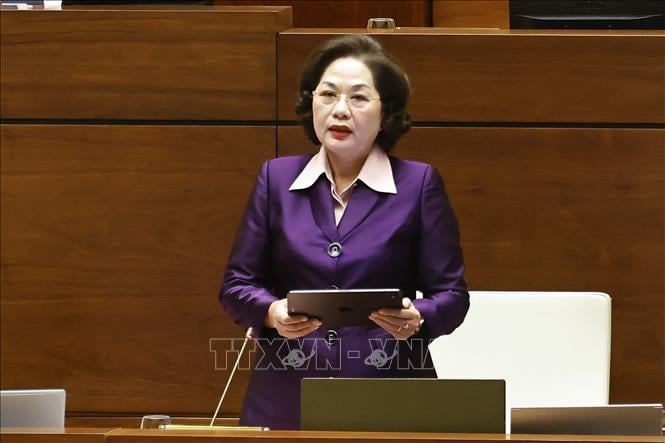
Regarding the fact that during the inspection process, the deposit insurance organization can make recommendations and warnings to credit institutions, Ms. Nguyen Thi Hong said that this is the result of the inspection activity, not necessarily included in the provisions of the law. The State Bank, as a management agency, will have a complete and comprehensive grasp of the situation of a credit institution.
“The State Bank will consider the recommendations of the deposit insurance to make decisions and take measures. Thus, through the inspection activities of the deposit insurance organization, it is possible to enhance the role and responsibility of the deposit insurance organization for the operational safety of the system of application organizations, as well as create an additional inspection channel to serve the state management of banking activities,” the Governor of the State Bank of Vietnam emphasized.
Approving the Resolution on the central budget allocation plan for 2026
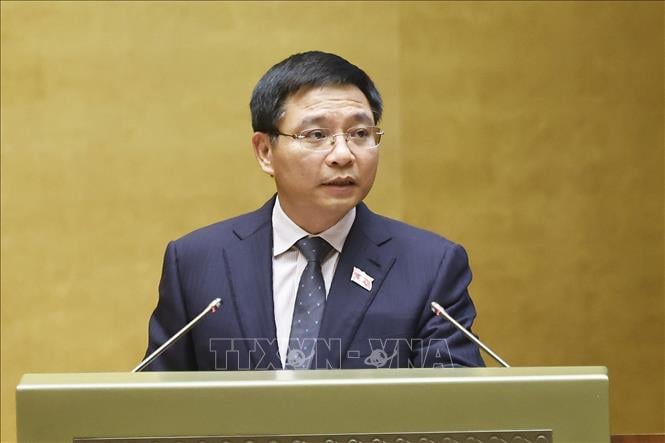
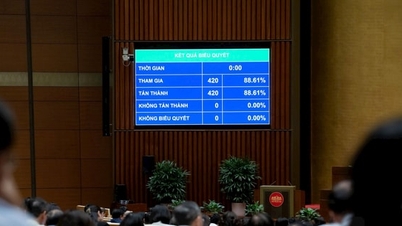
Also at the meeting, the National Assembly voted to pass the Resolution on the central budget allocation plan for 2026 with 420/420 delegates voting in favor (100%).
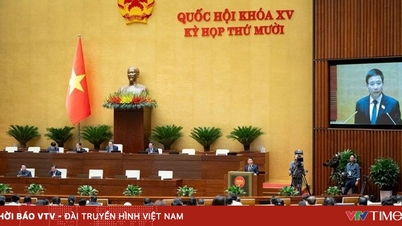
Before voting, the National Assembly listened to Minister of Finance Nguyen Van Thang present a summary report explaining, accepting and revising the draft Resolution on the central budget allocation plan for 2026.
Accordingly, the total central budget revenue is 1,225,356 billion VND. The total central budget expenditure is 1,809,056 billion VND, of which: an estimate of 238,421 billion VND to supplement the local budget balance; an estimate of 53,554 billion VND to supplement localities to ensure the implementation of the basic salary of 2.34 million VND/month; an estimate of 187,175 billion VND to supplement the local budget target.
According to Minister Nguyen Van Thang, enhancing the leading role of the central budget is one of the contents that the Party, State and Government pay great attention to and direct the Ministry of Finance to carefully review when building annual estimates. For the 2026 estimate, the leading role of the central budget is shown from various perspectives, accordingly: Total central budget expenditure accounts for 57.7% of total state budget expenditure, ensuring political, defense and security tasks, investing in important national tasks and projects, synchronously developing socio-economic infrastructure, creating momentum for the country's economic growth.
The central budget continues to supplement 479 trillion VND to the local budget to ensure balance, targeted supplementation to implement projects, social security policies and salary reform. Particularly for the central budget, accounting for 48.4% of the total state budget revenue, the reason is to ensure security, financial safety and prudence in the context of many fluctuations.
Balanced revenue from import-export activities is equivalent to the estimated implementation in 2025. Meanwhile, the estimated land use fee revenue in 2026 is expected to increase by VND 220 trillion compared to the estimate in 2025 because it is expected that in 2026, the national transport infrastructure will continue to be completed and land lease auctions will be promoted, while this is a local budget revenue that enjoys up to 85.7%.
The Minister of Finance said that if land use fee revenue is excluded, the central budget accounts for over 56% of the total state budget revenue. In addition, according to Article 44 of the Resolution on the 2026 state budget estimate, in implementation, the National Assembly assigned the Government to direct the effort to increase the state budget revenue in 2026 by at least 10% compared to the estimated implementation in 2025, so it is expected that the proportion of central budget revenue will increase during the implementation process, ensuring the enhancement of the leading role of the central budget.
For 2027, synchronous implementation according to the State Budget Law 2025 will comprehensively change the decentralization of revenue sources and expenditure tasks between the central and local levels, and the leading role of the central budget will be further consolidated.
Source: https://baotintuc.vn/thoi-su/lam-ro-gia-tri-phap-ly-cua-hoat-dong-kiem-tra-cua-to-chuc-bao-hiem-tien-gui-20251114172941189.htm



![[Photo] Unique art of painting Tuong masks](https://vphoto.vietnam.vn/thumb/1200x675/vietnam/resource/IMAGE/2025/11/14/1763094089301_ndo_br_1-jpg.webp)
![[Photo] Unique architecture of the deepest metro station in France](https://vphoto.vietnam.vn/thumb/1200x675/vietnam/resource/IMAGE/2025/11/14/1763107592365_ga-sau-nhat-nuoc-phap-duy-1-6403-jpg.webp)
















![[Photo] Special class in Tra Linh](https://vphoto.vietnam.vn/thumb/1200x675/vietnam/resource/IMAGE/2025/11/14/1763078485441_ndo_br_lop-hoc-7-jpg.webp)



























































Comment (0)