

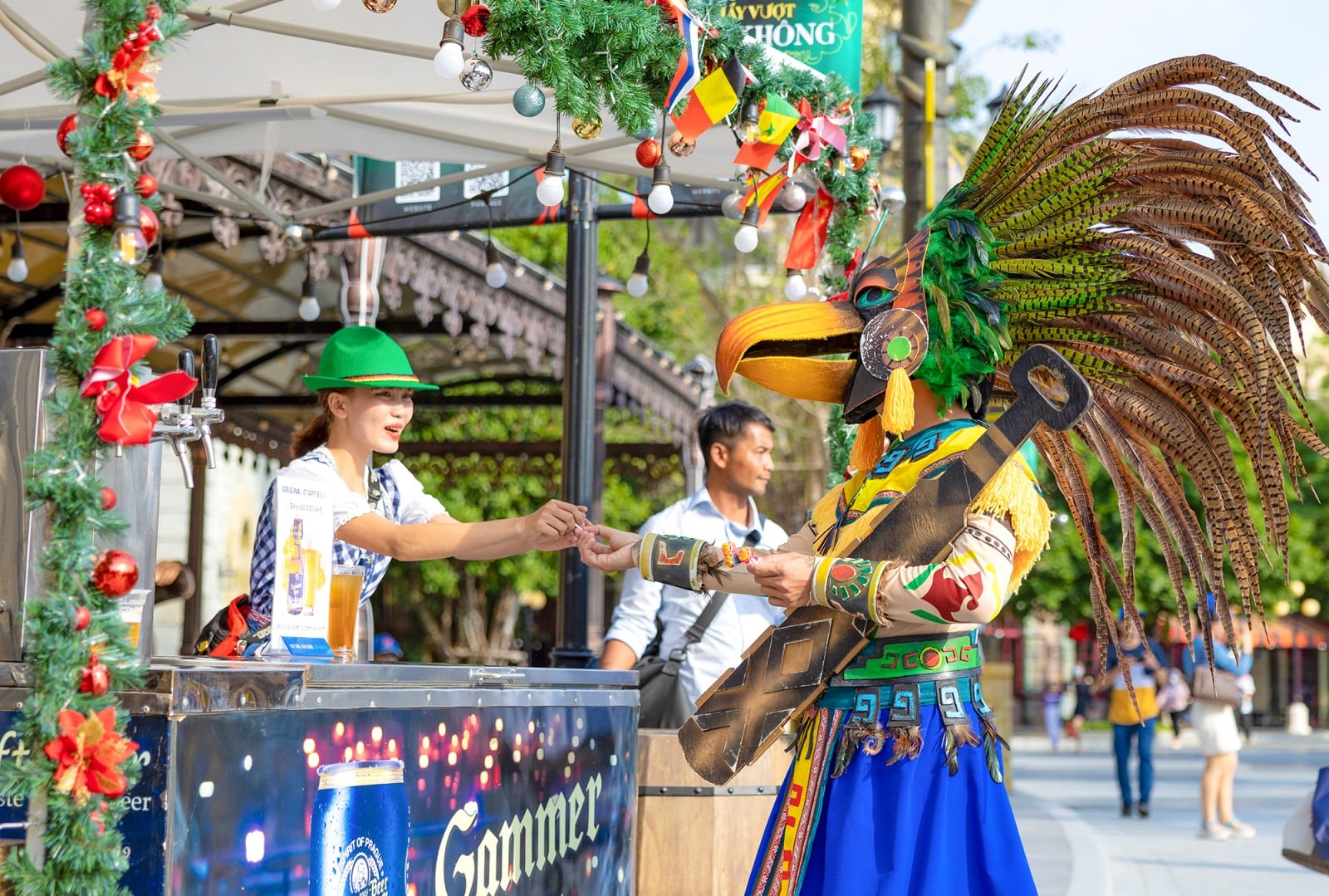
Seasonal workers add color to Phu Quoc tourism . Photo: PHAM HIEU
The seasonal labor market is heating up.
This year, for the April 30th and May 1st holidays, Nguyen Van To, a final-year student majoring in restaurant and hotel management at Kien Giang College, didn't return to his hometown in Tan Hiep commune but stayed in Rach Gia ward to work part-time. To said he's been working part-time since his first year of college. Besides his classes, he takes on part-time jobs at restaurants and hotels in Rach Gia. "Working part-time helps me earn extra income and hone my communication skills, accumulating necessary experience for my studies and future career," To said. According to To, he earns 180,000-200,000 VND for 6-8 hours of work, with double pay during holidays. With this income, To has enough money to cover his tuition and daily living expenses.
Mr. Tran Hoai An, a freelance tour guide in Ho Chi Minh City, who recently arrived in Rach Gia to prepare for his trip to Phu Quoc to lead tours during the April 30th and May 1st holidays, said that during peak tourist season, he has many tours in Ho Chi Minh City and several other provinces and cities, so he is quite busy. “Although the work leaves little time for rest, I am happy to meet clients, chat with them, explain about each place they visit, and I am happy to have money to cover my living expenses,” Mr. An shared. Mr. An said that a tour guide's salary during peak season can range from 25 to 35 million VND per month. In addition, there are tips from clients, tour sales revenue, etc., making it quite attractive.
According to businesses, the seasonality of tourism is a defining characteristic. Therefore, during holidays, Tet (Lunar New Year), and summer, the surge in visitors leads to a shortage of staff, and seasonal workers are quickly recruited to ensure uninterrupted business operations. “Phu Dien Tourist Area has 30 staff members, but during the April 30th and May 1st holidays, we still need an additional 15-20 seasonal workers each day to meet the workload. Without this workforce, the unit's operations would be difficult,” shared Mr. Vo Thanh Phong, Manager of Phu Dien Tourist Area, Rach Gia Ward.
Mr. Bui Ang Van, General Manager of Kim Hoa Resort Phu Quoc, said that in An Giang province , the most vibrant seasonal tourism labor market is Phu Quoc. This market is so "hot" that candidates are immediately interviewed and hired during the April 30th and May 1st holidays. The daily wage for seasonal tourism workers on the island ranges from 400,000 to 600,000 VND, including lunch. Despite this, there is still a labor shortage.
Many risks
According to Mr. Tran Hoai An, for seasonal tourism workers, income during peak season is quite good but unstable and unpredictable, lacking social benefits. “Because I'm a seasonal worker, I only have a contract for the job or a verbal agreement, so I'm easily exploited. Furthermore, I don't have social insurance or health insurance, meaning I don't receive support in case of work-related accidents or illness. When the peak tourist season ends, seasonal workers face the risk of losing their jobs immediately,” Mr. An said.
Furthermore, seasonal workers face risks such as unpaid wages, inadequate pay despite high workloads, and even recruitment scams. Many individuals exploit the demand for seasonal work to defraud workers by collecting brokerage fees or recruiting them for jobs that do not match the job descriptions.
From a business perspective, employing seasonal workers also presents numerous challenges, such as inconsistent labor quality and potential negative impacts on the company's image. Furthermore, seasonal workers often work for multiple companies simultaneously, potentially leading to staff shortages at critical times. In some cases, a lack of clear contracts or management procedures can result in disputes or risks when incidents occur with clients.
Mr. Le Van Dieu, Director of Mui Nai - Ha Tien Tourism Service Joint Stock Company, believes that to maximize the effectiveness of freelance labor, businesses should shift from using temporary workers to building a stable network, such as establishing a list of reliable collaborators with clear competency assessments. Along with that, short-term training should be organized to help seasonal workers understand the company's service processes and standards. Furthermore, businesses need to build flexible reward mechanisms such as performance-based bonuses or prioritizing work for high-performing employees; strengthening connections and creating a sense of belonging even for non-permanent employees…
Source: https://baoangiang.com.vn/lam-thoi-vu-du-lich-thu-nhap-cao-rui-ro-nhieu-a484494.html



































































































Comment (0)