

"The Capital " of Love
Also in the spring of 1558, Lord Nguyen Hoang, then Duke Doan, arrived from Thanh Hoa to take up his post and decided to stay in Ai Tu with his generals and soldiers. According to a story still passed down in folklore, upon dismounting and greeting the villagers, Duke Doan was offered seven jars of water by the elders, as if it were a sign from heaven that he would "receive water." At that time, his maternal uncle, Nguyen U Di, who was also his military advisor, remarked: "Heaven bestows everything as an omen. Now that the new Governor-General has arrived, the people are offering water; this is a good omen, foretelling that we will receive water."
 |
| Sắc Tứ Pagoda in Ái Tử - Photo: PXD |
From then on, Ai Tu village became the first capital of the Nguyen dynasty, opening up a vast and long-lasting empire following the southward expansion. Later, when the capital moved elsewhere, this area was still respectfully called Cuu Dinh or Dinh Ai Tu. Official historical records acknowledge the governance of Lord Nguyen Hoang: "He always showed kindness to the people, used fair laws to discipline his subordinates, and forbade the wicked. The people and soldiers of the two regions loved and respected him, appreciating his virtue and kindness. Customs were changed, the market did not have two prices, no one stole or robbed, the outer gates did not need to be locked, foreign merchant ships came to buy and trade at fair prices, military orders were strict, everyone strived, and the whole realm lived in peace and prosperity."
When mentioning Ai Tu, one cannot fail to mention the Sac Tu Tinh Quang Ancestral Temple, located on the site of the former Ai Tu village, now part of Trieu Phong commune. In a scientific seminar on the topic "Initial Understanding of Buddhism in Quang Tri," organized by the Lieu Quan Buddhist Cultural Center (Hue) at the temple, lay Buddhist Le Manh That remarked: "The issue of the lineage of the Sac Tu Tinh Quang Ancestral Temple needs further research to clarify its position in the history of Southern Vietnamese Buddhism in particular and Vietnamese Buddhism in general, during the period of our nation's expansion southward."
At this temple, I also spoke with the late Abbot Thich Tri Hai about the four stone monkey statues, most notably the three "Three Monkeys": not hearing, not seeing, and not speaking evil. The temple was recognized as a national historical monument by the State in 1991.
Learn from the past to understand the present.
That morning, I also had the opportunity to chat with Mr. Dinh Thuong Phuoc (commonly known as Mr. Phuc), whose Buddhist name is Thich Chan Quang. He is an elderly man, over 80 years old, knowledgeable in Chinese characters and devout in Buddhism. He told me that the Dinh family has been settled in Ai Tu for eight generations.
Taking a sip of tea, Mr. Phuoc calmly recounted the old days: “The village of Ai Tu used to be a dense forest, home to elephants, tigers, and wild animals. Originally part of Champa territory, it was only after the wedding of Princess Huyen Tran in 1306 that Vietnamese people came to live there. When Lord Nguyen Hoang established his kingdom, he knew to rely on the people, so Ai Tu village became a pillar of support for him. All important ceremonies issued by the Lord were entrusted to the people of Ai Tu village to handle.”
 |
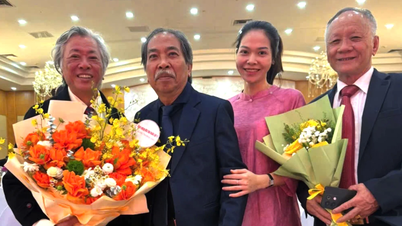
| The author converses with the elderly Ai Tu - Photo: PXD |
When I asked about the origin of the folk verse, Mr. Phuoc pondered: "It's true that the place name Ai Tu only exists here, while Mount Vong Phu exists in many places. Quang Tri doesn't have Mount Vong Phu, but perhaps because of the constant wars and invasions, the people combined the two place names into the verse: 'Mothers long for their children at Ai Tu Bridge / Wives long for their husbands at Vong Phu Mountain'."
Looking out into the courtyard, he enthusiastically recounted the legend of "Lady Trao Trao," who used her beauty to help Lord Nguyen Hoang defeat powerful invaders, contributing to the expansion of the kingdom's borders. He also mentioned that in 1842, King Thieu Tri, on his way to the North, visited the shrine of Lady Trao Trao, inspiring him to compose the poem "Passing by Ai Tu River and Reciting Ancient Poems," which he had inscribed on a stone stele erected at Giac Minh Pagoda (Ai Tu). The poem reads as follows: " Evening, a light boat glides past the emerald waters / The mountains and rivers evoke feelings beyond the thatched forest / The divine power of the emperor's creation will last for a thousand years / The sacred rain shines down, revering the ancients / The gentle breeze stirs the clear waves / The miraculous power sinks pirate ships / Why should the temple's incense burn ? / The wind stirs the waves , assisting the nation's heart."
The translation, as quoted by author Le Hoang Nguyen, reads: " The green boat glides lightly like a bird/ Our king guards this land/ Cultivating meritorious deeds for eternity/ Shining brightly with divine grace for eternity / Assisting the righteous, the shore resounds with the singing of birds/ Supporting the divine, enemy ships sink in the river/ The river is wise, the temples always have incense smoke/ The waves roar and the wind stirs, helping this country."
Stepping outside, I saw the golden sunlight pouring down like honey, and a gentle breeze blowing as if from the past, a past full of the nation's glorious past. A spring morning still lingered in my mind. My heart swelled with joy and hope for an increasingly warm and peaceful life in this homeland.
Pham Xuan Dung
Source: https://baoquangtri.vn/dat-va-nguoi-quang-tri/202605/lan-theo-cau-hat-que-nha-c1b3977/























































































Comment (0)