

Dong Thap province is not only known as the land of immense rice fields and year-round fruit-laden orchards, but also a place that preserves and develops many unique traditional crafts.
Among them, Dinh Yen mat weaving village stands out, formed and developed hundreds of years ago. This craft village is a place where the unique traditional cultural quintessence of the Southern region converges.
Dinh Yen mat weaving village is located along the Hau River, blessed by nature with a system of fertile sandbanks - ideal conditions for growing sedge and ba trees, two main raw materials used in mat weaving.
According to folklore researchers, the first residents of the village originated from the coastal plains of the North ( Thai Binh , Nam Dinh). During their migration to the South, they brought with them the traditional mat weaving craft and built the craft village as it is today.
Weaving mats is not a simple task. It requires skill, patience and experience accumulated over many generations. A skilled worker said that to make a beautiful mat, choosing sedge is a very important step. The sedge fibers must be even, not too big or too soft. After harvesting, the sedge is dried in the sun for 30 minutes to an hour to increase crispness and ease of dyeing.
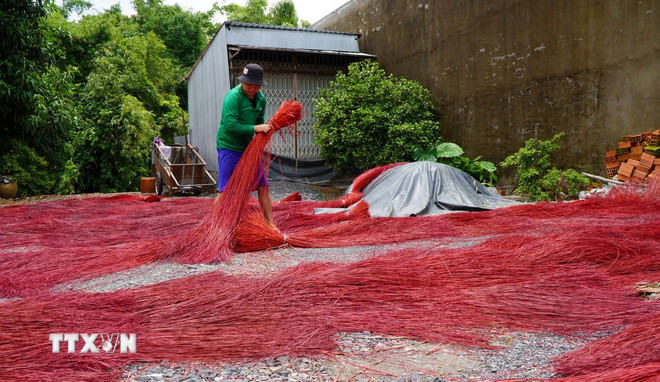
The process of dyeing sedge is an art. The dye is cooked in boiling water, then the worker will dip each small bundle of sedge into the color, adjusting the intensity by the number of times dipped - sometimes up to 2-3 times to achieve the desired color. After dyeing, the sedge fibers are dried again in the sun, before being woven.
The mat weaving stage is also the time for the craftsman to show his talent and aesthetic eye. Depending on the type of mat, the patterns, colors and techniques will be different. In particular, flower mats or snail-scale mats are considered the most difficult to weave, because they require meticulous calculation in the distribution of colors, creating patterns and "catching words" to make them even, balanced and eye-catching.
After weaving, the mat is cut, the fabric is sewn and dried one more time to complete the product.
Dinh Yen mats stand out for their diversity in designs, patterns and colors. In addition to simple white mats, the craft village is also famous for mats printed with traditional patterns, stork mats, and lavishly decorated wedding mats. Each mat is not only an everyday item but also carries aesthetic values and traditional cultural spirit.
The patterns on the mats often evoke nature and working life, such as snail scales, tea leaves, chess pieces, etc. This rustic yet vibrant aesthetic is what attracts customers everywhere, from rural to urban areas.
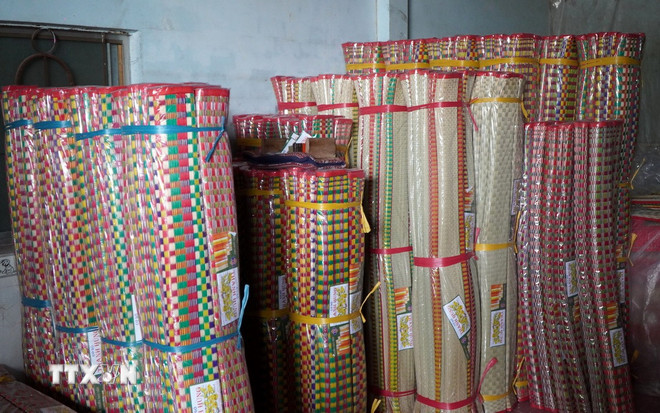
Not only limited to its functional use, Dinh Yen mats are also a symbol of the hard-working, meticulous spirit and skillful hands of the local people. Each mat is the crystallization of culture, of traditional handicraft skills and the flesh-and-blood attachment between the craftsman and his homeland. The Dinh Yen mat weaving profession not only contributes to preserving the national cultural identity but also plays an important role in developing the local economy . Hundreds of households are still attached to the profession, considering it the main source of income to help stabilize their lives and create jobs on the spot for many rural workers.
Dinh Yen mat weaving has been included in the National List of Intangible Cultural Heritage by the Minister of Culture, Sports and Tourism (according to Decision No. 3084/QD-BVHTTDL dated September 9, 2013)./.
Source: https://www.vietnamplus.vn/lang-chieu-dinh-yen-net-tinh-hoa-van-hoa-giua-vung-song-nuoc-dong-thap-post1080809.vnp






































































Comment (0)