LESSON 1: THE "KEY" TO DIGITALIZING BUSINESSES
In line with Resolution No. 57-NQ/TW, dated December 22, 2024, of the Politburo on the development of science and technology, innovation, and national digital transformation, enterprises are identified as a crucial driving force of economic growth. The resolution emphasizes creating favorable conditions for enterprise development, from administrative procedure reform and support for access to capital to encouraging technological innovation and digital transformation. A transparent and stable business environment will help enterprises feel secure in investing, expanding production, and creating more jobs for society.
 |
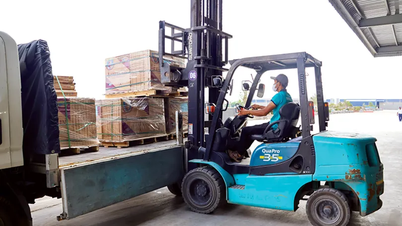
| Vedan Vietnam Co., Ltd. (Phuoc Thai commune) applies robots in production, increasing automation. Photo: CONG NGHIA. At 18, proudly joining the Party. Modern healthcare: a cornerstone for a livable city. 9 10 New vitality in the former revolutionary base area. (Photo: Nguyen Hoa) |
This is the "key" for many businesses nationwide, and in Dong Nai city in particular, to accelerate technological innovation, develop production and business, and contribute to the socio -economic development of the locality. This creates opportunities for high-quality workers to continue improving their skills, aiming to master technology, develop digital thinking, and quickly adapt to smart manufacturing.
Advantages of technological development
Dong Nai City is one of the provinces and cities with the fastest industrialization rate in the country, with a strong and large-scale industrial park system. According to information from the People's Committee of Dong Nai City, as of April 30, 2026, the city had more than 2,200 foreign direct investment (FDI) projects from over 50 countries and territories, with a total registered capital of over 45 billion USD. These projects focus on manufacturing, electronics, and high technology, leading to a large demand for high-quality labor, especially skilled technical workers capable of mastering technology.
Thanks to its advantageous geographical location, infrastructure, and investment environment, Dong Nai City has attracted thousands of domestic and foreign businesses to operate in many key sectors such as: processing and manufacturing industries; mechanical engineering; electrical and electronics; textiles; leather and footwear; food processing; supporting industries and high technology. The strong development of these industries has led to a large workforce, creating an urgent need for technological innovation to improve productivity, quality, and competitiveness.
In the context of increasingly fierce competition and rapidly developing technology, businesses in Dong Nai have recognized that automation and digital transformation are no longer experimental options but have become an inevitable trend. The application of machinery, software, and intelligent systems in production and operations helps businesses enhance their competitiveness and adapt flexibly to market fluctuations. Recent years have clearly demonstrated the effectiveness of automation and digital transformation.
Specifically, many businesses, after implementation, have significantly improved productivity, product quality, optimized operations, minimized unplanned downtime, and enhanced production and business efficiency. Notably, the application of technologies such as automated production lines, IoT, artificial intelligence (AI), and digital management systems not only shortens production time but also reduces operational errors. Along with this, "smart factory" models are gradually being implemented, becoming an important direction for businesses to improve management efficiency and increase competitiveness in the context of deep integration.
Beyond its current benefits, digital transformation and the application of Industry 4.0 technologies by businesses have contributed to enhancing competitiveness and expanding export markets. Many businesses in Dong Nai have met the requirements to access and conquer demanding markets such as the European Union (EU), the United States, and Japan. Simultaneously, the digitalization process helps businesses better meet international standards for traceability, product quality, and sustainable development requirements according to ESG (environmental, social, and corporate governance) criteria.
 |
| Workers at Vedan Vietnam Co., Ltd. (Phuoc Thai commune) during working hours. |
Accelerate production through automation.
Vedan Vietnam Co., Ltd. (Phuoc Thai commune) is one of the companies that has taken steps towards automation and digital transformation to serve the export needs of MSG and starch to the Japanese and EU markets. In recent years, the company has focused on automation and the application of robots in production, increasing the automation of the production line, helping to precisely control the fermentation, refining, and packaging stages of MSG. This company applies industrial robots in stages such as packaging, internal transportation, and palletizing. As a result, errors are reduced, productivity and stability are increased, and quality and traceability are ensured.
Mr. Dinh Van Sam, a robot operator at the packaging plant of Vedan Co., Ltd., said: "The transition to automation, especially the application of loading and unloading robots, has brought significant improvements to the production process. First of all, productivity has increased considerably because robots can operate continuously, stably, and at a higher speed than manual labor. In addition, the accuracy in loading, unloading, and arranging goods has also improved, helping to minimize errors and losses."
At Hung Vuong Concrete Plant in Binh Phuoc (Dong Xoai ward), the company, which supplies products to many important projects in and outside the city, has applied new technologies in concrete production. Specifically, it utilizes modern vibration-pressing technology for casting concrete pipes to meet customer deadlines. This advanced concrete pipe production process creates products with high durability, consistent quality, and superior productivity, while simultaneously reducing labor costs and product prices.
According to Thai Van Que, Director of Hung Vuong Concrete Plant in Binh Phuoc: Automation significantly increases labor productivity. Automated production lines can operate continuously with high accuracy, minimizing errors compared to manual labor. As a result, businesses can produce more in a shorter time, promptly meeting customer demands. Furthermore, employees can quickly adapt to new technologies after training. This is a crucial step for businesses to gradually build a high-quality workforce, ready to meet the demands of the Industry 4.0 revolution.
Meanwhile, Bosch Vietnam Co., Ltd. in Long Thanh Industrial Park (An Phuoc commune) has been promoting the application of high-level automation lines, industrial robots, and IoT technology, combined with real-time data-driven production management. Similarly, Nestlé Vietnam Co., Ltd. (Long Binh ward) has implemented a Manufacturing Execution System (MES), accelerating the digitalization of its entire process and managing its supply chain based on data. Energy optimization has helped the company improve operational efficiency, making it one of the leading food factories in terms of digitalization today.
Automation contributes to reducing long-term costs, minimizing material waste, and improving resource efficiency. Another significant benefit is improved product and service quality. Automated systems operate according to pre-programmed standards, ensuring consistency and stability.
Director of Hung Vuong Concrete Factory - Binh Phuoc, THAI VAN QUE
Nguyen Hoa - Thu Ngoc
Lesson 2: Proactively Innovating Towards Automation
Source: https://baodongnai.com.vn/kinh-te/202605/lao-dong-thoi-so-hoa-thich-ung-de-but-pha-bai-1-1850473/





































































































Comment (0)