As one of Vietnam's major industrial centers, Dong Nai city is undergoing a significant transformation driven by automation and digital transformation. With dozens of industrial parks and thousands of investment projects, the workforce here plays a core role in local economic development.
 |
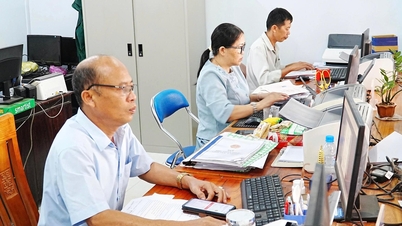
| Workers at Smart Topbank Co., Ltd. (Long Thanh Ward) are quick to adopt automation in their company. Photo: Nguyen Hoa |
However, this new phase presents many challenges as well as significant opportunities for workers.
Opportunities for breakthroughs and skill upgrades.
First and foremost, it's undeniable that automation offers many positive opportunities. Smart production lines reduce strenuous and dangerous tasks, thereby improving working conditions and ensuring worker safety. Furthermore, technological advancements create a new demand for highly skilled labor, particularly in areas such as machine operation, programming, and automated system maintenance. This allows workers to improve their skills, increase their income, and have opportunities for career advancement.
Furthermore, technological advancements have created and fostered new and thriving industries. Fields such as smart manufacturing, modern logistics, and digital services all require a skilled workforce. This opens up more diverse career paths, rather than being limited to traditional manual labor jobs.
Having worked at Global Mechanical Engineering Co., Ltd. (Trang Dai Ward) for nearly 10 years, Ms. Tran Thi Dieu Thu is highly regarded for her dedication, quick adaptability, and innovative spirit. Her practical innovations have contributed to improving the quality of products in the assembly team. “When the company applied automation to production, employees had an easier time and more time to be creative, improve their skills, and increase their income,” Ms. Thu shared.
Mr. Nguyen Van Tiep, Chairman of the Trade Union of Toan Cau Mechanical Engineering Co., Ltd., stated: "When the company accelerates the application of technology in its production and business activities, all employees demonstrate a proactive spirit of learning, a willingness to innovate, and a quick adaptation to the modern working environment. This is a crucial factor in helping the company improve productivity and product quality, while also creating a foundation for sustainable development in the current digital transformation context."
Mr. Nguyen Quoc Truong, General Director of Anh Duong Irradiation Technology Joint Stock Company (Long Thanh High-Tech Industrial Park), said: "The era of automation is creating a major turning point for the workforce in Dong Nai . Despite facing the risk of job loss and pressure to improve their skills, workers also have the opportunity to master technology and improve their income. In this context, adaptability and the ability to learn will be the key to ensuring workers are not left behind and become pioneers in the modern industrial sector."
Proactively adapt to avoid falling behind.
Resolution No. 57-NQ/TW, dated December 22, 2024, of the Politburo on the development of science and technology, innovation, and national digital transformation, clearly defines the viewpoint that science and technology and digital transformation are key drivers for socio-economic development. In this context, digital transformation is not simply the application of technology to production and management activities, but also a comprehensive change in the development model, from a traditional model to a model based on data and digital technology.
According to a report from the Department of Finance, Dong Nai is accelerating the development of three key industrial parks: Long Duc 3, Bau Can - Tan Hiep, and Xuan Que - Song Nhan, to create new logistics and industrial growth hubs, connecting with Long Thanh Airport. The Nhon Trach 3 and Nhon Trach 4 power plant projects, once operational, will provide impetus for the development of Dong Nai and the Southeast region. These projects have already employed and will continue to employ thousands of engineers and workers in various sectors: mechanics, electricity, construction, logistics, and port operations. This is a crucial driving force for the city's sustainable socio-economic development in the coming period.
Resolution No. 57-NQ/TW emphasizes the central role of workers and businesses. Therefore, the question is not only "how fast can the transformation be?" but also "how to transform so that no one is left behind." The answer lies in the synergy between the government and businesses in guiding, supporting, and accompanying workers.
In Dong Nai, the implementation of automation also presents numerous challenges. First and foremost, the biggest challenge facing workers is the risk of job loss due to machine replacement. Modern production lines are increasingly automated, from assembly and quality control to packaging. Repetitive jobs that do not require high skills are gradually being taken over by robots at a faster speed, with higher accuracy, and at lower costs in the long run. This puts a segment of the workforce, especially unskilled laborers, at risk of being laid off if they do not adapt quickly enough.
In addition, there is pressure from the green and sustainable transformation. Dong Nai is also promoting the "greening" of industry, applying modern technology to manage the environment and ensure sustainable production. This forces businesses to innovate technology, leading to new demands on workers. Employees not only need technical skills but also must adhere to clean production processes, save energy, and ensure environmental safety. If they fail to meet these requirements, they risk falling behind in the transformation process.
The labor market in Dong Nai City is projected to remain vibrant in 2026, with a recruitment demand of approximately 55,000 workers. This includes a significant increase in the number of unskilled and highly skilled workers (those with formal training, technical skills, mechanical engineering, and management expertise), particularly in the following sectors: industry, construction, services and logistics, and renewable energy.
According to a report by the Department of Internal Affairs, although the supply of qualified and certified labor in the city has increased significantly, the quality and practical skills of workers are uneven, and their ability to adapt to the actual working environment remains limited. Some training programs are not truly aligned with the production and business needs of enterprises; the percentage of graduates working in their trained fields is low, estimated at around 65%. In particular, the labor shortage in industrial parks by the end of 2025 is estimated at over 36,000 people, mainly concentrated in the technical and skilled worker groups.
Furthermore, the current supply of high-quality labor still falls short of the development requirements of high-tech industries, especially digital transformation, semiconductor technology, and automation, while the structure of vocational training still leans towards traditional technical fields. Overall, the gap between labor supply and demand in the city remains large, particularly for skilled and highly qualified technical workers. This highlights the urgent need to adjust the structure of vocational training and foster closer links between educational institutions and businesses.
According to Do Nguyen Phuong, Chairman of the Trade Union of Yuen Foong Yu Paper Co., Ltd. in Dong Nai (Long Thanh Ward): Automation in businesses today has replaced humans in many manual labor tasks. Therefore, it requires workers to improve their skills and take advantage of opportunities to prove themselves in their work; because if workers do not upgrade themselves, they will become outdated, even redundant, and easily laid off if they lack professional skills.
Mr. Phan Toi Tho Hiep, Chairman of the Trade Union of Nec Tokin Electronics Vietnam Co., Ltd. (Long Binh Industrial Park), said: "Workers who proactively learn and improve their skills and digital abilities will have a clear advantage, not only retaining their jobs but also having the ability to access positions with better income and working conditions. Therefore, the transition to automated production is not just a matter of technology but also a challenge in developing sustainable human resources in the new era."
Based on production realities and customer needs, businesses believe that to adapt to the era of automation, workers in Dong Nai need to proactively learn, improve their skills, and be ready to change careers. Slow adaptation could lead to job loss or falling behind. When each worker becomes a strong "digital link," businesses will operate more efficiently, and the economy will develop sustainably in the digital age.
Nguyen Hoa - Thu Ngoc
Final article: Developing a high-quality workforce
Source: https://baodongnai.com.vn/kinh-te/202605/lao-dong-thoi-so-hoa-thich-ung-de-but-pha-bai-3-49b30f9/



































































































Comment (0)