


Avoiding law enforcement
Recently in Hanoi, street vendors and sidewalk stall owners have been appearing and disappearing frequently to evade law enforcement. This struggle between making a living and maintaining urban order is raising the issue of implementing fees to bring daily life and business activities within the framework of the law.
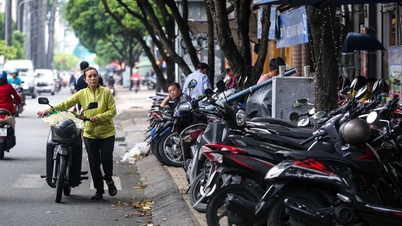
Every day, traveling over 20km from her hometown to Hanoi, Mrs. Quyen (63 years old, from Hung Yen province) hurries along with her street vendor stall on Tran Nhan Tong street. Despite the scorching sun, she doesn't dare set up an umbrella or tarp for shade. Tucked away in a secluded corner behind a tree, Mrs. Quyen uses cardboard sheets to make seating for customers, and her food and drinks are temporarily placed on wooden planks or stacks of bricks. However, to be able to sell her goods, she says she relies on connections and pays "hidden" fees.
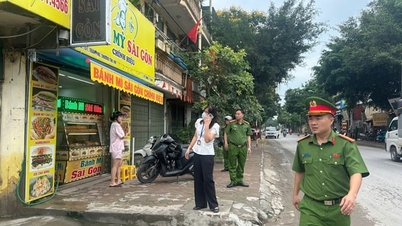
According to observations on Le Duan and Xa Dan streets, many sidewalk vendors avoid the hours when law enforcement patrols, or switch to selling goods from motorbikes, bicycles, or pushcarts to easily escape when they spot law enforcement from a distance. Many vendors choose to move into alleys or utilize the steps of closed businesses to sell their goods.
For many street vendors, the proposed fees could create an additional financial burden, as selling goods on the sidewalk is their only source of livelihood. As for Ms. Quyen, upon hearing about the proposal to rent sidewalk space for business at a maximum price of 45,000 VND/ m² /month, she said she would be willing to pay if she could secure a permanent and legal stall. According to her, converting these "hidden" fees into official sidewalk rental fees paid into the state budget would help reduce the financial burden on street vendors and ensure fairness and transparency.
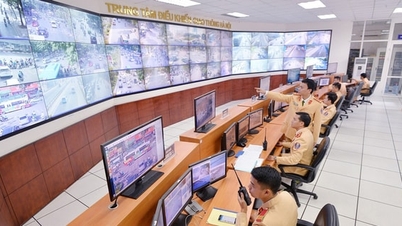
Using technology to maintain order on sidewalks.
Vung Tau Ward (Ho Chi Minh City) is a hub for tourism , services, and seaside restaurants, thus facing significant pressure to manage roads and sidewalks, especially on weekends and during peak tourist seasons. However, according to our reporter's observations, sidewalk encroachment has significantly decreased on many streets such as Nam Ky Khoi Nghia, Hoang Hoa Tham, and Thuy Van after the synchronized implementation of digital solutions combined with public awareness campaigns.
Mr. Nghiem Viet Hung, Head of the Economic and Urban Infrastructure Department of Vung Tau Ward, said that the ward has established a Zalo group called "Quick Coordination" to connect the leaders of the People's Committee, the police, and relevant departments. Residents can send images and specific locations to report sidewalk encroachment, spontaneous markets, or illegal parking, allowing authorities to receive and handle the issues immediately. The ward also utilizes the "On-site Report" application to enable residents to directly participate in urban monitoring. Using only a smartphone, residents can submit reports and track the progress of handling issues directly through the system. This approach increases transparency and brings the ward closer to the people in urban management.
In Tan Dinh ward (a central area of Ho Chi Minh City with a high density of businesses), sidewalk management is a complex issue, balancing urban order with ensuring residents' livelihoods. According to Ms. Pham Thi Anh Tuyet, Head of the Economic and Urban Infrastructure Department of Tan Dinh ward, the ward clearly assigns responsibilities to different departments for patrolling and handling violations. For certain streets and areas where temporary use of a portion of the sidewalk for business is permitted, the ward follows proper procedures for granting permits, collecting fees, and monitoring compliance.
The specific examples above show that the problem of sidewalk management in Ho Chi Minh City is being approached in a more flexible and practical way. Fines or temporary seizure of goods are always the last resort. The goal is not to "clean up" at all costs, but to restore urban order while ensuring long-term livelihoods for the people. To date, local authorities in Ho Chi Minh City have propagated and mobilized more than 34,000 businesses to sign commitments not to encroach on roads and sidewalks. Simultaneously, many areas are proactively seeking solutions to support livelihoods, such as planning concentrated business zones, night markets, pedestrian streets, or suitable food streets. In particular, in the near future, the Ho Chi Minh City Police will review areas with suitable sidewalks to advise on piloting night-time economic models, ensuring both legal trading spaces for people and maintaining urban order, aesthetics, and safety.
Fairness must be the foundation of policy.
Dr. Ly Viet Truong, from the Hanoi Studies and Capital Development Center (Vietnam Institute of Studies and Development Science), believes that researching the leasing of sidewalks demonstrates a stronger approach to managing, exploiting, and utilizing urban space more effectively. Sidewalks are public transportation infrastructure, so ensuring clear passage for pedestrians is crucial before considering business activities. However, Hanoi has tourist areas, food districts, pedestrian zones, and specific residential areas, so flexibility is needed for each space instead of applying a rigid model to the entire city. Specifically, in some large cities like Hanoi and Ho Chi Minh City, they could learn from the experiences of other countries to plan concentrated shopping areas with sanitation systems, cameras, and public seating with standardized aesthetic standards. The most important thing is to ensure stable, transparent, and long-term management.
Source: https://www.sggp.org.vn/linh-hoat-trong-quan-ly-trat-tu-do-thi-post852858.html

































































































Comment (0)