

The Draft Resolution on a number of breakthrough mechanisms and policies for the protection, care and improvement of people's health and the investment policy for the National Target Program on health care, population and development for the 2026 - 2035 period are two important contents related to the health sector, discussed by the National Assembly in the working session on the morning of December 2.
Pilot model of residential care for the elderly
These contents, according to National Assembly delegate Tran Thi Hien ( Ninh Binh ), are considered in the context of Vietnam's population entering the aging stage, forecast to become an old population by 2036 and "super old" by 2049.
“In addition to the goal of becoming a high-income country by 2045, the challenge of “aging before getting rich” is very real, and will put great pressure on both the State budget and social resources for health care, ensuring social security, preparing social infrastructure suitable for the elderly, especially the development of nursing homes and professional elderly care,” the female delegate stated.
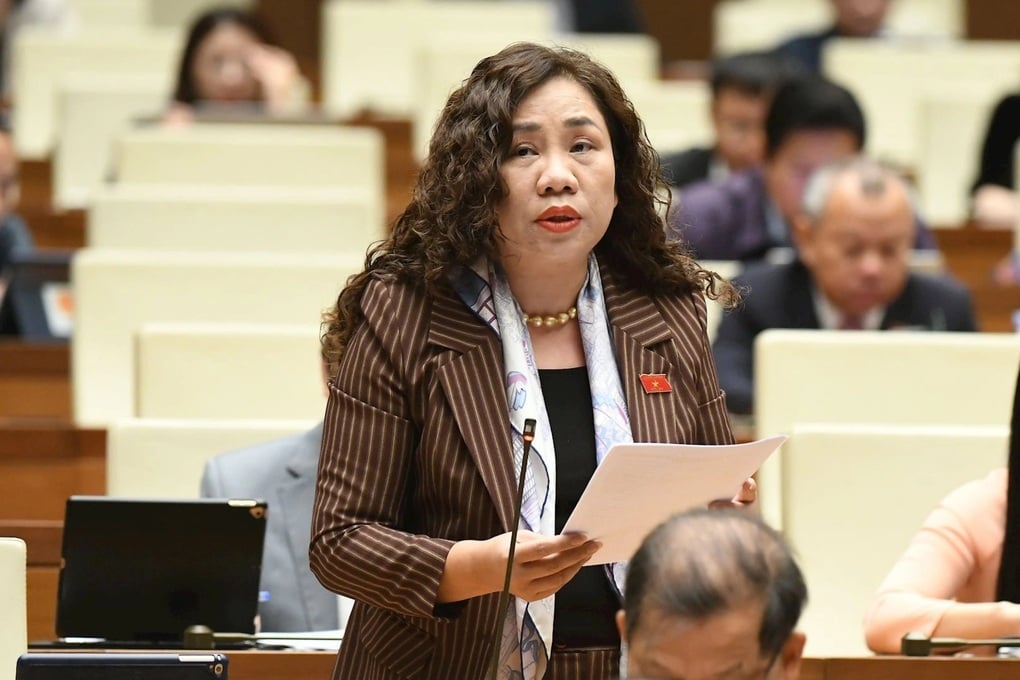
National Assembly Delegate Tran Thi Hien (Photo: Hong Phong).
In the context of limited public investment resources, delegate Hien said that promoting socialization and attracting private resources to develop elderly care services is an objective, urgent and strategic requirement.
However, she was concerned that the National Assembly's draft resolution on breakthrough mechanisms and policies for protecting, caring for and improving people's health had almost no breakthrough policies that focused on handling "bottlenecks" related to developing elderly care facilities and mobilizing social resources in people's health care.
Delegates from Ninh Binh province cited a series of figures such as current social protection facilities only meeting 30% of the demand; the public system has only 46 elderly care facilities out of a total of 425 social protection facilities (accounting for about 11%); many localities do not have specialized facilities for the elderly.
This national target program sets out the goal of "investing in the construction of at least 15 new nursing homes and social protection facilities in the 2026-2030 period; at least 10 facilities in the 2031-2035 period".
“Thus, by 2030 we will have about 60 facilities and by 2035 about 70 facilities. Meanwhile, according to the planning of the social assistance network for the period 2026-2030, by 2030 there must be at least 90 elderly care facilities, including both public and non-public. Thus, there needs to be a truly breakthrough mechanism and policy to attract social resources to develop about 30 elderly care facilities in the next 5 years,” delegate Hien suggested.
Regarding capital mobilization, she said that there should be a plan to increase the proportion of socialized capital. Along with that, in local planning, it is necessary to plan clean land funds for the development of nursing facilities and have breakthrough mechanisms and policies on credit incentives, interest rate support, and corporate income tax for investment in this field.
Making recommendations, delegates from Ninh Binh province said that there should be a policy to treat nursing homes that perform the functions of medical examination and treatment, long-term care, and rehabilitation for the elderly like medical facilities and enjoy special policies on land, taxes, and finance.

Discussion session at the National Assembly on the morning of December 2 (Photo: Hong Phong).
This will be a breakthrough solution to materialize the policy of "effectively combining medical facilities and elderly care facilities" as proposed in Resolution 72, according to delegate Hien.
She also proposed adding a number of activities to the national target program on health, such as researching and perfecting mechanisms and policies to promote the attraction of social resources to strongly develop nursing homes and care for the elderly; perfecting technical standards for nursing homes; and piloting a model of semi-boarding care for the elderly.
Specifying solutions to adapt to population aging
Delegate Nguyen Van Manh (Phu Tho) also raised the issue that Vietnam is a country with one of the fastest aging populations in the world.
He said Resolution 72 of the Politburo has identified many solutions to adapt to population aging, including investing in developing geriatric institutes and general hospitals with geriatric specialties.

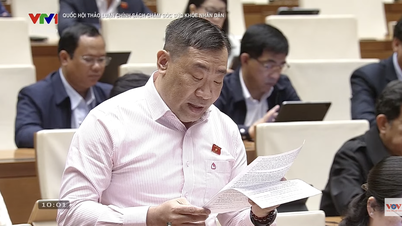
National Assembly Delegate Nguyen Van Manh (Photo: Hong Phong).
The requirement mentioned by Mr. Manh is that each province and centrally-run city must have at least one specialized end-level hospital, one geriatric hospital or a general hospital with a geriatric department, in order to provide better health care for the elderly.
However, he said that this content has not been specified in the National Target Program for People's Health Care.
Therefore, he suggested that the Government should balance the development investment capital allocated in the Program to allocate for sub-projects to improve population quality and sub-projects to adapt to population aging and care for the health of the elderly. "In the absence of sufficient funding, it is necessary to select a pilot project in a number of provinces and cities to implement the deployed planning," the delegate suggested.
Source: https://dantri.com.vn/thoi-su/lo-dan-gia-truoc-khi-giau-dbqh-de-nghi-goi-von-tu-nhan-xay-vien-duong-lao-20251202084940579.htm


![[Photo] National Assembly Chairman Tran Thanh Man receives First Vice Chairman of the Federation Council of the Federal Assembly of the Russian Federation](/_next/image?url=https%3A%2F%2Fvphoto.vietnam.vn%2Fthumb%2F1200x675%2Fvietnam%2Fresource%2FIMAGE%2F2025%2F12%2F02%2F1764648408509_ndo_br_bnd-8452-jpg.webp&w=3840&q=75)


































































![[Photo] General Secretary To Lam and his wife attend the 50th Anniversary of Laos National Day](https://vphoto.vietnam.vn/thumb/402x226/vietnam/resource/IMAGE/2025/12/02/1764644139308_1.jpeg)





























Comment (0)