

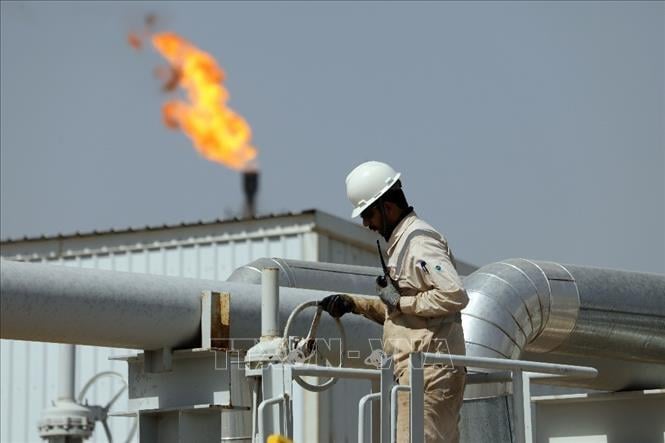
The current market picture is dominated by cautious sentiment, as investors have to weigh the pressure of real oversupply against uncertain expectations about US monetary policy as well as geopolitical developments in Eastern Europe.
Specifically, at 2:17 p.m. (Vietnam time), Brent crude futures fell 0.1% to $62.42 a barrel; US light sweet crude (WTI) also fell 0.2%, trading at $58.75 a barrel. Selling pressure had appeared since the previous session, pushing both oil benchmarks down more than $1 a barrel after news that Iraq – a key OPEC member – had restored production at the West Qurna 2 field. The return of supply from one of the world's largest fields immediately raised concerns about a short-term supply-demand imbalance.
Beyond the immediate impact from Iraq, the longer-term market outlook is also clouded by gloomy forecasts. Kelvin Wong, senior analyst at OANDA, said the biggest “drag” right now is the upcoming report from the International Energy Agency (IEA).
Observers fear that the IEA will continue to warn of a record supply surplus in 2026. If this scenario is confirmed, WTI oil prices are likely to be pushed back to a deeper support zone, around 56.80 - 57.50 USD/barrel. In that context, even the news that the Group of Seven (G7) and the European Union (EU) are discussing tightening the ban on transporting Russian oil is not enough to create momentum for the recovery of "black gold" prices.
In addition to the supply and demand factors, the geopolitical "unknown" from the Ukraine conflict is still an unpredictable variable that prevents cash flow from boldly disbursing. Mr. Tim Waterer from KCM Trade assessed that the market is in a "wait and see" state. According to him, oil prices will only fluctuate within a narrow range until the negotiation results are finalized: the failure of negotiations could push prices up, conversely, any progress that paves the way for Russian supply to return to the market will be a factor that puts downward pressure on prices.
The final piece of the puzzle that will impact the market this week is the US Federal Reserve's policy meeting on December 9-10. Although the market is betting up to 87% on the possibility of the Fed cutting interest rates by 0.25 percentage points, experts are not too optimistic about the impact of the Fed's decision. Ms. Priyanka Sachdeva, an expert at Phillip Nova, analyzed that although low interest rates can support short-term oil prices at the level of 60-65 USD/barrel, the price structure is still fundamentally restrained by the "ghost" of oversupply in the medium and long term.
Source: https://baotintuc.vn/thi-truong-tien-te/lo-ngai-du-cung-phu-bong-len-gia-dau-chau-a-20251209150946227.htm




![[Photo] Urgently help people soon have a place to live and stabilize their lives](/_next/image?url=https%3A%2F%2Fvphoto.vietnam.vn%2Fthumb%2F1200x675%2Fvietnam%2Fresource%2FIMAGE%2F2025%2F12%2F09%2F1765248230297_c-jpg.webp&w=3840&q=75)



































































![[Photo] General Secretary To Lam works with the Standing Committees of the 14th Party Congress Subcommittees](https://vphoto.vietnam.vn/thumb/402x226/vietnam/resource/IMAGE/2025/12/09/1765265023554_image.jpeg)




























Comment (0)