

"Four together" approach to attract people to class.
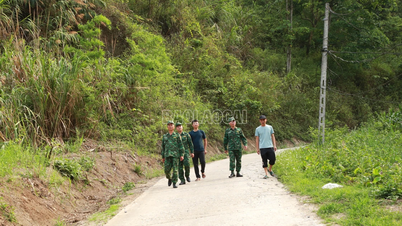
A Mú Sung – where the Red River flows into Vietnam – is a place of endless mountain ranges, where winding roads challenge the footsteps of strangers. Life for the people there remains difficult, with food and clothing being constant worries, and literacy a luxury for many. The green-uniformed soldiers of the A Mú Sung Border Guard Post have kindled new hope for the people's literacy journey. Among them, Lieutenant Colonel Dinh Thai Dat is a dedicated individual committed to this special mission: eradicating illiteracy and helping the people integrate into society through knowledge.
Having been deployed to numerous border guard posts and experienced the "four together" principle (eating together, living together, working together, and speaking the local language together) with the local people, Dinh Thai Dat deeply understood the difficulties, shortages, and disadvantages faced by the people in border areas: poverty, difficult roads, limited education levels, and a hesitant attitude when interacting with officials. In the early days of opening the literacy class, difficulties piled upon difficulties, as the classroom lacked four essential elements (no blackboard, insufficient books and notebooks, no desks or chairs, and insufficient lighting)... The students were people who had long passed the age for schooling, over 40, 50, or even older. They came to class with shyness, their hands, accustomed to holding hoes and knives, trembling as they held pens, hesitant to spell out each letter. Dinh Thai Dat himself also lacked teaching qualifications. In the early days, while teaching literacy, he also diligently learned and adjusted his methods to make the lessons easier to understand and remember the characters, so the villagers didn't mind writing... There were also days when torrential rain poured down in the jungle, the dirt roads were slippery, and fog covered the paths... yet the teacher in his green military uniform still traveled for kilometers to class, to keep his promise to a few students.
 |
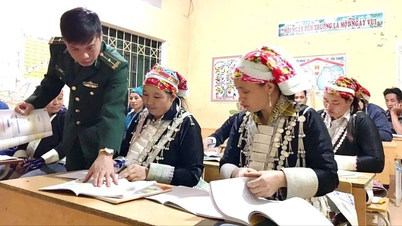
| Teacher Dinh Thai Dat, in military uniform, at a literacy class (November 2023). Photo provided by the subject. |
However, the most difficult challenge wasn't the lack of material resources, programs, or lesson plans... but rather retaining students and persuading them to attend classes. People had to make a living, caught up in the seasons, so the process of going to their homes to encourage them to attend was very difficult for Dinh Thai Dat. Not to mention, many students were the breadwinners of their families, working in the fields during the day and returning home late at night, eating dinner and then going to bed, making it very difficult to convince them to participate in literacy classes. Some classes were therefore attended by only one or two people. But the military teacher Dinh Thai Dat never lost heart. He still went to class, still prepared his lessons. Above all, he went to each house, persistently persuading the villagers. During his visits to the villagers' homes, he didn't shy away from difficulties, doing whatever work came his way, from sweeping the yard, chopping bananas for the pigs, chopping vegetables for the chickens, gathering grass for the horses, helping with firewood... to advising and chatting about family matters, planting trees, selling rice... Dinh Thai Dat sat for hours by the fire, chatting and persuading the villagers to understand that learning wasn't a burden but an opportunity to access knowledge and change their perceptions. The class, which was initially sparsely populated, gradually filled up. Familiar faces appeared more regularly. The sounds of children spelling out words and reading aloud echoed through the quiet mountains, giving the military officer Dinh Thai Dat more confidence.
To keep the classes running regularly, Lieutenant Colonel Dinh Thai Dat is not just a teacher. He is an organizer, a connector, and an inspirer. He adjusts the class schedule to suit the seasons, choosing a teaching method that is relatable, easy to understand, and connected to real life. The written word is no longer dry and boring, but connected to people's names, village names, and everyday stories at the market. Initial hesitant glances give way to eagerness. From having to persuade each person individually, the class has become a place where people come on their own. The classroom lights in this border region no longer flicker but shine steadily every evening, like a lighthouse of knowledge in the border area.
After such courses, the students all know how to read, write, add, subtract, multiply, and divide. For Ms. Sung Thi E (a Mong ethnic minority woman from Cua Suoi village) and many other villagers, the most important thing is the increased confidence in communication, no longer feeling self-conscious when going to the commune office, and no longer having to use fingerprints as before. As for Dinh Thai Dat, what touched him most was that when he walked through the villages, the villagers affectionately called and greeted him "Teacher Dat"—a simple title but one that contained trust and affection.
When words open up new horizons
If it had only focused on helping people learn to read and write, Mr. Dat's literacy class would have fulfilled its mission. But what Lieutenant Colonel Dinh Thai Dat has achieved is far greater than that.
The classroom becomes a place for expanding knowledge.
Beyond teaching literacy, each class incorporated the dissemination of the Party's guidelines and the State's policies and laws; he encouraged people not to cross the border illegally or listen to malicious individuals; and he raised awareness of border protection and solidarity. He persistently campaigned against child marriage and consanguineous marriage, pressing issues directly affecting the quality of the population and the future of the community. After each lunar cycle, the villagers gradually changed their perceptions. They understood that learning to read and write was not just for reading and writing, but to open new doors, access information, develop family economies , integrate into modern life, and work together to safeguard the nation's borders. Concepts that once seemed alien gradually became more familiar. People understood more about their rights and responsibilities, learned how to apply advancements to production, how to take care of their health, and how to raise their children. The simple lessons of this military teacher quietly instilled in them the belief that life could change for the better with knowledge. Ms. Vang San May (a Dao ethnic minority woman from Nam Giang village) understood the importance of education and decided against letting her children drop out of school early as initially planned. She persistently encouraged them to complete high school before starting work.
From another perspective, the classroom is also a place that nurtures human relationships.
After a hard day's work, the villagers come to class not only to learn but also to meet and chat. The distance between teacher and students disappears. Everyday stories are shared, and laughter echoes through the mountain landscape. The teacher is not just standing at the podium teaching, but also sitting down to listen, accompany, be a friend, and inspire.
The distance between teacher and student gradually disappeared. Lieutenant Colonel Dinh Thai Dat became a familiar figure in each student's family. He understood the circumstances of each student, knowing who was busy with farming, who was facing difficulties, and who needed encouragement. This closeness created a classroom unlike any other—a place where knowledge and affection went hand in hand.
For students, letters are more than just characters. They represent a turning point that can change perceptions and actions.
For the first time, some people were able to read their own names on their identification documents. It seemed like a simple task, but it moved them deeply. Before, they had to rely on others to read or write their names for them. Now, they could do it themselves, a feeling they had never experienced before.
Some people know how to sign instead of using fingerprints. The signatures are clumsy, the handwriting shaky, but they contain a joy like electricity and water arriving in their village. It's not just a simple action, but a milestone in their changing mindset: They are no longer on the sidelines of procedures and paperwork, but have become active participants.
For them, literacy is the key to accessing and integrating into the civilized world . Knowing how to read and write is not just a skill, but a crucial step in their self-worth, giving them greater confidence to enter a new farming season. That confidence is their greatest achievement. Because eradicating illiteracy is not just about eliminating a lack of knowledge, but also about removing psychological barriers, opening the door for people to break free from their own limitations. Many people are also more aware of maintaining security and order in their villages, participating with the Border Guard in protecting the border. When landslides occur, or when there are signs of illegal entry or exit, they promptly report it to the Border Guard and local authorities.
In the remote border region, Lieutenant Colonel Dinh Thai Dat didn't just open a classroom. He opened doors. From those doors, the light of knowledge, faith, and a brighter future is quietly spreading. And the border is not only guarded by boundary markers and lines, but also by knowledge and faith in a better future.
| The efforts of teacher Dinh Thai Dat, a military officer, have been recognized with numerous titles and awards: Outstanding Soldier at the grassroots level in 2023, a commendation from the Political Commissar of the Border Guard in 2025, and one of the exemplary figures honored in the "Sharing with Teachers" program in 2025 organized by the Central Committee of the Vietnam Youth Union in coordination with the Ministry of Education and Training ... |
Source: https://www.qdnd.vn/phong-su-dieu-tra/cuoc-thi-nhung-tam-guong-binh-di-ma-cao-quy-lan-thu-17/lop-hoc-dac-biet-oa-mu-sung-1038255
















































































Comment (0)