


The journey of bringing letters to the mountainside
A Mu Sung ( Lao Cai ) is a land covered in mist all year round, where ethnic minorities still face many difficulties and deprivations. In those remote villages, literacy was once a luxury, and going to school for adults was a rarity. In that context, the appearance of border guards - the "green uniformed soldiers" - has kindled new hope for the people's journey to learn to read and write.
Among them, Lieutenant Colonel Dinh Thai Dat (born in 1978), a mass mobilization officer (VĐQC) of A Mu Sung Border Guard Station, is the one who has been persistently attached to the special task: eliminating illiteracy and helping people reintegrate into life with knowledge.
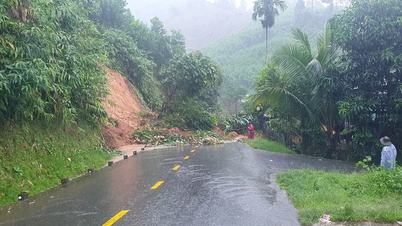
Having been assigned to many Border Guard stations, experiencing the "4 together" - eating together, living together, working together, speaking the same ethnic language - he deeply understands the difficulties, deprivations and disadvantages of people living in the border areas: poverty, difficult roads, limited education level and shyness when interacting with officers.
Therefore, when the Party Committee and the Station Command assigned him the task of coordinating with schools to open literacy classes, Mr. Dat understood that he was taking on a great responsibility: bringing the light of knowledge to those who had never held a pen in the true sense.
Start with perseverance
As soon as the class opened, the most difficult problem was not the program or lesson plan, but… to persuade people to attend the class. Mr. Dat said that people here go to the fields during the day and only return home at night. After a hard day's work, their habit is to eat and sleep, so it is very difficult to convince them to attend the evening literacy class.
In the early days, class sizes were always unstable. Some nights there were only a few students, other days the class was almost empty. Understanding the hardships of the people, Mr. Dat was not discouraged. After many sleepless nights, he suggested to the station commander to go to the village early to mobilize each house, both visiting and supporting the small tasks in the family to create closeness.
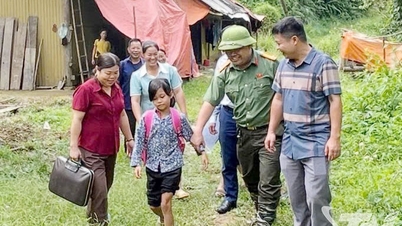
And so, day by day, the villagers gradually got used to seeing Mr. Dat in the village, regardless of the steep road, the weather or the work in the student’s family. It was his sincerity and perseverance that convinced the villagers.
The class began to fill up. People who never thought they would ever hold a pen were now sitting at simple wooden tables, in front of a blank sheet of paper, yearning to change their lives.
Although he had experience in mobilizing the masses, teaching in class was a completely different task. In the beginning, he could not help but feel bewildered: how to teach in an easy-to-understand way? How to make people not afraid to write? Where to start with students who had never learned to read?
From that question, Lieutenant Colonel Dat researched the documents himself, learned the teaching methods of local primary school teachers, and adjusted them to suit the elderly. He thoroughly applied the “4 together” method, using the ethnic language to explain in a friendly and easy-to-understand way.
Thanks to his dedication, the lessons gradually became familiar to the people. They practiced writing their names, spelling, and doing simple calculations. Some older people had trouble holding a pen, so he patiently held their hands and guided each stroke. Some students were reluctant to learn, so Mr. Dat went to their homes to encourage them.
After the course, 100% of the students knew how to read, write, add, subtract, multiply, divide, and even text. More importantly, they were more confident in communication, no longer felt self-conscious when coming to the commune office, and did not have to point fingers like before.
During his return to the village, Mr. Dat was moved when he heard the villagers affectionately call him "Teacher Dat", "teacher in green uniform" - a simple title but containing the love and gratitude of the people.

Classroom – where knowledge opens up
Not only teaching, in each class, Mr. Dat also incorporates propaganda of the Party's policies and the State's laws; encourages people not to illegally cross the border, not to listen to bad guys; raises awareness of border protection and solidarity.
In particular, he persistently advocates for the elimination of child marriage and incestuous marriage - a burning issue that directly affects the population quality and future of the entire community.
Thanks to the classes, people’s awareness has gradually changed. They understand that learning to read and write is not only for reading and writing, but also to open new doors, access information, develop the family economy , integrate into modern life and join hands to protect the country’s borders.
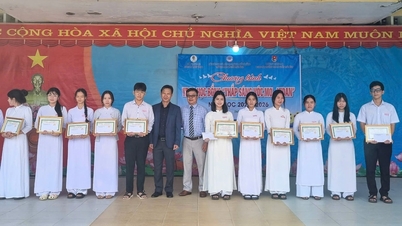
Mr. Dinh Thai Dat's efforts have been recognized with many awards: Emulation Fighter at the grassroots level in 2023; Certificate of Merit from the Executive Committee of the Ministry of Education and Training's Trade Union in 2019. But for him, the greatest reward is the smiles of people when they can write their names, the confidence when they communicate at the commune headquarters, or the bright eyes of students who know how to text their children for the first time.
Source: https://baolaocai.vn/lop-hoc-thap-sang-uoc-mo-noi-bien-cuong-a-mu-sung-post888348.html









































































Comment (0)