

MB Economic Insights is an annual economic forum organized by the Military Commercial Joint Stock Bank (MB) for over a decade, aiming to accompany businesses in the face of global economic fluctuations. This year's theme is "Proactive adaptation - Creating momentum for breakthroughs".
According to international organizations such as the IMF, World Bank and OECD, Vietnam continues to be a bright spot in the Asian region in 2025 with a forecast growth rate of 6.2-6.8%, among the highest in the world . A stable macro-economic foundation, controlled inflation around 3-4%, and strong domestic purchasing power are factors that help Vietnam maintain its growth momentum in the context of global instability.
|
Overview of the 11th MB Economic Insights Forum |
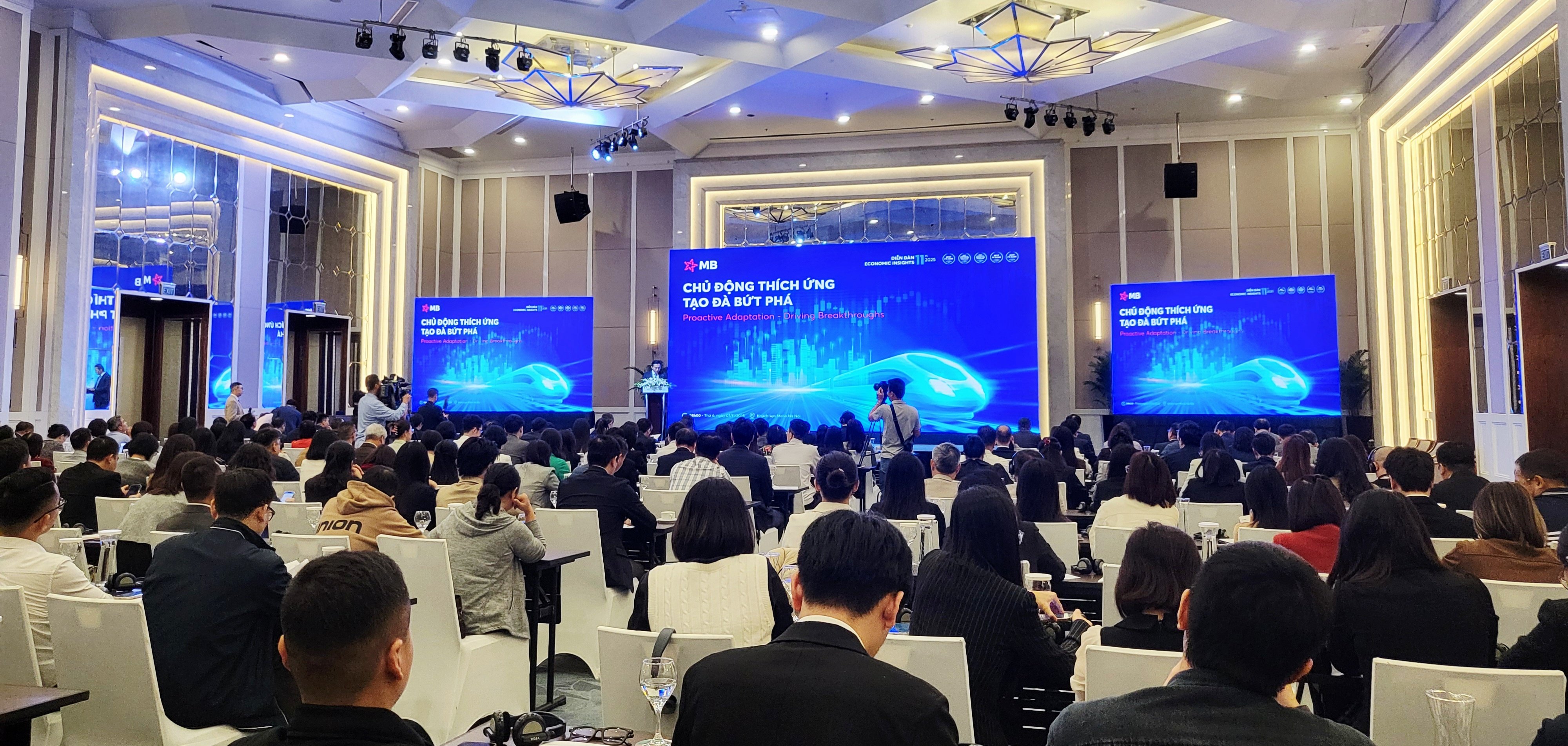
Mr. Sacha Dray, Chief Economist of the World Bank in Vietnam, presented the topic: “Current global and Vietnamese context: Upcoming economic opportunities and challenges”. Vietnam's economy is recovering strongly with GDP growth in the first 9 months of 2025 reaching 7.9%, the highest level in a decade, thanks to the improvement in industrial production, exports and services.
The IMF also appreciated China's flexible monetary policy and efforts to improve the investment environment, helping to attract FDI flows shifting from China to high-tech and green sectors.
However, growth depends on exports, global trade slows and fiscal policy space is limited. OECD forecasts that by 2026, Vietnam's economy could grow by 6.0-6.5%, if it continues to promote digital transformation, renewable energy and domestic consumption.
Despite challenges, Vietnam is still seen as a “rarely balanced economy in the region”, capable of maintaining stability and moving towards a new breakthrough phase if it can take advantage of the wave of investment and technological innovation in the next two years.
According to Mr. Nguyen Xuan Thanh, expert of Fulbright School of Public Policy and Management - Fulbright University Vietnam, in 2026, Vietnam still has the opportunity for positive growth but will face many risks from international trade fluctuations and macroeconomic pressures. GDP is forecast to be difficult to reach double digits, but management policies will continue to be flexible, prioritizing growth in parallel with macroeconomic stability.
The biggest challenge comes from the US's reciprocal tax policy when the tax rate increased by 20% on many Vietnamese export products, significantly affecting the textile, footwear, furniture and seafood industries. However, Vietnam's trade is still a bright spot, the trade balance continues to have a surplus.
The reciprocal tax policy from the United States has caused the exchange rate to increase sharply, and transportation costs to escalate. Many customers have encountered financial difficulties and delayed payments, leading to financial risks for export enterprises, said Mr. Tran Mau Huy, representative of Hao Hung Company Limited.
|
Mr. Pham Nhu Anh, General Director of MB shared at the forum |
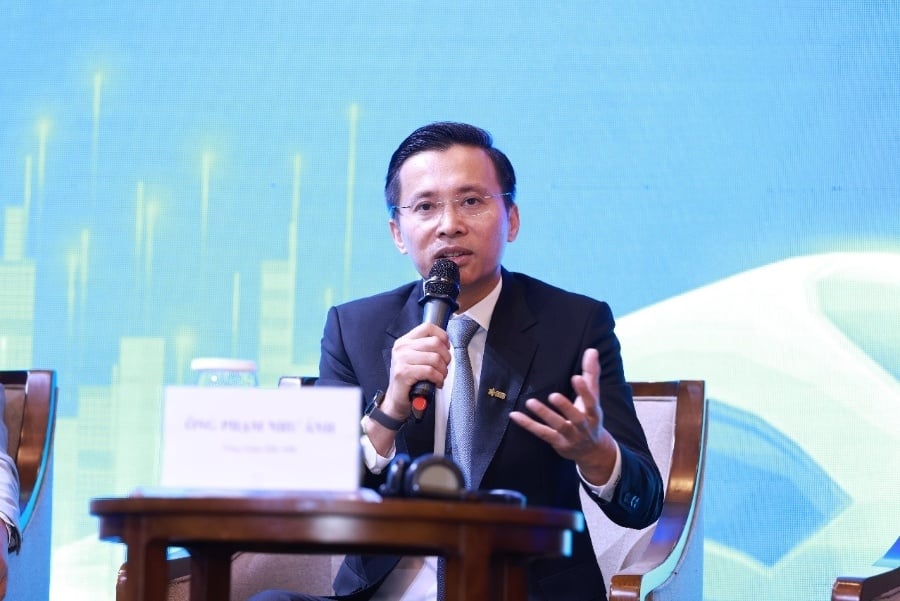
At the forum, Mr. Pham Nhu Anh, General Director of MB shared: “Proactive adaptation means that financial institutions and businesses need to identify, analyze, learn and calculate the fluctuations that may occur in 2026”.
MB will work closely with import-export businesses to discuss, evaluate and prepare appropriate response solutions. Based on the trends pointed out by experts at the forum, clearly identifying industries that are negatively impacted and industries with development opportunities based on the global and domestic policy context is a key factor to help businesses maintain growth momentum. On that basis, MB will design appropriate financial products for each import-export industry, supporting customers to seize opportunities and prevent risks.
On the management side, Ms. Trinh Thi Thu Hien, Deputy Director of the Import-Export Department ( Ministry of Industry and Trade ), said that it is estimated that in the first 10 months of 2025, Vietnam's total import-export turnover will reach about 762 billion USD, an increase of 17.4% over the same period last year. Of which, exports will reach 391 billion USD, imports will reach 371 billion USD. The trade surplus of more than 19.5 billion USD is considered a positive foundation, helping the Vietnamese economy enter the fourth quarter with a proactive mindset. However, the adjustment of trade policy from the United States has put short-term pressure on some labor-intensive industries such as textiles, footwear. However, the overall export picture remains positive thanks to the steady growth of high value-added industries such as electronic components, agricultural products, processed foods, chemicals and high-tech products.
Faced with increasingly deep integration requirements, the Government has directed ministries and branches to increase transparency of origin and strictly implement international commitments.
“Currently, we are actively coordinating with industry associations to consult and propose appropriate regulations on rules of origin, to ensure that products of legal origin are eligible for tariff incentives,” added Ms. Trinh Thi Thu Hien.
|
MB Economic Insights has become a space connecting knowledge between academia, management agencies and the business community. |

After more than a decade of maintenance and development, MB Economic Insights has gone beyond the framework of an economic analysis forum, becoming a space connecting knowledge between academia, management agencies and the business community. Through in-depth discussions, the forum contributes to shaping new development thinking, improving management capacity and adaptability of Vietnamese enterprises in the period of global integration.
Source: https://thoibaonganhang.vn/mb-economic-insights-dong-hanh-cung-doanh-nghiep-va-but-pha-nam-2026-173325.html














































































![Dong Nai OCOP transition: [Article 3] Linking tourism with OCOP product consumption](https://vphoto.vietnam.vn/thumb/402x226/vietnam/resource/IMAGE/2025/11/10/1762739199309_1324-2740-7_n-162543_981.jpeg)






Comment (0)