

Record low prices
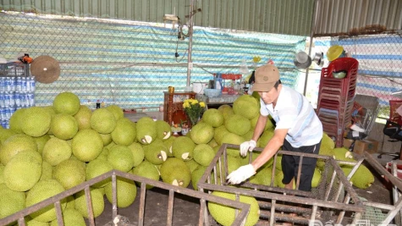
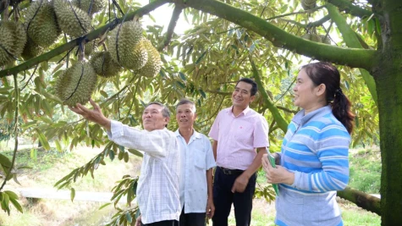
Pointing to his durian orchard with many ripe fruits falling to the ground, Mr. Le Thai Huan (in Cai Lay commune, Dong Thap province ) said that the price of the "king of fruits" has never been as low as it is now. "Currently, traders are buying Ri6 durians at the orchard for only 25,000-30,000 VND/kg. That's for selective purchases; buying the whole orchard at once is less than 20,000 VND/kg. At this price, we farmers are suffering heavy losses, because production costs are nearly 40,000 VND/kg," Mr. Huan sighed.
In the Central Highlands region, durian prices are in a similar situation, even though the harvest season has only just begun. Mr. Tran Van Ngoc, a durian orchard owner in Dak Lak, shared that even first-grade durians with uniform fruit are only being bought by traders for 35,000-50,000 VND/kg. “Because of the low price, my family is hesitant to sell our more than 3-hectare durian orchard. In recent days, with the onset of rain and wind, many fruits have fallen. This season, after deducting labor costs, fertilizer, and pesticides, my family will not make a profit, and may even face losses if prices continue to fall,” Mr. Ngoc said. To mitigate losses, in some provinces and cities such as Dong Thap, Tay Ninh, and Can Tho , many durian orchard owners are accepting selling off their entire orchards at 18,000-20,000 VND/kg. Many orchard owners are harvesting their own durians and transporting them to highways for retail sale to passersby, but sales remain very difficult due to the insignificant number of buyers.
According to Mr. Vo Tan Loi, Chairman of the Durian Association of Dong Thap province, durian prices are "hitting rock bottom," and sales are difficult due to increased supply. Currently, durian-growing areas in the Mekong Delta such as Dong Thap and Tay Ninh are in their main harvest season. Dong Thap province alone has over 32,000 hectares of durian, with an estimated harvest of 111,200 tons in May and June 2026. In addition, some other large durian-growing regions in the country, such as the Central Highlands and the Southeast, are also beginning their harvests.
According to information from the Department of Crop Production and Plant Protection (Ministry of Agriculture and Environment), durian exports are heavily dependent on a few markets, mainly China. In the first four months of this year, Vietnam's fruit and vegetable exports reached approximately US$2.06 billion, with the Chinese market accounting for more than 50%. When this market tightens standards or reduces imports, the prices of many domestic fruit and vegetable products are significantly affected. |
According to many durian exporting businesses in the Mekong Delta, the main reason for the sharp drop in durian prices is the bottleneck in the testing process for export. Currently, many testing laboratories in the Mekong Delta are closed or limiting sample acceptance. This is due to a lack of consensus on results between testing laboratories recognized by China in Vietnam and the post-export inspection department in China. This situation makes businesses hesitant to purchase, putting farmers in a difficult position during the peak durian harvest season.

Besides increased supply and inspection bottlenecks, some agricultural experts believe that the drop in durian prices and difficulties in sales stem from a lack of transparency in production and traceability. In many localities, durian traceability is hampered by four issues: inconsistent procedures, disconnected data, fragmented information between different levels, and producers' unfamiliarity with digital management methods. In some areas, there is a practice of "borrowing" planting area codes to facilitate export procedures; production data is not synchronized; and quality control processes are not rigorous enough.
Increase testing capacity and implement appropriate post-inspection mechanisms.
In light of the above situation, local leaders have requested relevant agencies to urgently inspect planting area codes and packaging codes to control quality, especially cadmium levels, and manage production volume; strengthen domestic consumption connections and promote processing to reduce pressure on output. According to Nguyen Phuoc Thien, Vice Chairman of the People's Committee of Dong Thap province, the locality has requested the Ministry of Agriculture and Environment to direct testing centers approved by China to increase their durian testing capacity; and to discuss with the General Administration of Customs of China to consider a suitable post-inspection mechanism and to promptly assess and approve the accreditation of qualified testing laboratories in the province, in order to supplement testing capacity for durian and other fruit exports.
Leaders of the Ministry of Agriculture and Environment stated that they are focusing on controlling quality and ensuring transparency throughout the production chain. Specifically, the pilot program for tracing the origin of durian has been implemented since January 1, 2026, and is expected to be applied nationwide from July 1, 2026. This system aims to manage the entire process from cultivation and harvesting to packaging and export, ensuring stable exports, maintaining market share, and increasing competitiveness. Furthermore, the Ministry of Agriculture and Environment is guiding durian-producing localities to adhere to VietGAP standards and the Integrated Plant Health Management (IPHM) program, reducing risks related to residue levels and improving the ability to meet import market requirements. Simultaneously, increased control over cultivation area codes and packaging facilities is being implemented to limit violations of export regulations.
According to sggp.org.vn
Source: https://baodongthap.vn/minh-bach-chuoi-san-xuat-sau-rieng-a240556.html















































































Comment (0)