

 |
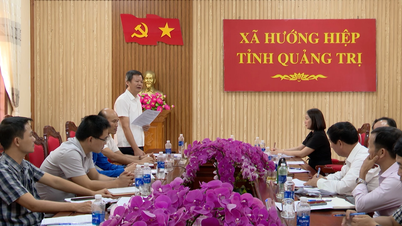
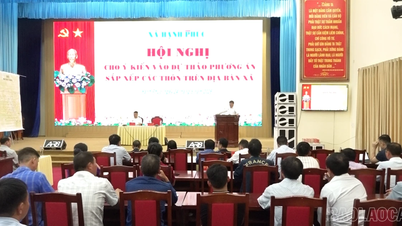
| Scene from the working session - Photo: QV |
 |
| Leaders of the Department of Agriculture and Environment report at the working session - Photo: QV |
According to a report from the Department of Agriculture and Environment, Quang Tri province has completed the surveying and mapping of land records for all 78 communes, wards, and special zones. The total area surveyed and mapped is over 1,268,676 hectares (100% of the natural area has been completed); the province is also continuing the surveying and mapping of land records and building and completing the local land database.
 |
| Comrade Hoang Nam, Standing Vice Chairman of the Provincial People's Committee, speaks at the working session - Photo: QV |
 |
| Delegates attending the working session - Photo: QV |
Regarding the construction of the land database, as of March 31, 2026, the land database has been synchronized and shared in 67 out of 77 communes and wards (excluding the Con Co Special Zone). The remaining 10 communes and wards have not yet synchronized due to delays in submitting documents, thus failing to match with the Ministry of Public Security's database. The synchronization process is ongoing and is expected to be completed in May 2026. In addition, the review and classification of land data for 2.64 million land parcels in 77 communes and wards has been completed. As of May 19, 2026, the percentage of Group 1 data (which is "correct, complete, clean, and active") for the entire province reached 29.6%, lower than the national average (39%).
 |
| Delegates attending the working session - Photo: QV |
However, in many localities, the land cadastral records, which were created a long time ago and have undergone significant changes, are slow to be updated and revised regularly. This leads to the quality of land data derived from these records not accurately reflecting actual land use, resulting in discrepancies between the sheet and parcel numbers in the land database and the cadastral maps and records. Furthermore, the updating, revision of changes, and management of land records and documents at the former district level and the current commune level still lack essential land data.
 |
| The conference was connected online to locations in communes, wards, and special zones throughout the province - Photo: QV |
During the meeting, representatives from various departments, agencies, and localities focused on discussing the achievements, identifying practical difficulties, and proposing solutions to effectively implement land surveying, cadastral mapping, and the construction of a national land database in the future.
 |
| Comrade Nguyen Van Phuong, Secretary of the Provincial Party Committee, concludes the working session - Photo: QV |
Concluding the meeting, Comrade Nguyen Van Phuong, Secretary of the Provincial Party Committee, highly appreciated the efforts of the localities in completing the review and full statistical survey of the number of land parcels in the area, especially the proactive and decisive implementation by many localities, resulting in a fairly high rate. However, many localities have not yet proactively developed plans, so the rate is still low compared to the overall progress set.
 |
| Comrade Nguyen Van Phuong, Secretary of the Provincial Party Committee, requested a 30-day intensive campaign to accelerate the updating of land database - Photo: QV |
Comrade Nguyen Van Phuong, Secretary of the Provincial Party Committee, emphasized: The land database plays an extremely important role and is the foundation of digital government. Therefore, he requested that departments, agencies, and localities closely adhere to the overall progress requirements, including launching a 30-day intensive campaign to clean up the national land database in the province; striving to achieve a rate of 35% in reviewing, compiling, and classifying the current status of the land database by the end of May 2026, and over 50% by the end of June 2026.
 |
| Delegates attending the working session - Photo: QV |
Furthermore, departments, agencies, and localities need to continue to thoroughly understand and identify the completion of the land database, ensuring it is "accurate, complete, clean, functional, unified, and for shared use," as a key and urgent political task; directly lead, guide, inspect, and supervise its implementation in accordance with the "six clear principles": clear person, clear task, clear time, clear responsibility, clear product, and clear authority; tasks must be grouped for implementation; and proactive measures should be continuously improved, with clear targets, objectives, and deadlines for completing the land database. The Department of Agriculture and Environment will continue to work closely with localities to decisively implement the completion of the land database, with the goal of digitizing information that can be used online.
Quoc Viet - Cong Hung
Source: https://baoquangtri.vn/thoi-su/202605/mo-dot-cao-diem-30-ngay-tang-toc-cap-nhat-co-so-du-lieu-dat-dai-cfc38e0/























































































Comment (0)