

.jpg)
The village communal house is the "identity card" of the village; the "key" to its success or failure lies there.
1. I checked the compass; the direction of My Xuyen Dong temple is southwest, which corresponds to the Kun trigram in the I Ching. It represents the earth, the mother, and the woman. Is there any land or road in our country that isn't connected to her? That's what I think.
It is unknown whether, at the time of establishing the communal house, the venerable Le Quy Cong - the Chief Admiral, Hung Long Hau - obeyed the imperial court's command to guard the land from south of Hai Van Pass to the capital of Do Ban. While traveling along this Thu Bon River, he reined in his horse and surveyed the land before deciding to establish the village and the communal house. And so, over the centuries, through countless vicissitudes, the river has eroded and then deposited sediment, villages have been engulfed in war and chaos, and the people have been scattered. Yet, the ancestral burial ground, marked at that time, seems to have ordained that it would fulfill the people's desires, just as it did during the communal house's festivals?
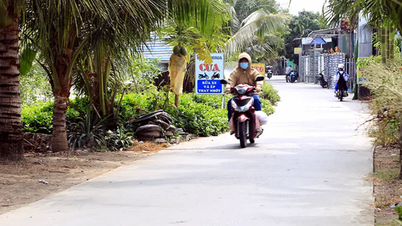
Mr. Huynh Cong Phuc, whose house is right at the far left corner of the temple, heard my question and pulled up a chair for me to sit down. He explained that about 30 years ago, he came here from My Xuyen Tay to buy land. Back then, the road in front of his house was about 3 meters wide, full of mud, with a ditch a little further up, right next to the football field.
This entire area, stretching along the Nguyen Quang family's house for about half a kilometer, is temple land. From here, about 100 meters further, you'll find the canal – the boundary between My Xuyen East and West.
Mr. Phuc still remembers that the river was much bigger back then. Things changed, and it gradually filled in; now it's just a shallow channel. The story goes that in his grandparents' time, boats could easily pass through that canal.
He shook his head: "When I bought the land to build my house, the village square didn't have a fence. During the time of demolishing the temple and pagoda, the land gradually disappeared, making way for houses to spring up. The land on the other side of the banyan tree was also the temple grounds, where the willow wood shop was located. Back then, the temple was dilapidated, but later the province, the district, and the descendants of the various clans in the village all pitched in to rebuild it into the grand structure it is today."
I interjected with a question: "Is it sacred?" "Not at all," he brushed it off, "back then, they sang continuously every January. Since the temple was rebuilt and recognized as a historical site, they no longer sing."
"Who's singing?"
"It's just a bunch of gay men. They hang hammocks in the temple, sleep under the banyan tree, they're not afraid of anything, they don't care about anything spiritual."
.jpg)
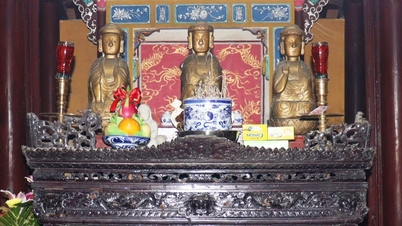
I laughed along. Perhaps he's too familiar with this place, but in this incense-filled haven where the living and the dead meet, who knows what might happen…
2. Mr. Phuc recounted his story, and I was transported back to my school days in the district town. Friends from out here would occasionally cycle back. My memories are still naive; I only remember the enormous banyan tree, which you could see from the highway.
"The spirit of the banyan tree, the ghost of the rice tree" are nowhere to be seen, only the market at the communal house is held right at the base of this banyan tree. Its location at the crossroads is absolutely beautiful, stirring like a sincere greeting.
The tree was grotesque, enormous, and gnarled like a prehistoric man, even though it had been replanted by the village after the destruction of bombs and bullets, regenerating on its original stump. The wind was still. I stood admiring it, its roots and leaves spreading out like a giant woman with flowing hair.
It stands beside the communal house, serving as an explanation that the banyan tree, the well, and the communal house courtyard are the trinity of the soul of the Vietnamese village. The waterfront, the river right at the edge of the market now, has dried up. Nature (banyan tree), source of life (waterfront), communal house courtyard (community belief). People say this is the cultural triangle, the three-legged stool that preserves the village and creates what is called its identity.
A moment of wistful reflection on the old days, at the bustling yet humble village market, stirred up a sense of nostalgia. Phuc recounted that the market was moved because of road construction, but despite the name, it wasn't really far from the banyan tree; it was just across the road. He heard that the entire neighborhood, including houses in front of the market, would also be moved so the market would be visible. How wonderful it would be if that could be done.
The guardian deity resides in the village temple. The banyan tree is the deity's dwelling place. The protective ritual, both vague and tangible, is etched into the memory of the people of this land, a firm seal in Tang Dynasty poetry, suggesting that with such land, such temple, such trees, how could people's hearts not remain steadfast amidst the vicissitudes of life?
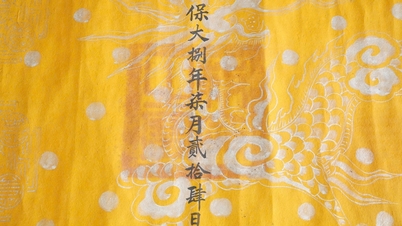
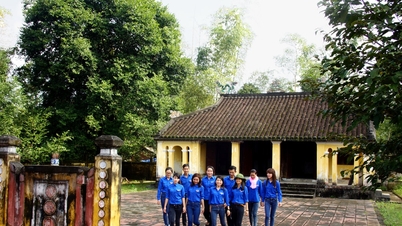
This temple houses 30 perfectly preserved royal decrees, dating from the reigns of Emperor Minh Mạng to Emperor Khải Định. Preserving them is no easy feat, considering how few villages in this land have remained intact during wartime.
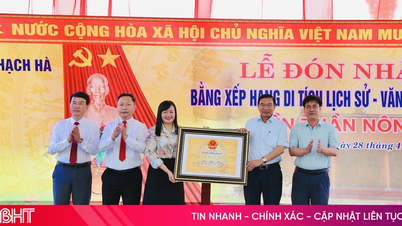
Simply put, this illustrates how the people of My Xuyen Dong village have preserved the royal decree, or more accurately, the very soul of the communal house, preserving it with unwavering devotion to their homeland. It was recognized as a Provincial-level Cultural Heritage site on December 30, 2011.
The essence of the village has been mentioned extensively in historical texts. Then, around this village, even the names themselves—My Xuyen, My Xuyen Dong, My Xuyen Tay…—are shrouded in historical uncertainty, a topic that seems endless. But one thing is certain: this communal house, this land, this village, for six centuries casting its shadow on the banks of the Thu Bon River, has left a colossal mark on the very existence of this land. A vibrant red mark in the heart, a testament to the fervent love for Mother Earth.
3. I wandered around the temple, thinking about how people are afraid to build houses in front of the temple gate, so there's a vacant plot of land right in front of the temple, visible from the gate. "Nobody dares to buy it," Mr. Phuc said with a laugh.
.jpg)
It should be left untouched, looking straight out at the bamboo groves, where there's still a shallow river, the market nearby. Whoever does the planning, dredging, cleaning, and clearing the waterway, I can stand on the other side and see the lush green vegetables and beans, lost in thought about the fields, the river, and the village temple – that's what it looks like. It's catching the tourism trend of this era.
It was pleasantly cool at midday. The wind gently caressed the banyan tree's branches, as if carrying the lingering echoes of the Thu Bon River's waves. In an era where land is precious and there's a rush of concrete and steel construction, the fact that this place has preserved the banyan tree beside the village temple is a treasure.
I suspect that, in the memories of some of the villagers who were displaced, at some point, the echoing sound of the Thu Bon River waves, the beckoning wave of the ancient banyan tree branches, and the rhythmic drumming of the village temple in the second lunar month urged generations of villagers to return, respectfully paying their respects to their ancestors who founded the land.
Like a choked sob from memory, the path home immediately came to mind: my village was above Cau Lau Bridge, where you could see the large banyan tree! At that point, anyone who was a native of this land, upon hearing the story, would instantly identify themselves as residents of My Xuyen Market! A household registration as certain as... a crab's shell, like a royal decree the villagers had dug tunnels to keep, more secure than any signature! That's how the village didn't disappear. And as long as the village remains, the people remain.
I sat with a retired leader who was deeply concerned about the village communal house – the heart of the village, the eternal "camera" that educates the people, the place where everyone, regardless of their status, enters the gate and is inevitably treated with respect. A soft power that remains unbroken by time and tyranny. A cultural space of an agricultural land. Our country is not lacking in magnificent, solemn, majestic, yet approachable village communal houses.
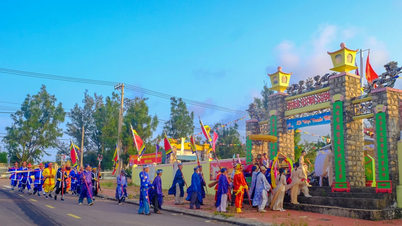
Mr. Huynh Cong Phuc laughed and repeated, "I live in My Xuyen Tay, but east or west doesn't matter, here we are. Whenever there's a temple ceremony, we have to wear turbans and long robes to beat the drums..."
Land, there is no distinction between people. Divisions are merely administrative matters. The temple belongs to the land. The land belongs to the people. With sincere devotion, the guardian deity will accept everything.
No matter what kind of separation or merger there is, no one can erase the village name or move the communal house, because touching that is touching the genes of the land, the veins of the land, the very essence of the survival of Vietnamese culture.
I've noticed that during relocations and urban planning projects, whenever there are temples, shrines, or ancient trees associated with spirituality, people avoid them. They're afraid. And that fear is justified. Because when there's no more fear, it's not the gods or demons who will act first, but the living themselves who will decide their fate. However, only when that fear isn't primarily rooted in spirituality, but in the fear of damaging the culture, will the survival of the community and the nation be truly secure.
My Xuyen Dong, the waterfront is gone, but the spiritual haven remains…
Source: https://baodanang.vn/mot-ben-tam-linh-3330914.html















































































Comment (0)